Place
Hogwarts Castle
Hogwarts Castle was a large, seven-storey high building supported by magic…

The castle is a stronghold of ancient magic.
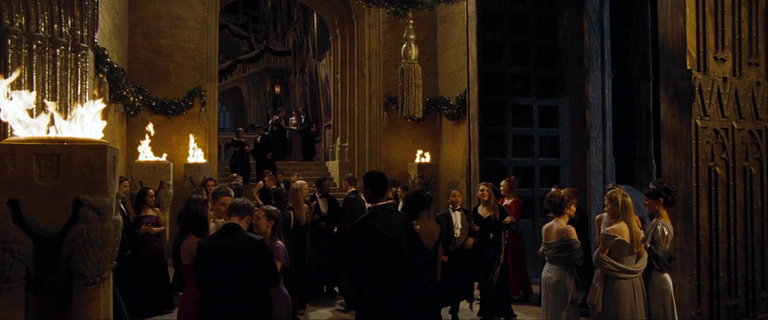
Hogwarts Castle was a large, seven-storey high building supported by magic, with a hundred and forty-two staircases throughout its many towers and turrets and very deep dungeons. The castle was built over a thousand years before Harry Potter's time by a wizard architect and the four most celebrated wizards of the age: Godric Gryffindor, Helga Hufflepuff, Rowena Ravenclaw and Salazar Slytherin. The castle was the main building of Hogwarts School of Witchcraft and Wizardry, regarded as the finest wizarding school in the world.
Hogwarts was built in a valley area — surrounding mountains were part of the landscape — with the fairly large Great Lake to the south of the main building. The huge main oak front doors that led into the Entrance Hall faced west, and opened up to sloping lawns. The deep Forbidden Forest extended around to the west of the castle. There were also exterior greenhouses and vegetable patches on the school grounds.
Hogwarts was located in the Scottish Highlands, near the all-wizard village of Hogsmeade and "not far" from Dufftown, in Moray, and Achintee, in Lochaber.
It was the setting of the final battle of the Second Wizarding War, the Battle of Hogwarts, which resulted in the deaths of several witches and wizards who fought in defence of the castle, including Remus Lupin, Nymphadora Tonks, Fred Weasley, Colin Creevey, Lavender Brown, and Severus Snape. The castle was badly damaged in the battle, but ultimately the Order of the Phoenix won when Harry Potter defeated his nemesis, Lord Voldemort, in the Great Hall.
Due to its extremely advanced age and the sheer amount of magic present in or around it, the castle was implied to have developed some form of sentience or awareness, such as when it sealed the Headmaster's Tower against Dolores Umbridge in 1996, and the various trick steps and false doors. Hogwarts Castle was also the most haunted location in Great Britain, being home to many ghosts.
Magic
The castle was supported by magic (unable to be maintained or constructed by any other means), good examples being the moving staircases and the ever-changing floor plan, features contributed by one of the four Hogwarts founders, Rowena Ravenclaw. Hogwarts was also protected by numerous ancient spells, such as the Anti-Disapparition Jinx; this could, however, be overridden by the Head of the school when necessary. It was also unplottable and bewitched so that, if Muggles approached the castle, all they would see would be a mouldering ruin with a sign warning them to keep out and that it was unsafe. Nevertheless, Muggles could presumably see the castle if they were invited or otherwise aware of its existence, as was the case with Jacob Kowalski in 1932. The protective magic over Hogwarts appeared to repel even talented Dark wizards.

Rubeus Hagrid claimed that Hogwarts was the safest place there was, even more so than Gringotts Wizarding Bank, a reason why the Philosopher's Stone was sent to the castle for protection. After the Ministry finally admitted that Lord Voldemort had returned in 1996, the castle's defences were further increased, much of them were cast by Albus Dumbledore himself, such as gates being locked with spells that can only be undone by teachers, and spells to prevent entrance via broomsticks and wall-scaling. All of the secret passageways that were previously allegedly unknown were given more protection. Additionally, with members of the Order of the Phoenix and Aurors placed as guards, and Caretaker Argus Filch checking all incoming and outgoing students for dangerous materials, intrusion seemed completely impossible.
However, Draco Malfoy utilised a pair of Vanishing Cabinets as a passageway, which none of the castle's defences could negate, to allow Death Eaters into the castle. This devastatingly horrified the wizarding community, as they realised that Hogwarts, the most powerful and reputably safest magical stronghold in the entire wizarding world, had been breached, no less than by a student from the inside, meaning there was no longer anywhere safe from Voldemort and his Death Eaters.
As a result of all the magic that occurred on the premises (both from learning students, magical artefacts therein and the enchantments cast over the building itself) a magical atmosphere pervaded the entire structure, causing any technology that was not adapted to run off of it to fail. This was presumably why candles and lanterns were used for light. Mechanical things like watches seemed to do alright, as Colin Creevey's traditional Muggle camera seemed to have worked until it was destroyed by the Basilisk's eyes. (Colin mentioned that another student told him that he could develop the pictures in a potion so that they moved. One of his pictures showed Harry trying to escape a picture of him and Gilderoy Lockhart.)
Below the ground floor
Chamber of Secrets


He was standing at the end of a long, dimly lit chamber. Towering stone pillars entwined with more serpents, rose to a ceiling lost in darkness, casting long, black shadows through the odd, greenish gloom that filled the place.
The Chamber of Secrets was allegedly created deep under the dungeons of Hogwarts Castle during the Medieval times by Salazar Slytherin, who disagreed with the other Hogwarts founders on the merits of blood purity. The Chamber of Secrets was home to an ancient Basilisk, which was intended to be used to purge the school of Muggle-born students.
The entrance could be found in Moaning Myrtle's bathroom on the second floor. In order to gain entrance one had to say "open" in Parseltongue, and a sink would open into a slide. While falling down the large, dark pipe, one could see hundreds of other pipes leading off. At the end of the pipe, one was launched into a damp, stone chamber. This room was stated to be "miles beneath the school" and under the Lake. This was where Tom Marvolo Riddle used his ability to speak Parseltongue and attack Harry Potter.
Dungeons

The dungeons of Hogwarts Castle were located under the school, and it was colder there than in the main castle.
Dungeon cupboard

This cupboard was a small room off the Dungeon Corridor, just before the dungeon hall.
Deathday Party Hall

This was one of the roomier dungeons at Hogwarts Castle. The room was accessible via the Dungeon Staircase. On 31 October 1992, this dungeon was where Sir Nicholas de Mimsy-Porpington's five-hundredth Deathday Party was held.
Potions Classroom

The Potions Classroom was where Potions classes were taught. The classroom used to be squared-sized, very large, with large tables and windows. From 1995-1996, the classroom was an oval shape and relatively smaller, with small work tables. In 1996, the classroom was extended, adding space for more work tables.
Potions basement
There was a storage basement under the Potions classroom at Hogwarts Castle. It was accessible via a trapdoor and it was used to store cauldrons, ingredients and phials.
Head of Slytherin's office
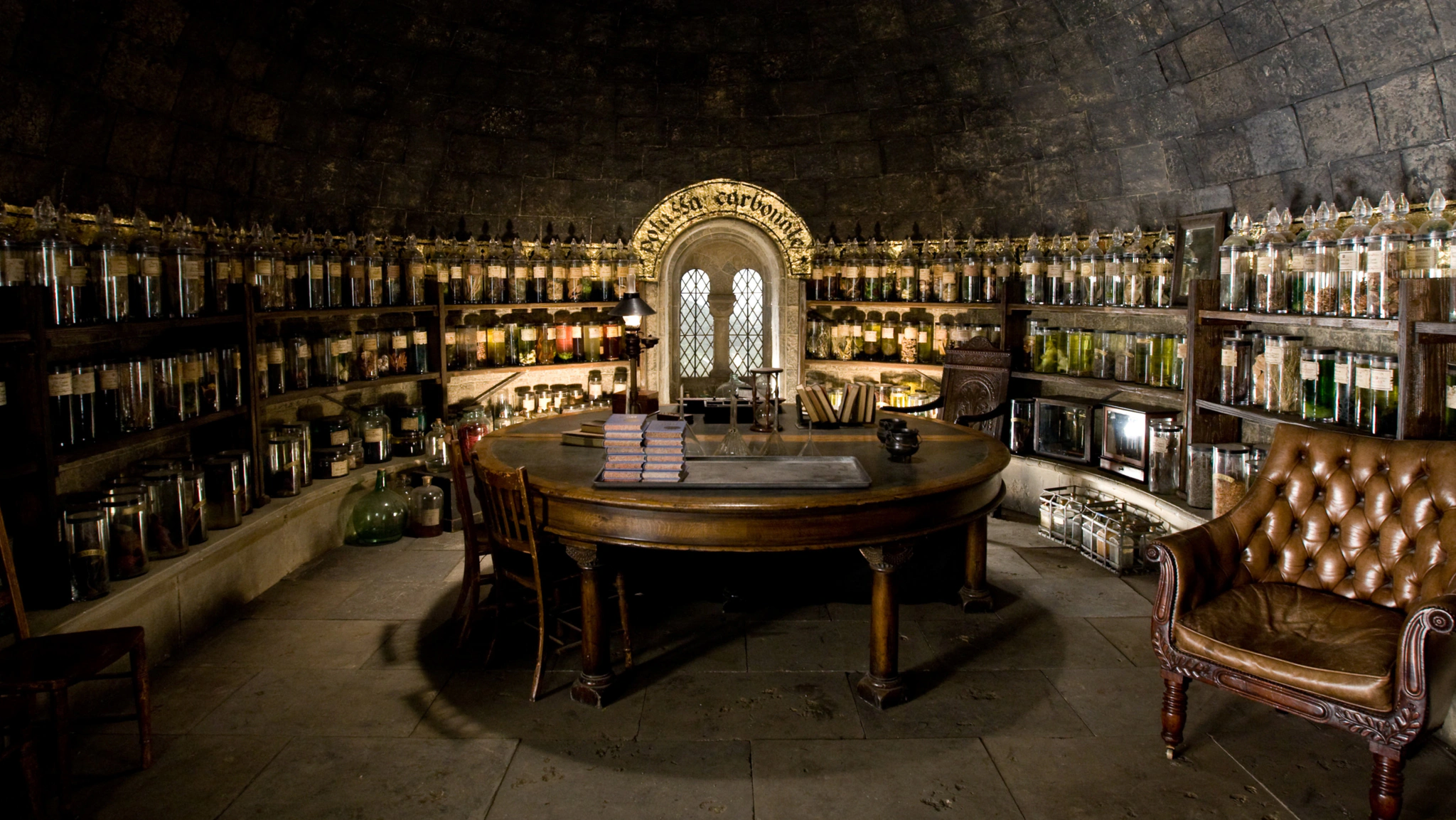
This office was used by Severus Snape during his long tenure as Potions Master at Hogwarts. It was a gloomy and dimly-lit room found in the school Dungeons. The shadowy walls were lined with shelves of large glass jars filled with slimy, revolting things, such as bits of animals and plants, floating in potions of varying colours.
The office had a fireplace. In a corner, there was a cupboard containing Snape's private stock of potion ingredients. The office was sealed with a spell only wizards could break.
Slytherin common room

The Slytherin Dungeon was located behind a wall in the dungeons of Hogwarts. A Password spoken to the wall was required to enter it; whereupon a passage was revealed leading to the common room — a low-ceilinged, dungeon-like room with greenish lamps and chairs. The room also contained black leather couches and a fireplace. This dungeon extended partway under the lake, which allowed students to glimpse the inhabitants of the Great Lake.
Off of this room also included the Slytherin Boys' Dormitory.
Philosopher's Stone chambers
These chambers were a series of rooms underneath Hogwarts School of Witchcraft and Wizardry that served as the defences surrounding the Philosopher's Stone during the 1991–1992 school year. There were seven chambers in total that contained an obstacle or task that guarded the stone against being stolen.
Harry Potter and the Philosopher's Stone Harry Potter and the Philosopher's Stone
2) Winged Keys
4) Troll
Other locations in the Dungeons
Potion-Mixing Room
Dungeon Five
Dungeon cave
Dungeon Corridor
Entrance Dungeon
Dungeon hall
Dungeon Staircase
Slug Pit
Quidditch cave
Dungeon Pit
Lever Rooms
Basement
Hufflepuff common room

It is a very cosy and welcoming place, as dissimilar as possible from Snape’s dungeon. Lots of yellow hangings, and fat armchairs, and little underground tunnels leading to the dormitories, all of which have perfectly round doors, like barrel tops
The Hufflepuff Basement was the common room for Hufflepuff students at Hogwarts. The entrance to the Hufflepuff Basement was hidden behind a stack of barrels. It could be entered by tapping a certain rhythm on the barrels. It was located near the kitchens. The cellar was decorated with yellow hangings and filled with fat armchairs. Underground tunnels led off to the students' dormitories and all the doors were perfectly circular, like barrel tops.
This was the only common room Harry Potter did not enter at some point during his years at Hogwarts.
Kitchens
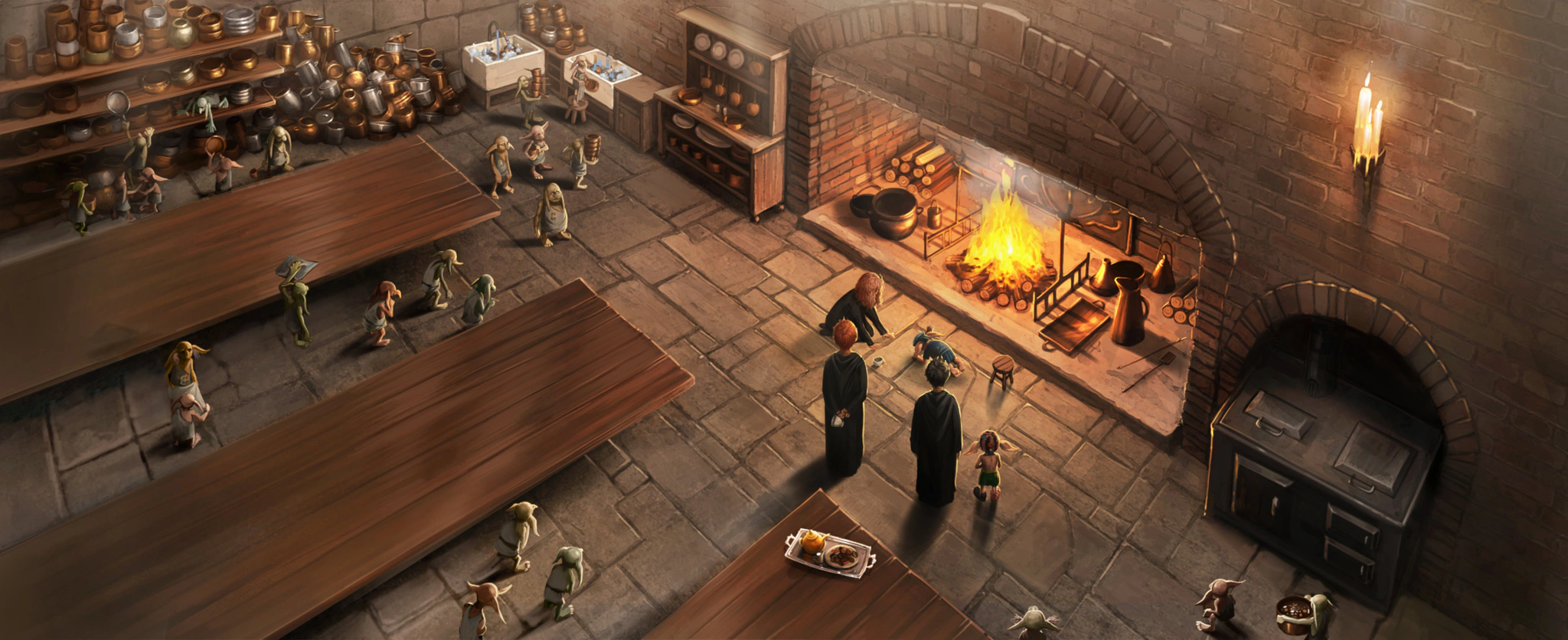
The Hogwarts kitchen was located directly under the Great Hall, down the same staircase that led to the Hufflepuff common room. It contained tables identical to those in the Great Hall and were directly below them; food had to simply be placed on the tables in the kitchens, and it magically appeared in the Great Hall. The kitchens were staffed by over 100 house-elves, including Dobby, Winky, and Kreacher (after Harry Potter inherited him and ordered him there in 1996).
To gain access to the kitchens, one had to tickle the pear on a fruit portrait, which would then turn into a door knob.
Boathouse

The Boathouse was an underground harbour at Hogwarts where the boats were stored and docked after bringing the first years to the castle every 1 September. Up until 1995 a portrait of Percival Pratt hung on the walls, concealing a shortcut to the Grand Staircase.
After Pratt's portrait was removed, there were only three entrances to this building: the path outside the Paved Courtyard, the stairs down from the Viaduct Courtyard, and the Great Lake.
Ground floor
Entrance Hall

The Hogwarts Entrance Hall was located on the ground floor of Hogwarts School of Witchcraft and Wizardry, with a wide marble staircase opposite the oak doors. Double doors to the right led into the Great Hall. The basement, the kitchens, the dungeons, and the Grand Staircase could also be accessed via the Entrance Hall.
Chamber of Reception

The Chamber of Reception was a little building before the Entrance Hall where Professor Minerva McGonagall made the first-year students wait before the Sorting Ceremony and the Start-of-Term Feast.
Viaduct Courtyard

The Viaduct Courtyard was located off the Entrance Hall. This courtyard replaced the Entrance Hall antechamber beyond 1994.
Great Hall

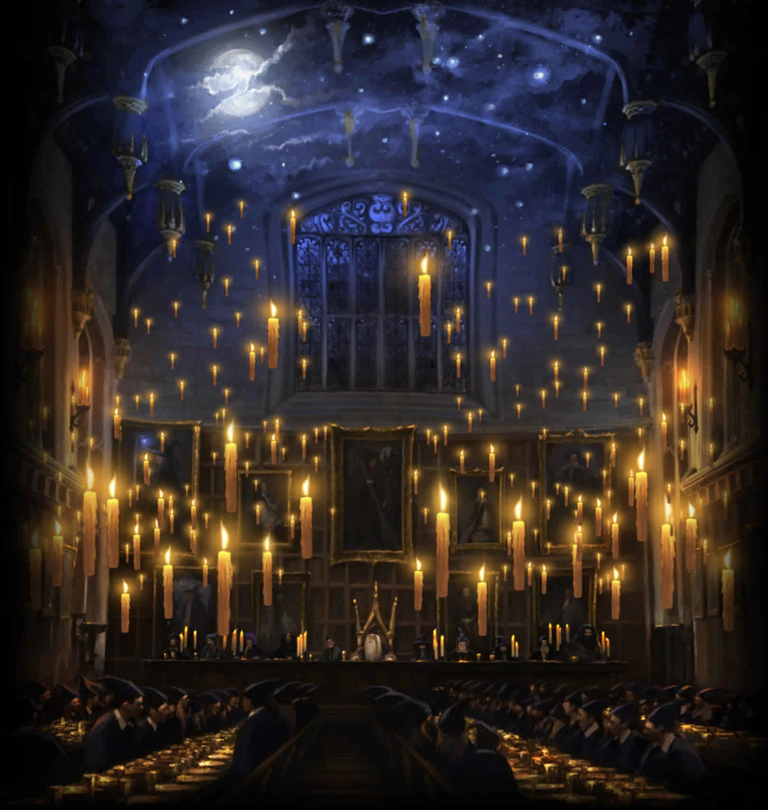
The Great Hall in Hogwarts was the main gathering area in the school. Students ate their meals, received daily owl posts, and had certain special events. The Great Hall was a large hall that could easily hold all of the school's students, staff and guests. It had tall walls that reached up to the ceiling, which was enchanted to look like the sky above.
It was the scene of Harry Potter and Lord Voldemort's final showdown, which was the Dark Lord's ultimate defeat. This was because the Elder Wand refuse to kill its true master, so Harry was not killed. Since Voldemort was now a mortal man, the curse rebounded on him, killing Tom Marvolo Riddle once and for all.
Staffroom
The staffroom was a long, panelled room with mismatched, dark wooden chairs. There was a wardrobe inside it which was once home to a Boggart. The entrance to this room was guarded by two talking stone gargoyles.
Caretaker's office
The caretaker's office was the room where Argus Filch lived in Hogwarts Castle. It was connected to the Entrance Hall, on the Ground Floor of Hogwarts Castle. It was a small, simple, windowless room with a single oil lamp in the ceiling. It smelled vaguely of fried fish.
Transfiguration Courtyard

This was one of the cloisters in the inner part of Hogwarts Castle. This courtyard had grass in the open area, in which a big tree had grown over the centuries. There was one massive iron armillary sphere that stood in the centre of the courtyard.
Transfiguration department

This was a wing at Hogwarts Castle containing the rooms dedicated to the teaching of Transfiguration. The Transfiguration department was presumably located around the Middle Courtyard area, including such rooms as Classroom 1B.
Transfiguration Classroom

This classroom was where Transfiguration class was taught. The classroom was located on the ground floor around the Middle Courtyard. The classroom itself was big, surrounded by high windows, had four rows of three desks, and still had enough room for several cages and bookshelves, two chalkboards, and a desk.
Classroom Eleven
Classroom Eleven was on the ground floor of Hogwarts Castle. It was used by the Centaur Firenze, who taught the subject of Divination. Albus Dumbledore changed the room to look like the Forbidden Forest, Firenze's home.
Viaduct Entrance

This was a big chamber which connected the Viaduct to the first floor by a staircase that led to the Tapestry Corridor. There was also an archway that led down the Potions staircase to the Dungeon Corridor.
The Quad


This viaduct was constructed out of stone, and extended all the way down to the lake. It was connected to the Viaduct Courtyard at one end and was connected to the left long viaduct tower and the right long viaduct tower.
Other locations on the ground floor
House Point Ceremony chamber
Herbology Store
Corridor off the Entrance Hall
Ground-floor corridor
Central tower courtyard
Portrait Room
Training Grounds Entrance
Temporary Defence Against the Dark Arts classroom
First floor
Library

The Library could be accesed from a corridor on the first floor of Hogwarts School of Witchcraft and Wizardry and contained tens of thousands of books on thousands of shelves. Overseen by Madam Irma Pince, the library was where students could go to peruse or borrow books to supplement their studies (or for personal enjoyment). The library closed at 8pm every day.
History of Magic Classroom

This classroom was where History of Magic classes were taught at Hogwarts School of Witchcraft and Wizardry. The subject was taught by Professor Cuthbert Binns, a ghost, who was widely regarded by almost all Hogwarts students as the most monotonous and boring teacher in existence.
Muggle Studies Classroom

This classroom was where Muggle Studies classes were taught at Hogwarts School of Witchcraft and Wizardry.
Hospital Wing
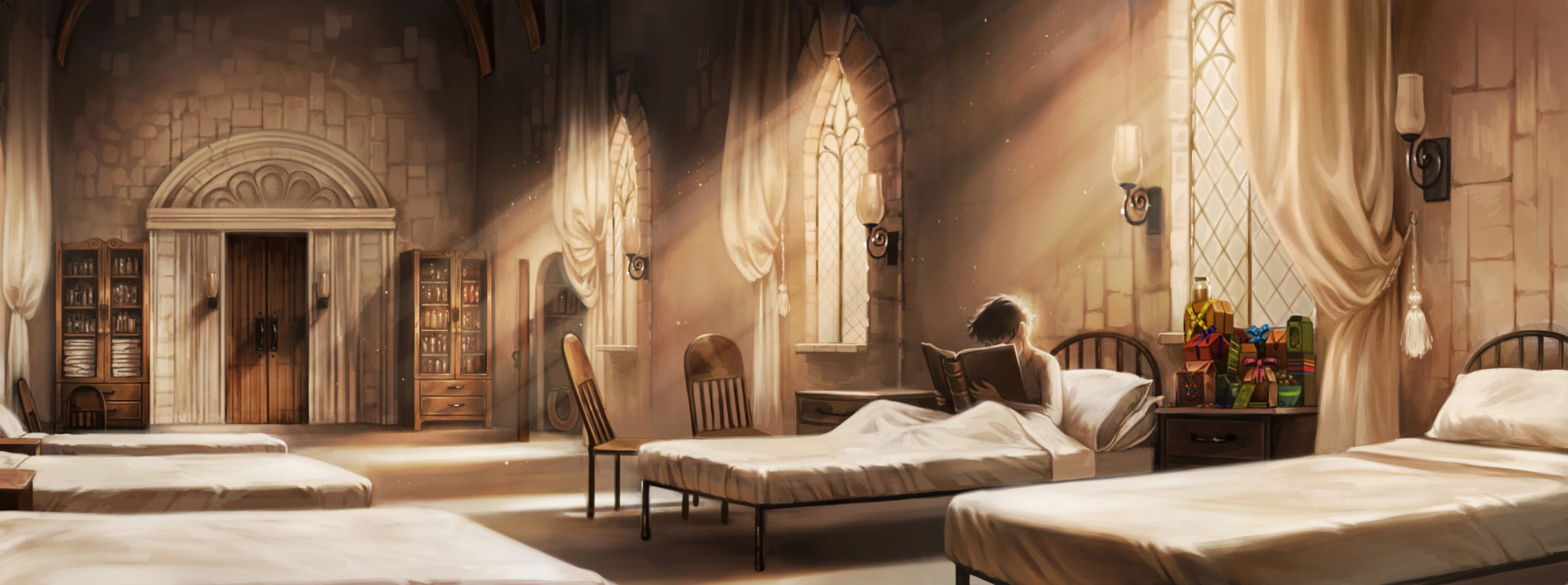
The Hospital wing was run by Poppy Pomfrey. Students who suffered mishaps during the school year were sent or brought to the hospital wing for treatment. The hospital wing was well equipped to deal with all manner of magical and mundane injuries, from broken limbs to regrowing lost bones.
Only in the most severe cases were students sent to St Mungo's Hospital for Magical Maladies and Injuries for further treatment, such as when Katie Bell touched a cursed Opal necklace in 1996.
Matron's office
This office was a large room adjacent to the Hospital Wing at Hogwarts Castle owned by Poppy Pomfrey, the matron. It contained a bookcase, a desk, two closets, two beds for patients, and another bed closed off from the room by a curtain.
Gryffindor Head's office
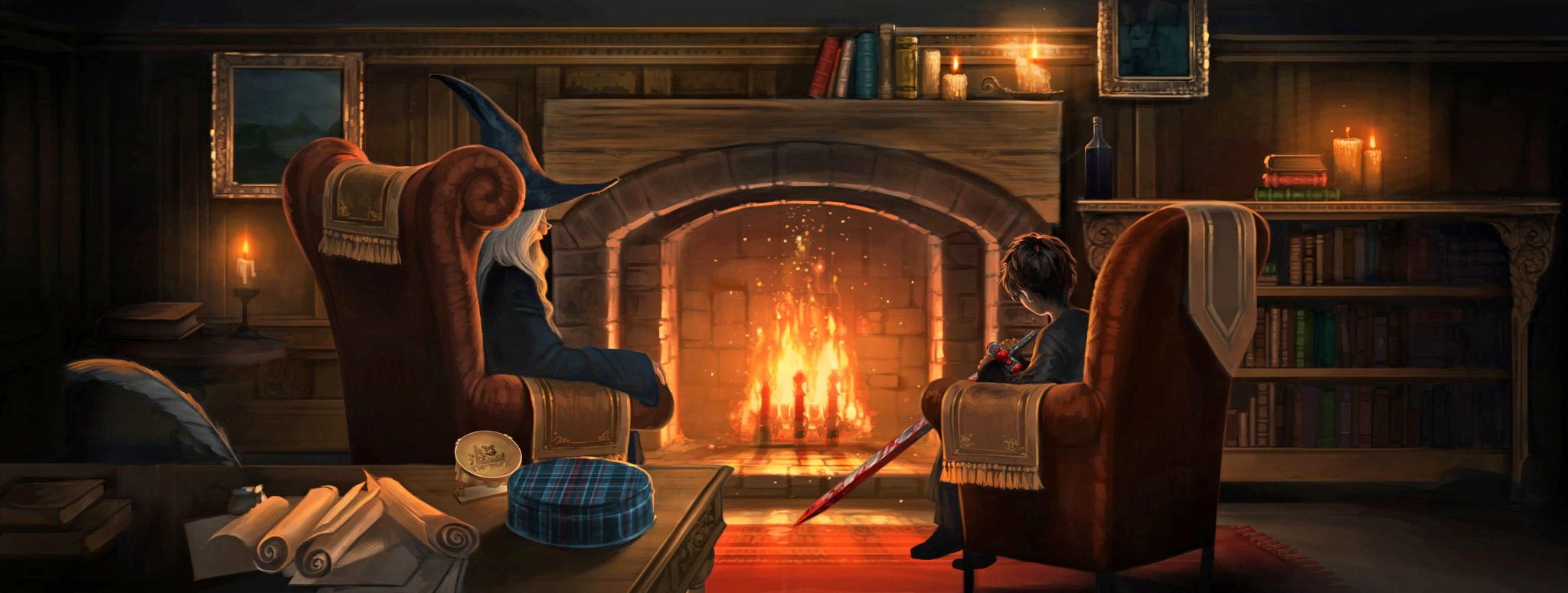
The Gryffindor Head's Office was positioned on a corridor which could be accessed by climbing the large staircase in Hogwarts' Entrance Hall. This office was occupied by Professor McGonagall, head of Gryffindor house, for many years. The room had an adjacent bedroom accessible by a concealed door.
Stone Bridge

The Stone Bridge was next to the Suspension Bridge. It connected the main First-floor corridor of the Stone Bridge Tower with the Tapestry Corridor in the Viaduct Entrance.
Tapestry Corridor

This corridor was located on the first floor of Hogwarts Castle. It connected the Viaduct Entrance to the main first floor. Its walls were covered in tapestries and, hung over the tapestries, portraits of wizards.
Storeroom

This storeroom was located in the Tapestry Corridor, this was where Severus Snape stored his private supply of potions and potion ingredients. It was one of two known potions storerooms in the castle; this being his private store; the other being the student store cupboard. The students cupboard was located in the dungeons. Items stored in Snape's store room included Veritaserum and ingredients for Polyjuice Potion.
First-Floor Girls' Toilets

Located on the first floor, this was where a mountain troll attacked Hermione Granger on 31 October, 1991.
The Quad battlements

There were battlements all around the top of The Quad at Hogwarts Castle.
These battlements were used by the Hogwarts defence during the Battle of Hogwarts. They were heavily damaged during the course of the battle, with parts of the floor falling in, revealing the corridors below.
Other locations on the first floor
Duelling Classroom I Duelling Classroom II
Advanced Arithmancy Studies classroom
Classroom 1A
Classroom 1C
Classroom 1D
Classroom 1E
Detention Chamber
First-floor corridor
Passage of the Fouls
Rear Hall
Second floor
Second-floor corridor

The second-floor corridor was located on both sides of the castle on the second floor.
Defence Against the Dark Arts Professor's office

The office used by the Defence Against the Dark Arts Professor at Hogwarts School of Witchcraft and Wizardry was located on the second floor of Hogwarts Castle. It was connected to the Defence Against the Dark Arts classroom by two staircases.
Moaning Myrtle's Bathroom
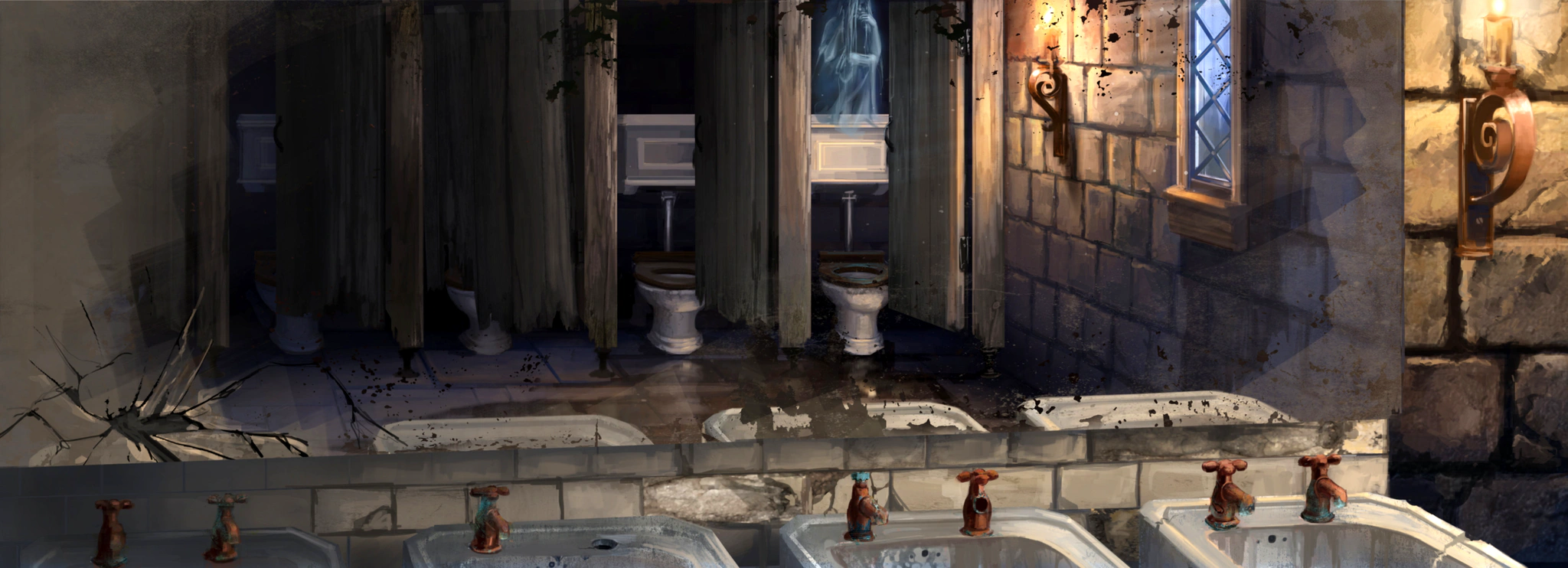
This girls' lavatory (also known as Moaning Myrtle's Bathroom) was situated on the second floor of Hogwarts Castle. It had been out of order ever since a student named Myrtle was killed there by Salazar Slytherin's Basilisk on the orders of Tom Riddle, the Heir of Slytherin.
Myrtle haunted the bathroom ever since, leading it to be a place most students did not want to enter. This bathroom held the entrance to the Chamber of Secrets.
Third floor
Charms Classroom

This classroom was where Charms classes were taught at Hogwarts School of Witchcraft and Wizardry. The classroom had four long, large desks that were built like stairs, and were located on both sides of the classroom. There was also a large fireplace in the room, as well as several stacks of books, where Professor Flitwick lectured his pupils.
Clock Tower Entrance

This was one of the three main entrances of Hogwarts Castle. It consisted of a large open space at the base of the Clock Tower, with two stairwells going up towards the upper levels of the tower. Opposite the main entry was a large window. A portrait of Damara Dodderidge was hung here, and in 1995, so was a portrait of Temeritus Shanks.
The massive pendulum of the clock swung over this entrance. The entrance could be sealed with a portcullis (which could be lowered and raised with the aid of a lever) and the massive double doors could be locked with numerous bolts.
Turret Stairwell

The Turret Stairwell was a spiral stairway leading into an upper turret at Hogwarts Castle. It could be accessed via Hesperius Hall, which was adjacent to the entrance to the Clock Tower.
Turret

This turret was on the third floor of Hogwarts Castle and was accessible through its own stairwell.
Inside this tower of the castle was a room used for an office by Albus Dumbledore while he was still a young Professor.
Serpentine Corridor
This was a wide, curved corridor in the Hogwarts Turris Magnus at Hogwarts Castle. One could access the Defence Against the Dark Arts, Ghoul Studies and Arithmancy Classrooms through this corridor, as well as Lost Wands.
Defence Against the Dark Arts Classroom

This classroom was where Defence Against the Dark Arts class was taught. An iron chandelier hung from the ceiling, as well as a Dragon's skeleton. On one end of the classroom stood a projector that was activated by magic. Several desks and tables could be found in the classroom as well as some sets of large windows.
The classroom decoration had several changes over the years, spanning from lots of pictures of Gilderoy Lockhart to tons of skeletons and Shrunken Heads.
Arithmancy classroom
The Arithmancy Classroom was where Arithmancy classes were taught at Hogwarts School of Witchcraft and Wizardry. It was located on next to classroom 3C off the Serpentine Corridor. It included number charts, a blackboard and large rows of tables for students to sit in. It might also have been where Advanced Arithmancy Studies was taught.
One-Eyed Witch Passage
The One-Eyed Witch Passage was a secret tunnel that led from Hogwarts to the cellar of Honeydukes Sweetshop in Hogsmeade. Harry Potter first learned of it from Fred and George Weasley when they gave him the Marauder's Map in 1993.
Trophy Room

The Trophy Room was where awards, trophies, cups, plates, shields, statues, and medals were kept in crystal glass displays. This room also contained a list of Head Boys and Head Girls. Prominently displayed were Hogwarts Awards for Services to the School, with known recipients being Tom Marvolo Riddle, Harry Potter and Ron Weasley.
Probably, in 1995, the Triwizard Cup was placed here as well. The Trophy Room was connected to an Armour Gallery.
Armoury
The Armoury was a corridor adjacent to the Trophy Room. There were a large amount of suits of armour on exhibition in this corridor.
Third Floor Corridor

The Third Floor Corridor on the right side of the Castle was out of bounds during the 1991–1992 school year because it was the access point to the Chambers where the Philosopher's Stone was being hidden. Fluffy, a three-headed dog owned by Rubeus Hagrid, guarded a trap door that led into the Chambers.
Cauldron cupboard
The Cauldron cupboard was one of the rooms seen on the Marauder's Map. It was possibly a store room where cauldrons were kept. It is possible that the cupboard was close to the Potions Classroom or Snape's provisions cupboard.
Stink Bomb Store
The Stink Bomb Store was one of the rooms seen on the Marauder's Map. It was possibly an illegal store, because when a Hogwarts Professor burst in, the students inside it ran out of the room. It was (possibly) the place where Stink Bombs and Dungbombs were sold.
Other locations on the third floor
Classroom 3D
Gunhilda of Gorsemoor Corridor
Storeroom (third floor)
Fourth floor
Restricted Section

The Restricted Section was an area in the fourth floor section of the Hogwarts Library closed off by a rope and only accessible to students with permission from a professor. In order to enter, they had to present a signed note from a professor. The books within the Restricted Section typically discussed the Dark Arts or other information not for the general public or young children. They could be studied by older students for Defence Against the Dark Arts.
Study Area
This study area was a library on the fourth floor of Hogwarts Castle, located near Classroom 4F. There was a secret passageway hidden behind a bookshelf which led to the Seventh-floor corridor, just opposite a portrait of Sir Cadogan, as well as another behind a tapestry, which Hermione Granger accessed using Draconifors. There was a large fireplace, and a door leading to the Fourth Floor Corridor.
Disused classroom

This room was where the Mirror of Erised was kept from September to December 1991, and where Harry saw the image of himself and his deceased relatives, including his parents. After this, it was moved under orders from Dumbledore to protect the Philosopher's Stone.
Bathroom
This was the bathroom where Graham Montague appeared after entering the Vanishing Cabinet in 1995.
Cuthbert Binns's office
This office was used by Cuthbert Binns as Professor of History of Magic at Hogwarts School of Witchcraft and Wizardry. The office had a fireplace. It also had two closets, the teacher's desk and a table. Behind a curtain was Cuthbert's bed, although since becoming a ghost it is unlikely that he used it.
Other locations on the fourth floor
Fourth-floor balcony
Fourth-floor corridor
Fourth-floor hospital tower corridor
Mirror passage
Fifth floor
Prefects' bathroom
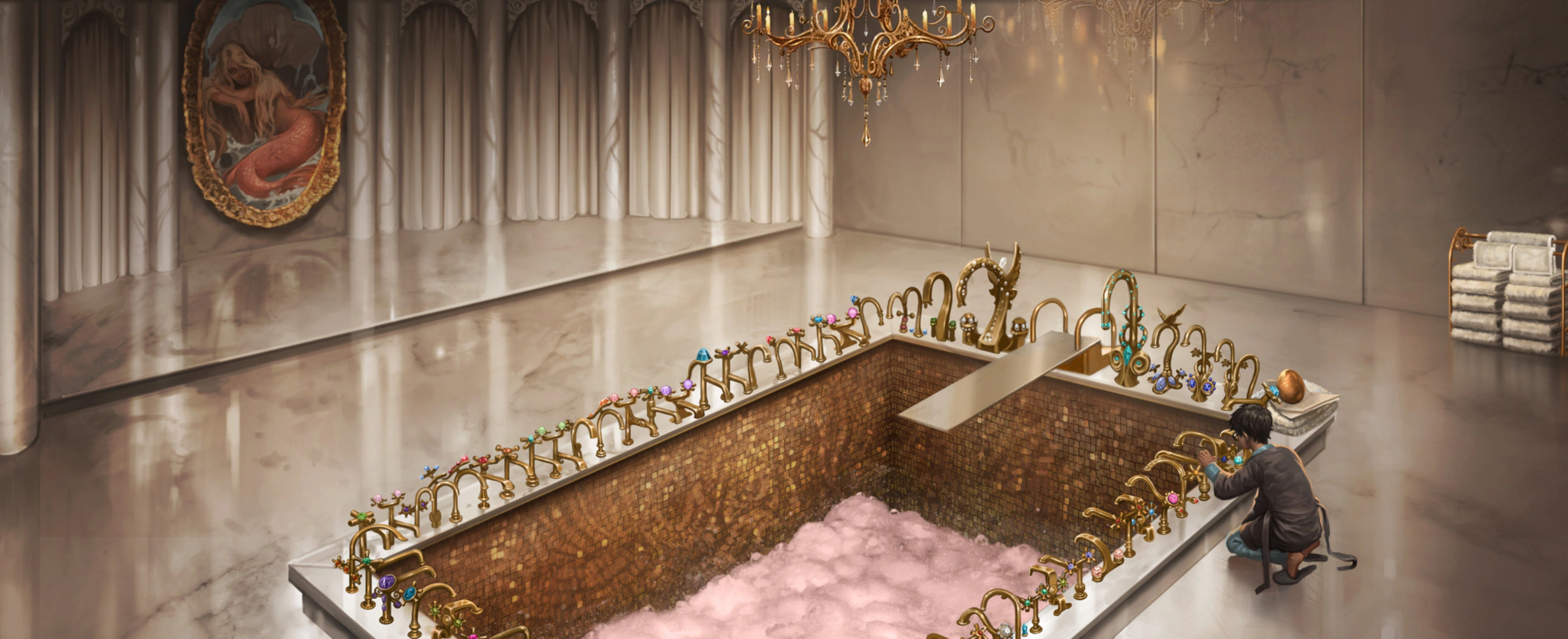
This was a special bathroom that was restricted to use by school Prefects, Head Boys, Head Girls and Quidditch captains. It was located on the fifth floor behind the fourth door to the left of a statue of Boris the Bewildered, which only opened when given the correct password, which, as mentioned by Cedric Diggory, was 'Pine Fresh' in the 1994–1995 school year.
Art classroom
This was where both Art and Muggle Art classes were taught at Hogwarts. This classroom had six easels, three paintings on the walls, a cabinet, a table, and the teacher's desk.
Music classroom
This classroom was located in the Fifth-floor corridor of Hogwarts Castle. It was in this classroom that both the Music and Muggle Music classes were taught at Hogwarts.
Other locations on the fifth floor
Fifth Floor hospital tower corridor Fifth Floor classroom
Fifth-floor boys' restroom
Classroom 5B
Fifth-floor corridor
Muggle Studies showroom
Icy Corridor and one of the Cursed Vaults
Ravenclaw Tower staircase
Sixth floor
Sixth-floor corridor

The sixth-floor corridor was one of the many corridors in Hogwarts Castle. It included a professor's office and some kind of bird that Draco Malfoy used in his plan to mend the Vanishing Cabinet in the Room of Requirement. It was very similar to the Seventh-floor corridor.
It was also connected to Horace Slughorn's Staircase to the North Tower and to the sixth floor of the Grand Staircase in the Grand Staircase Tower.
East Wing
This was a large hall located on the sixth floor of Hogwarts Castle. There was a huge fireplace in the centre of the room and some portraits hung on the walls. There were various suits of armour, which guarded the room after the sun was down. The entrance was located on Glanmore Peakes' Corridor, and it had an entryway to the room where Fred and George Weasley hid the Marauder's Map.
Sixth-floor boys' bathroom

There was a passage leading from this bathroom to the seventh floor.
Disused bathroom
This bathroom was accessible through a portrait in the reading room, as well as a door on the other side of the castle, adjacent to Glanmore Peakes' Corridor. It had not been used since sometime prior to the 1993–1994 school year. In that year, Fred and George Weasley expanded their Weasleys' Wares business, which started in a bathroom on the seventh floor, to this one.
Study of Ancient Runes Classroom
This classroom was where Study of Ancient Runes and Ancient Studies classes were taught at Hogwarts School of Witchcraft and Wizardry. It included some desks, a bookcase and a lectern for the professor.
Horace Slughorn's office

This office was once used by then-Defence Against the Dark Arts Professor Galatea Merrythought, it was later used by Horace Slughorn, Potions Master. Fairly roomy, this office included a fireplace with two large sofas surrounding it, a round dinner table big enough to sit ten people, and access to a private balcony. It had enough space to hold a Christmas party. Also, the room had two entrance doors, with at least one connecting to the sixth-floor corridor.
Room of Rewards

Other locations on the sixth floor
Storeroom
Classroom 6A
Sixth-floor empty classroom
Glanmore Peakes' Corridor
Writing Supplies Room
Seventh floor
Ravenclaw Head's office
The Ravenclaw Head's office was the thirteenth window from the right of the West Tower. The office contained portraits, a desk, and sleeping quarters. This was where Sirius Black was held captive, awaiting the Dementor's Kiss in 1993. He was rescued by Harry Potter and Hermione Granger, and escaped on Buckbeak the Hippogriff.
Room of Requirement

The Room of Requirement was a secret room in Hogwarts that only appeared when a person was in great need of it. The room transformed itself into whatever the witch or wizard needed it to be at that moment. It was believed that the room was Unplottable, as it did not appear on the Marauder's Map, nor did its occupants, although this could simply be because James Potter, Remus Lupin, Sirius Black, and Peter Pettigrew, who were the Marauders, never found the room.
Hall of Hexes

The Hall of Hexes was a hall on the seventh-floor of Hogwarts Castle, close to the Room of Requirement.
Fat Lady's Corridor

This corridor contained the portrait of the Fat Lady that served as the entrance to Gryffindor Tower. The corridor was at least one turn away from the Grand Staircase. In the 1993–1994 school year, security trolls were stationed here to protect the Fat Lady following the attack on her by Sirius Black.
North Wing

This wing had hundreds of bookshelves lined along the walls and various tables and furniture placed around the room. It served the Castle as a reading room and study hall. There were two entrances; one in the seventh floor corridor and the other by the Fat Lady's portrait.
Disused bathroom

It was unused prior to 1991, by which time Fred and George Weasley had taken up residence there and set up their own shop for Gryffindor students. This bathroom was accessible through a portrait in the reading room.
Divination Classroom

This was where Divination classes were taught at Hogwarts. It was located in the North Tower. It was accessible through a circular trapdoor and was described as looking like a cross between somebody's attic and an old-fashioned teashop. The Divination Staircase led to this classroom.
Divination Professor's office
This office was the workplace and residence of the Divination professor. It was located up a small staircase from the Divination Classroom.
Other locations on the seventh floor
Classroom 7B
Classroom 7C
Staircases
The castle had a hundred and forty two staircases.
Grand Staircase
The Grand Staircase was a massive structure in Hogwarts Castle, mainly used to access each floor of the castle, including the dungeons. There were hundreds of portraits covering the walls in this tower, some of which concealed secret passages to other areas within the school.

The multiple staircases in the Grand Staircase led from platform to platform and went as high as the seventh floor where they came to an end.
Staircases between levels below ground
Dungeon Staircase (Deathday Party Hall to the Dungeon Corridor)
Staircases ascending from below ground-level
Entrance Dungeon staircase (Entrance Dungeon to the Quad)
Quidditch staircase (from Quidditch Gate to the Training Grounds)
Slughorn's Staircase (dungeons to the seventh-floor corridor; also allowing access to the sixth-floor corridor)
Slughorn's Stairs (Dungeon Corridor to the Entrance Hall)
Staircase from the Restricted Section to the Athenaeum antechamber (from the Athenaeum antechamber to the Restricted Section storage room)
Staircases ascending from ground-floor
Herbology staircase (ground-floor of the greenhouse tower upwards)
Hogwarts Turris Magnus staircase
Marble Staircase (Entrance Hall to the first-floor corridor)
Staircase between the courtyard corridor and the Serpentine Corridor
Staircase between the ground-floor and the second-floor corridor
Staircase between the Ground-floor corridor and the second-floor corridor
Suspension Bridge staircase (Ground-floor corridor to the third-floor corridor)
Staircases ascending from first-floor
Staircase between the first-floor corridor and the second-floor corridor
Staircase between the first-floor corridor and the Serpentine Corridor
Staircase between the library corridor and the second-floor corridor
Faculty Tower staircase between the Musical corridor and the second floor
Staircases ascending from the second-floor
Staircase between the second-floor arcade and the third-floor
Staircases ascending from the third-floor
Clock Tower staircase (Clock Tower Entrance to the Fifth-floor hospital tower corridor; also allowing access to the fourth-floor hospital tower corridor)
Turret Stairwell (third-floor to a turret)
Griffin Stairwell (Gargoyle Corridor to the Headmaster's Tower)
Staircase between the third floor and the Main Landing (to the fourth-floor Main Landing)
Staircases ascending from the fourth-floor
Hospital tower staircase (fourth-floor corridor to the fourth-floor hospital tower corridor)
Secret stairway from the fourth floor to the seventh floor (fourth-floor corridor to the Fat Lady's Corridor)
Staircases ascending from the fifth-floor
Astronomy Stairs between the Astronomy Corridor and the Astronomy classroom
Ravenclaw Tower staircase (to the Ravenclaw common room)
Vanished Stairs from the Icy Corridor to the Vault of Ice
Staircases ascending from the sixth-floor
Staircase between the sixth-floor and the seventh-floor corridor
Staircases ascending from the seventh-floor
Divination Stairwell (Divination corridor to the Divination Classroom's landing)
Grumpy Staircase (seventh-floor corridor to a turret)
Gryffindor girls' staircase from the Gryffindor common room to the Gryffindor Girls' Dormitory
Staircases ascending from an unknown floor
Staircase to the West Tower battlements
Swivelling staircase
West Towers
The West Towers were towers of the west side of the castle, many of which were near The Quad.
Clock Tower

The Clock Tower did not begin at the Ground Floor level. Because it was placed on top of a hill, the Tower began at the Third Floor level. In the entrance to the Tower, there was a huge space, like an Entrance Hall with flights of wooden stairs at the right and left side. The first landing was at the Fourth Floor level. It was at this landing where the clock's gears and face were.
This same corridor connected the Tower to the remaining castle. Up another flight of wooden stairs was another landing, this time at the Fifth Floor level. It was in this landing that the clock's bells were; some massive gold and copper bells. There was another corridor at this landing; like the other, it linked the Tower to the main castle.
Grand Staircase Tower

The Marble Staircase Tower was one of the many towers of Hogwarts Castle. It was one of the most prominent and recognisable features of the castle, dominating the skyline near the Great Hall and the Quad. The tower was extremely large, spanning all seven floors as well as the basement level and countless attic-level rooms, judging from the many dormer windows in its conical roof. There were three smaller turrets on the roof of the tower.
The Marble Staircase Tower received its name from the Marble Staircase, a large staircase which connected the Entrance Hall to the Grand Staircase. The Grand Staircase itself, consuming most of the space in the tower in a large, rectangular room, spanned at least eight storeys and had large windows that looked out over the Quad.
Gryffindor Tower

Gryffindor Tower was located behind the portrait of the Fat Lady on the Seventh Floor of Hogwarts Castle. A Password was required to enter it, which was spoken to the portrait. A circular hole was behind the painting, leading to the common room, which was a circular room where Gryffindor students could relax after a long day of studying. The common room was full of squashy armchairs, tables, and a bulletin board where school notices, ads, lost posters, etc. could be posted. A window looked out onto the grounds of the school, and a large fireplace dominated one wall.
The Gryffindor dormitories were also located in the Tower, with two doors leading off from the common room that opened to spiral staircases. One of them led to the girls dormitory, the other to the boys. The stairs to the girls dormitories were enchanted to become a slide if any boy attempted to climb them, but not vice-versa, since it was deemed that girls were more trustworthy than boys.
Headmaster's Tower

The Headmaster's office was located within this tower. To gain entrance, a password had to be given to a stone gargoyle, which would move aside at the correct password to reveal a spiral staircase with moving steps. The office was a circular room with windows, decorated with portraits of previous Headmasters including Dilys Derwent and Phineas Nigellus Black. Many magical instruments were kept here, such as the Sorting Hat and the Pensieve.
Hospital Tower

The hospital tower was one of the many towers of Hogwarts Castle which had a semi-ovular shape. It was located on one side of The Quad and was at the end of the hospital corridor which connected the Clock Tower to the rest of the castle. On the fourth floor of the tower was the Hospital Wing and school matron's office. There was also a staircase that led to the fourth-floor corridor and, by extension, to the Grand Staircase.
There was also a secret passage behind a bookshelf in the matron's office. The Prefects' Bathroom was located on the fifth floor, just above the hospital wing.
he Hospital Wing at Hogwarts School of Witchcraft and Wizardry was run by Madam Poppy Pomfrey. Students who suffered mishaps during the school year were sent or brought to the hospital wing for treatment.
Ravenclaw Tower

Ravenclaw Tower was located on the west side of Hogwarts. The staircas leading up to the common room was presumably located on the fifth floor, and was the location of the Ravenclaw common room and dormitories.
The entrance to the room was at the top of a spiral staircase, and was a door without doorknob or keyhole but a bronze knocker in the shape of an eagle. In order to enter the room, one had to answer a question asked by the eagle knocker; if a student answered wrong, they had to wait for someone who got it right.
North Tower

The North Tower was one of the many towers in the castle. The tower was the location for Divination classes and the Divination teacher's office. The entrance consisted of a ladder leading through a trap door.
Stone Bridge Tower

This was one of the four towers surrounding The Quad. It overlooked the Stone Bridge. The first floor landing of the tower went over here connecting the First-floor corridor to the Stone Bridge.
West Tower
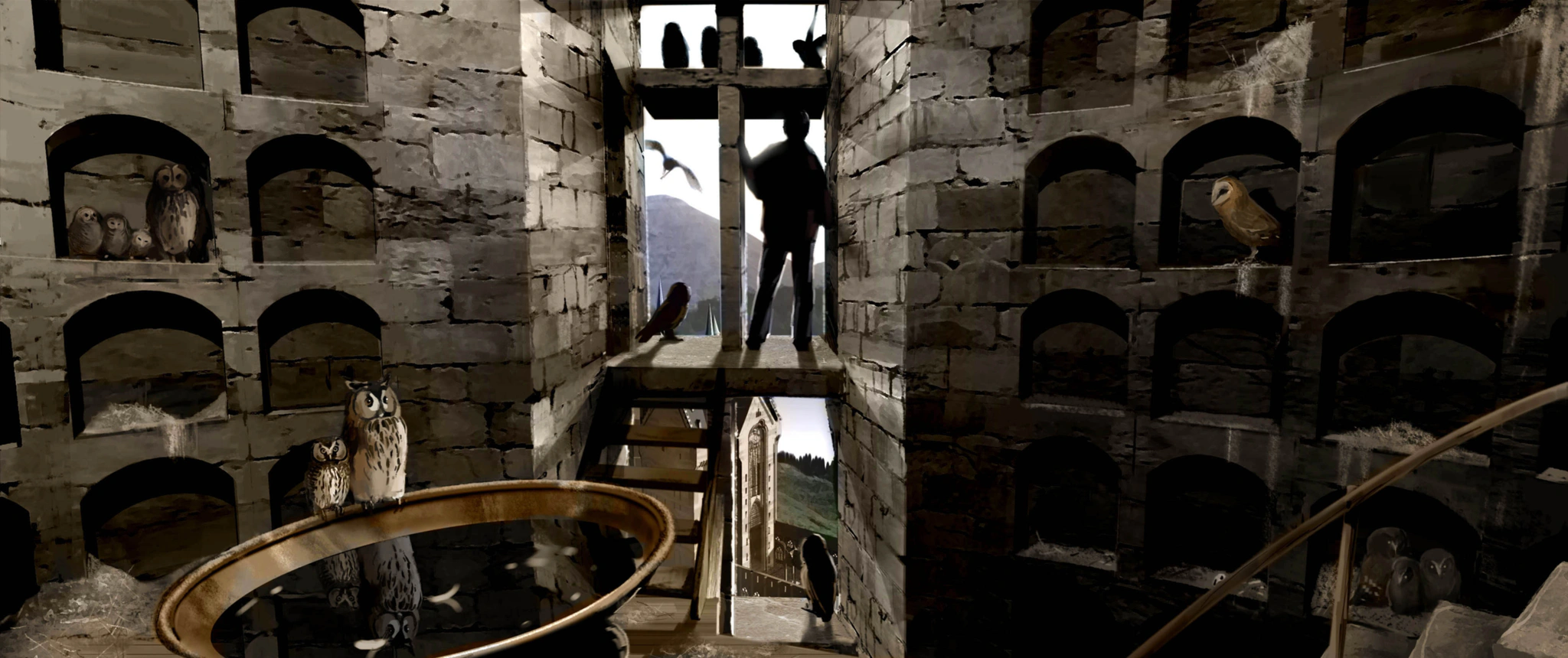
The Owlery was located on the top of this tower. During the winter months, the tower was very cold, to the point that one had to be careful with ice on the higher landings. A tightly spiralling staircase led from the bottom of the tower on the seventh floor up to a door leading out onto the battlements.
East Towers
The East Towers were towers of the east side of the castle, many of which housed classrooms.
Astronomy Tower

The Astronomy Tower was the tallest tower at Hogwarts Castle, surrounded by a parapet and turret. It is where students studied the stars and planets through their telescopes in Astronomy lessons with Professor Aurora Sinistra. This was usually done at midnight when the stars were best seen. The tower was usually out-of-bounds except for classes. All the way down from the boathouse, one could see the huge window of the Astronomy Tower. Located within this tower was the Astronomy Corridor, Astronomy reading room, Astronomy classroom, Astronomy stairwell, Astronomy department and the Astronomy Room. In 1997, Hogwarts' headmaster, Albus Dumbledore, was killed here on this tower by his eventual successor, Severus Snape. However, it was planned between Dumbledore and Snape to spare Draco Malfoy being a murderer and spare the headmaster from a slow painful death. This was because Dumbledore's hand was affected by a dangerous curse created by Tom Marvolo Riddle, to protect his Horcrux (Marvolo Gaunt's ring).

Bell towers

The Bell towers were two towers that rose over the main entrance to the Herbology Greenhouses. Between the two towers were a set of double wooden doors which led along the Ground Floor Corridor. Inside the left bell tower was Filch's Office.
Dark Tower

The Dark Tower was a small but high tower near the Transfiguration Courtyard at Hogwarts Castle. This tower seemed to be used as a prison. It had several prison cells, with the topmost being at the roof. The cells were not, however, charmed or otherwise protected against breaking-in from the outside. It had seven floors.
Defence Against the Dark Arts Tower

Hogwarts Turris Magnus was among the largest towers of the Hogwarts Castle. It stood next to the Viaduct Entrance, overlooking the Suspension Bridge and the Training Grounds. It had a semi-circular shape.
The tower was home to Minerva McGonagall's office on the first floor, the third floor and Serpentine Corridors, Classrooms 3C and 7A, Lost Wands store and the Ghoul Studies classroom on the third. A staircase ran through the centre of the tower.
Other towers
Second-floor girls' lavatory tower Turris Medius The Tower
Central tower
Founders' Tower
Herbology tower
Right Long Gallery tower
Suspension Bridge towers
Training Grounds tower
Quidditch tower
Right Long Gallery tower
Small Locked Tower
Upper Hall tower
The grounds
Gamekeeper's Hut

The gamekeeper's hut was located on the edge of the Forbidden Forest. Rubeus Hagrid, the gamekeeper during Harry Potter's time at Hogwarts, lived here for many years.
Forbidden Forest

Also known as Dark Forest or Black Forest, the forest bordered the edges of the Hogwarts School of Witchcraft and Wizardry grounds. As its name suggests, it was strictly off limits to students - except in the case of detention, or Care of Magical Creatures lessons that occasionally took place there. Of course, with the various dangerous creatures, such as centaurs, Thestrals, unicorns, Hippogriffs and Acromantulas living in the Forest, few students would probably even want to venture into it.
Greenhouses and gardens

There were at least three greenhouses in which Herbology classes were held, under Professor Sprout's supervision. Greenhouse Three was restricted to students as it housed dangerous plants such as Venomous Tentaculas, Mandrakes, and others.
Vegetable patch
Within the grounds of Hogwarts School of Witchcraft and Wizardry, there was a vegetable patch (sometimes referred as vegetable gardens), roughly between the Hogwarts greenhouses and Hogwarts Castle. After taking Felix Felicis, Harry Potter bumped into Horace Slughorn at the vegetable patch while travelling to Hagrid's Hut. The vegetable patch sometimes flooded when it rained.
Great Lake

The Great Lake was a large body of water located to the south of the castle. It was about half a mile in diameter and the Hogwarts plumbing network drained into it. It was home to a giant squid and a colony of Merpeople. The lake was also used as the site of the Second Task of the Triwizard Tournament.
Quidditch pitch

The school had its own Quidditch pitch, where each house's Quidditch teams practised and played games against each other. Each year would see a total of six inter-house matches, along with numerous training sessions by each house team.
Quidditch Gate

The Quidditch Gate was the entrance to the Quidditch Pitch. It was flanked by two stone structures which resembled two of the spectator towers surrounding the pitch. Inside the gate, several trophies and shields were housed. Through the gates led to a steep winding downhill decent from the vicinity of the Wooden Bridge.
Entrance Gates

The Entrance Gates to Hogwarts were located a short distance from Hogsmeade station. The gates would be opened on the first day of term and carriages pulled by Thestrals would take students up to the castle. The Entrance Gates were made of magnificent wrought iron and were flanked by two columns topped with statues of winged boars. Just a few yards from the gates was a small guardhouse with a tall chimney.
Clock Tower Courtyard

The Clock Tower Courtyard was a cloister on the base of the Clock Tower at Hogwarts School of Witchcraft and Wizardry. This cloister seemed to be one of the older parts of the castle, and the ceiling and walls were dilapidated. It also led to the Wooden Bridge.
Wooden Bridge

The Wooden Bridge was a feature of Hogwarts Castle. The bridge appeared derelict, and was constructed of wood beams which extended to the floor of the ravine it lay across. The roof of the Wooden Bridge was sagging and appeared thatched and tarred. The bridge blended in with the natural environment surrounding it.
The Wooden Bridge began at one end of the Clock Tower Courtyard, at the base of the Clock Tower. At the end of the Wooden Bridge there was a small stone gazebo with benches. Outside of it was the Sundial Garden. Given its unstable look it was possibly held up by magic.
Training Grounds

This was where Flying classes were taught to first years at Hogwarts School of Witchcraft and Wizardry by Madam Hooch. The grounds were flat, short-cut grassy areas and were located near the Herbology greenhouses. It was overlooked by the Training Grounds tower.
White Tomb

The White Tomb was the only grave at Hogwarts School of Witchcraft and Wizardry. Located on the shores of the Lake, it was the final resting place of Albus Dumbledore, who willingly gave his life in the service of the Order of the Phoenix fighting Lord Voldemort's Death Eaters in the course of the Second Wizarding War.
Castle Ramparts
The Castle Ramparts were a series of ancient rooms and corridors which surrounded the castle grounds. Along with the magical protective enchantments that Hogwarts employed, these ramparts served as a physical barrier of entry to anyone wishing to access Hogwarts. The many rooms hidden within these ramparts also served as good hiding locations, such as for the Caged Bathtub during the 19th century.
Other locations on the grounds
Rubeus Hagrid's pumpkin patch Rubeus Hagrid's garden Waterfall by Hogwarts Castle
Entrance footpath
Gargoyle Gate
Stone Circle
Secret room near the Training Grounds
Bowtruckle Island
Unknown locations
Book of Monster's Repair Workshop
The Book of Monster's Repair Workshop was one of the rooms at Hogwarts Castle that was seen on the Marauder's Map. It was, presumably, the place where damaged copies of The Monster Book of Monsters were repaired.
Other unknown locations
Assembly hall Resting Chamber of Lord Voldemort
Ghoul Studies classroom
Runic Corridor
Lost Wands
Hieroglyphic Hall
Ædificium Oriens
Room of Doom
Room of Runes
Way to Courtyard
Porticus Circumscriptus
Porticus Imago
Porticus Medius
Porticus Olidus
Porticus Periculum
Lower Chambers Portrait Corridor
Hogwarts Apothecary Dept.
Horace Slughorn's first office
Rolanda Hooch's office
Hogwarts laundry
Shop
The Grindylow Lagoon
Hogwarts attic
Prowling Passage
Poltergeist Passage
Undercover route to the Kitchens
Study Hall
Care of Magical Creatures classroom
First year written exams classroom
Detention Escape Route
Lower Chambers Corridor North-East
Lower Chambers Corridor West
Vestibule of Mischief
Sources
Adapted from the original article, under CC BY-SA 3.0.