Lore
Potions (class)
Potions was a subject and core class taught at Hogwarts School of Witchcraft…
You are here to learn the subtle science and exact art of potion-making. As there is little foolish wand-waving here, many of you will hardly believe this is magic. I don't expect you will really understand the beauty of the softly simmering cauldron with its shimmering fumes, the delicate power of liquids that creep through the human veins, bewitching the minds, ensnaring the senses... I can teach you how to bottle fame, brew glory, and even stopper death — if you aren't as big a bunch of dunderheads as I usually have to teach.
Potions was a subject and core class taught at Hogwarts School of Witchcraft and Wizardry and Ilvermorny School of Witchcraft and Wizardry. In this class, students learnt the correct way to brew potions. They followed specific recipes and used various magical ingredients to create potions, starting with simple ones and moving to more advanced ones as they progressed in knowledge.
A standard potions kit included plant ingredients such as belladonna, and supplies such as glass phials and weighing scales, along with a standard cauldron that all students were expected to bring with them to lessons.
The Professor of this subject was referred to as a Potions Master. The Potions Master at Hogwarts for many years was Horace Slughorn and later Severus Snape. By 2016, Professor Slughorn had retired for a second time, and by 2021, another new teacher had taken over.
Class information

When they arrived in the corridor they saw that there were only a dozen people progressing to N.E.W.T. level.
At Hogwarts School of Witchcraft and Wizardry, Potions was a required subject for students, from the first year to the fifth year. Potion recipes could be found in many books, including the books the students at Hogwarts used in their classes, but the intricacies of timing, ageing, stirring techniques, and bottling which are much more difficult to learn without the mentoring of the experienced masters. Certain ingredients could be found in the cupboard in the classroom, but others had to be bought before the start of the year at the apothecary. Slytherin students typically did well in this class, owing to the number of potion awards presented to Slytherin students that were stored in the Trophy Room. Around 1981, Severus Snape became the professor of Potions at Hogwarts. Snape served as the school's potions professor through 1996, until he became the Defence Against the Dark Arts professor and was replaced by Horace Slughorn.

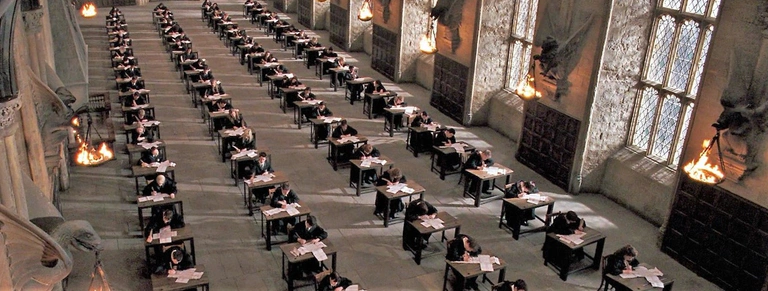
Ordinary Wizarding Level examinations were taken at the end of a student's fifth year; as such students spent time learning Ordinary Wizarding Level potions and possibly revisiting the past four years of lessons. As part of their Potions O.W.L., students had to sit a written exam; one of the questions was to identify the effects of Polyjuice Potion and its purpose, and after students had to complete a practical exam. Professor Snape mentioned that achieving a high mark at Ordinary Wizarding Level was difficult, which was later demonstrated in 1996, when only twelve students reached the required level to advance to N.E.W.T.
When Severus Snape was the professor, students had to achieve an 'Outstanding' on their O.W.L. in order to take his advanced class. As Head of House, Professor Snape tended to favour students from Slytherin House more than other students, so Slytherins tended to do better than others at the subject. On the other hand however, Horace Slughorn was more lenient; Harry and Ron were both allowed to continue to the N.E.W.T. class with an 'Exceeds Expectations' O.W.L. He also did not grant Slytherins special treatments, thus having them lose their advantage in good classwork.
According to Professor Aesop Sharp, Herbology class was just as important to the learning of Potions as Potions class itself. It was good to have a solid grasp on not only how to combine ingredients, but to have an understanding of the ingredients themselves. The plants nurtured in Herbology class were often essential in Potions.
Location and time
Potions lessons took place in the Dungeons.
Classroom layout
The classroom used to be squared-sized, very large, with large tables and windows. In the corner resideed a stone basin used to wash students' hands and ladles. From 1992-onwards, the classroom was of an oval shape and relatively smaller, with small work tables. In 1996, the classroom was extended, adding space for more work tables.
Lesson times
Year Day Period - First Monday first - Wednesday - Friday first/second - Second Monday third - Wednesday - Friday - Third Monday - Tuesday afternoon - Thursday third - Friday first - Fourth Tuesday third - Friday fourth/fifth - Fifth Monday second (last half) - Sixth afternoon - Seventh Unknown Unknown
First year
Snape made them all nervous, breathing down their necks while they tried to remember how to make a Forgetfulness Potion.
Besides potions and their ingredients, other information was covered in the first year as well. Students were informed of the basic details on preparation of the Draught of Living Death, along with the nature of various ingredients, such as Infusion of Wormwood, Powdered Root of Asphodel and Aconite. The class also covered the twelve uses of dragon blood, the types of cauldrons, and the types of phials used in potion-making. Bezoars were briefly mentioned and the Standard Ingredient was also used in most beginner potions.
Potions
Harry Potter: Hogwarts Mystery Harry Potter and the Philosopher's Stone Harry Potter: Hogwarts Mystery Harry Potter: Hogwarts Mystery Y1 Harry Potter: Magic Awakened
Antidote to Common Poisons
Strength Potion
Ingredients
Flitterby Moth
Infusion of Wormwood
Flobberworm Mucus
Aconite
Asphodel
Dittany
Moly
Wiggentree bark
Moondew
Salamander blood
Sloth brain mucus
Spine of Lionfish
Snake fangs
Bones
Foxglove
Second year
Thursday afternoon’s lesson proceeded in the usual way. Twenty cauldrons stood steaming between the wooden desks, on which stood brass scales and jars of ingredients.
Second-year students were set an essay on Flobberworm Mucus and its uses in potions. In addition, homework included something that involved Hair-Raising Potions. This year appeared to focus more on actual potion brewing than the previous one.
Potions
Harry Potter: Hogwarts Mystery Harry Potter: Hogwarts Mystery Harry Potter: Hogwarts Mystery Harry Potter and the Chamber of Secrets Harry Potter and the Chamber of Secrets (video game)
• Wiggenweld Potion (Revision)
Ingredients
Harry Potter and the Chamber of Secrets
• Wiggentree bark
• Flobberworm Mucus
• Lavender
• Valerian
• Nettles
• Bat spleens
• Rat tails
• Salamander blood
• Griffin claw
Third year
They were making a new potion today, a Shrinking Solution.
Third-year students learnt about Undetectable Poisons and were instructed to write an essay on Shrinking Solutions.
Potions
Harry Potter and the Prisoner of Azkaban (video game) Harry Potter and the Prisoner of Azkaban Harry Potter: Hogwarts Mystery Harry Potter and the Prisoner of Azkaban Harry Potter: Hogwarts Mystery Harry Potter: Hogwarts Mystery Harry Potter and the Prisoner of Azkaban
Girding Potion
Antidote to Uncommon Poisons
Ingredients
Mistletoe berries
Daisy roots
Rat spleen
Leech juice
Chizpurfle carapaces
Graphorn horns
Flying Seahorses
Fire Seeds
Billywig sting
Fairy wings
Dragonfly thoraxes
Snake fang
Dragon liver
Hemlock
Cowbane
Fourth year

Professor Snape was forcing them to research antidotes. They took this one seriously, as he had hinted that he might be poisoning one of them before Christmas to see if their antidote worked.
Fourth-year lessons included information on Poison Antidotes. It was unknown what type of poison these potions referred to, common or uncommon. Also, this lesson was most likely a theoretical one. Mixing antidotes is complex and advanced, which were also covered in the sixth year as well as this one.
Potions
Harry Potter and the Goblet of Fire Harry Potter: Hogwarts Mystery Harry Potter: Hogwarts Mystery Harry Potter: Hogwarts Mystery Harry Potter: Hogwarts Mystery Harry Potter: Hogwarts Mystery Harry Potter: Hogwarts Mystery Harry Potter and the Goblet of Fire this image Harry Potter: Hogwarts Mystery Harry Potter: Hogwarts Mystery
Ingredients
Harry Potter and the Goblet of Fire
Belladonna
Spine of Lionfish
Ginger root
Armadillo bile
Scarab beetle
Jewelweed
Newt spleen
Fifth year
I think it appropriate to remind you that next June you will be sitting a important examination, during which you will prove how much you have learned about the composition and use of magical potions.
Fifth-year homework included writing an essay on the properties of Moonstone and its uses in Potion making and to write an essay on how to properly brew the Strengthening Solution. Also potions and other classwork this year was O.W.L.-level in preparation for the upcoming exam.
Potions
Harry Potter and the Order of the Phoenix Harry Potter and the Order of the Phoenix Harry Potter: Hogwarts Mystery Harry Potter: Hogwarts Mystery Harry Potter: Hogwarts Mystery Harry Potter: Hogwarts Mystery Harry Potter: Hogwarts Mystery Harry Potter: Hogwarts Mystery Harry Potter: Hogwarts Mystery
Draught of Peace
Wiggenweld Potion (Revision)
Ingredients
Harry Potter and the Order of the Phoenix Harry Potter and the Order of the Phoenix Harry Potter and the Order of the Phoenix Harry Potter and the Order of the Phoenix (video game)
Syrup of Hellebore
Salamander blood
Powdered Griffin claw
Scurvy grass
Lovage
Porcupine quills
Billywig stings
Sixth year

I've prepared a few potions for you to have a look at, just out of interest, you know. These are the kind of things you ought to be able to make after after completing your N.E.W.T.s. You ought to have heard of 'em, even if you haven't made 'em yet.
In the sixth year, Golpalott's Third Law was covered in class. The Law appeared to say that the antidote for a blended poison could not simply be created by finding the antidotes to each separate poison in the blended whole and mixing them together. Students had to write an essay on Everlasting Elixirs, using their textbook Advanced Potion-Making as a source of information.
Potions
Harry Potter and the Half-Blood Prince (video game) Harry Potter and the Half-Blood Prince Harry Potter and the Half-Blood Prince Harry Potter and the Half-Blood Prince Harry Potter: Hogwarts Mystery Harry Potter: Hogwarts Mystery Harry Potter: Hogwarts Mystery Harry Potter: Hogwarts Mystery Harry Potter: Hogwarts Mystery Harry Potter: Hogwarts Mystery Harry Potter: Hogwarts Mystery Harry Potter: Hogwarts Mystery Harry Potter: Hogwarts Mystery Harry Potter: Hogwarts Mystery
Elixir to Induce Euphoria
Cure for Boils (Revision)
Amortentia
Antidote to garish pink blended poison
Ingredients
Ginger root Dried Nettles
Sopophorous bean
Sloth brain
Powdered Root of Asphodel
Infusion of Wormwood
Valerian root
Scarab beetles
Armadillo bile
Newt spleens
Snake fangs
Horned slugs
Porcupine quills
Peppermint
Wormwood
Cheese
Knarl quills
Billywig wings
Seventh year
Potions
Harry Potter: Hogwarts Mystery Harry Potter: Hogwarts Mystery Harry Potter: Hogwarts Mystery Harry Potter: Hogwarts Mystery Harry Potter: Hogwarts Mystery Harry Potter: Hogwarts Mystery Harry Potter: Hogwarts Mystery
Ingredients
• Aconite
• Infusion of Wormwood
• Sloth brain
• Valerian root
• Sopophorous bean
• Stewed Mandrake
Known professors
• Bartholomew †
• Unidentified 16th-century Potions professor
• Smoky-eyed Potions professor
Passing grades
Outstanding [O]
Acceptable [A]
Fail grades
Troll [T]
• Poor [P]
• Dreadful [D]
Known O.W.L.s
All Healers and Aurors, as an O.W.L. and N.E.W.T. at Exceeds Expectations or Outstanding was a compulsory requirement in this subject in order to apply for their relevant training.
Sources
Adapted from the original article, under CC BY-SA 3.0.