Thing
Elder Wand
The Elder Wand, also nicknamed "The Deathstick" and "The Wand of Destiny", was…

There are gaps, of course, and long ones, where it vanishes from view, temporarily lost or hidden; but it always resurfaces. It has certain identifying characteristics that those who are learned in wandlore recognise … Whether it needs to pass by murder, I do not know. Its history is bloody, but that may be simply due to the fact that it is such a desirable object, and arouses such passions in wizards. Immensely powerful, dangerous in the wrong hands, and an object of incredible fascination to all of us who study the power of wands.
The Elder Wand, also nicknamed "The Deathstick" and "The Wand of Destiny", was one of three magical objects that made up the fabled Deathly Hallows, along with the Resurrection Stone and the Cloak of Invisibility. According to The Tale of the Three Brothers, it was the first Hallow created, supposedly made by Death himself.
It was bestowed upon Antioch Peverell after he requested, as his bounty, a wand worthy of someone who had outsmarted Death. According to legend, whoever united the wand with the other two Hallows (the Resurrection Stone and the Cloak of Invisibility) would become the Master of Death.
It was said to have been the most powerful wand ever to exist, able to perform feats of magic that would normally be impossible even for the most highly skilled wizards, such as mending another wand damaged beyond normal magical repair. The Elder Wand's core was the tail hair of a Thestral, a vigorously potent yet extremely tricky substance to master; only a witch or wizard who was capable of accepting death could do so.
Description
The wand was made of elder wood, was 15 inches and contained a Thestral tail hair core. This type of wood contained powerful magic and was the rarest of all wand woods, but was said to be deeply unlucky and much more difficult than any other to master. Only a highly unusual person who was the superior of their company would find their perfect match with this wood. The Thestral core was "a tricky substance that only wizards that mastered death can control".
Despite its legendary reputation and immense ability, the Elder Wand was an unassuming object. Appearing at face value to be a wand like any other, it had a smooth, unadorned shaft and a handle formed from two conjoined spheres.
The Elder Wand gave its loyalty to whoever could win it from its previous master. Most people believed that meant one had to kill the Elder Wand's current master, but this was not actually the case; simply disarming the master of the Wand — either by knocking it out of their hand with a spell or physically grabbing it out of their hand — sufficed to win its allegiance. It also did not necessarily have to be the Elder Wand that the master was disarmed of for its loyalty to change, the change in loyalty also happened if the master was disarmed of their own wand, as long as they were disarmed and even if they did not have the Elder Wand with them at the time. Normally, a wand still had some bond with its previous master(s), even when its loyalty changed, but this was not the case with the Elder Wand; its estrangement towards its former masters and change in loyalty was complete and total.
Mythic origins of the Elder Wand

So the oldest brother, who was a combative man, asked for a wand more powerful than any in existence: a wand that must always win duels for its owner, a wand worthy of a wizard who had conquered Death!
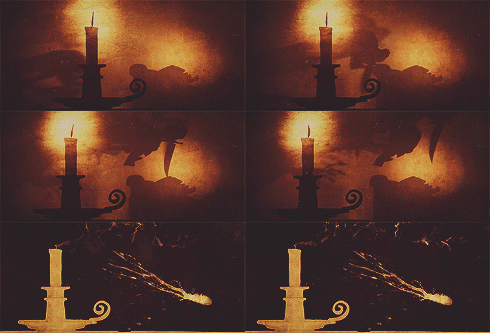
According to The Tales of Beedle the Bard, three brothers — suspected to be Antioch, Cadmus, and Ignotus Peverell — were out travelling when they came to a treacherous river that had been known to claim the lives of many that had attempted to cross it. Taking no chances, the three brothers pulled out their wands and conjured a bridge out of thin air. However, halfway across it, they encountered a tall, cloaked, hooded figure, blocking their path. The figure, revealed to be Death himself, felt cheated that the three brothers had outsmarted him and had not drowned in the river, as many others had.

While pretending to congratulate them for their triumph, Death schemed against them. He offered each brother their choice of gift as a reward for outsmarting him. Antioch, the eldest, went first, and being a combative man he asked for a wand that would defeat all others (i.e. "a wand that must always win duels for its owner"). Death went to a nearby elder tree and created a wand from its wood, which he handed to Antioch.
The second brother, Cadmus, being an arrogant man who wanted to humiliate Death even further, asked for an object that would recall the dead and was given the Resurrection Stone.
The youngest brother, Ignotus, was much wiser than his brothers and was distrusting of Death's intentions. Therefore he asked for an object that would allow him to live his life without the fear of Death following him. Very reluctantly, Death handed over a part of his own Cloak of Invisibility.
Antioch Peverell's possession
Albus Dumbledore thought it was unlikely that the Elder Wand was actually made by Death, and assumed that it may have been created by the eldest of the three Peverell brothers, Antioch. However, Antioch did not possess the Elder Wand for very long: After killing a rival wizard in a duel shortly after creating the wand, Antioch drunkenly boasted of the wand's powers. Hence he was murdered in his sleep that night by another envious wizard who slit his throat and took possession of the wand.
Known owners

The bloody trail of the Elder Wand is splattered across the pages of Wizarding history.
Over time, this powerful and mysterious wand passed through various hands, usually by violent means, and acquired names such as "The Deathstick" and "The Wand of Destiny". Several of the wand's owners are well-known to wizarding history, as the "bloody trail" wrought by the wand was recorded in numerous historical accounts. Many owners were killed by their successors in a lust for power, and over time the inaccurate legend grew that murder was necessary in order to attain mastery of the Elder Wand.
- Wizards Biography - Emeric the Evil The Tales of Beedle the Bard - Egbert the Egregious a barbarous duel. What became of Egbert after mastering the Elder Wand is unknown. What is known is that century later, Godelot is recorded to have obtained mastership of the wand. - Godelot The Tales of Beedle the Bard (real) Dark magic (including a passing reference to Horcruxes in its introduction). Godelot perished in his own cellar after he was locked in there by his son, Hereward, who did this to gain ownership of the Wand. - Hereward killing his father, Godelot. He succeeded in this by locking his father in his own cellar to die and stealing the wand afterwards. - Barnabas Deverill Following Hereward, the next known Master of the Elder Wand was Barnabas Deverill. In the early eighteenth century, he used it to carve out a reputation as a fearsome warlock until his reign of terror was ended by Loxias, who murdered Barnabas and gained mastery of the wand. - Loxias Loxias's own mother. From Xenophilius Lovegood's understanding of history, either Arcus or Livius seemed to have killed him, as he believed one of them to be the next Master of the Elder Wand. - Arcus or Livius According to Xenophilius Lovegood, it is debated whether Arcus and Livius became the Master of the Elder Wand after Loxias's death, as tracking the wand's history any further than this point becomes difficult.
Recent history
Mykew Gregorovitch's possession
At some point during the late nineteenth or early twentieth century, the Elder Wand came into the possession of wandmaker Mykew Gregorovitch. Upon realising that it was the most powerful wand in existence, Gregorovitch spent many years experimenting to try and duplicate its powers. Gregorovitch, somewhat foolish by nature and hoping it would improve his business, even started a rumour detailing that he possessed the wand and his efforts to replicate its properties.

This would eventually lead to Gregorovitch's undoing; sometime between 1899 and 1926, he heard someone breaking into his workshop one night. He promptly ran inside and saw that an intruder had taken the wand: a young blonde haired man, who promptly shot a Stunning Spell at Gregorovitch to acquire mastery of the wand, before leaping out the window. Gregorovitch never discovered the man's identity.
Gellert Grindelwald's possession
Gellert Grindelwald was one of the most powerful and dangerous Dark wizards of all time. He was educated at Durmstrang Institute, but was later expelled. Grindelwald's great-aunt was the famous magical historian Bathilda Bagshot, and following his expulsion he lived with her in the village Godric's Hollow for a summer. During this time he struck up a friendship with a young Albus Dumbledore, and the two made plans to find the Deathly Hallows. They believed that possessing the Hallows would allow them to create a world in which Muggles, out of necessity and for the greater good, would be subservient to wizards and witches. This partnership fell apart after the two were involved in a vicious three-way duel with Albus's brother Aberforth, which resulted in the accidental death of his sister Ariana.
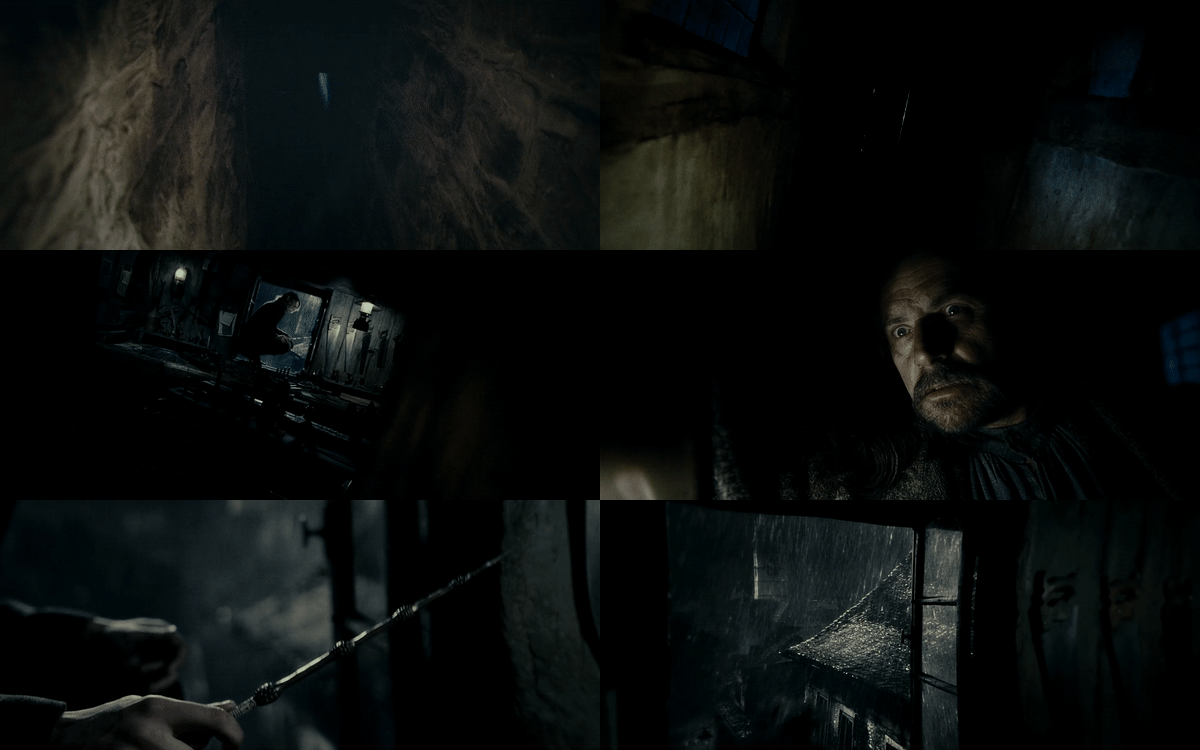
After his falling out with Dumbledore, Grindelwald delved into his research of the Deathly Hallows and uncovered the location of the Elder Wand. Rumours had been circulating that the renowned wandmaker Gregorovitch had the wand and was trying to duplicate its properties. Grindelwald broke into the wandmaker's workshop, and succeeded in claiming ownership of the fabled wand by waiting until Gregorovitch came and then casting a stunning spell at him, making himself the rightful owner.
Over the years, Grindelwald raised an army and began a reign of terror that spread through several European countries and resulted in the murder of many wizards and Muggles for many years. He never attempted to seize power in Britain, though, due to his fear of his former friend Dumbledore, who was "a shade more skilful" than he was. During his reign, Grindelwald built the Nurmengard prison to hold any enemies or objectors, all while claiming that everything he did was "for the greater good", which was the phrase he inscribed above the entrance of Nurmengard.
In 1927, Grindelwald used the wand in his escape. Later on, Aurors infiltrated the rally in Lestrange Mausoleum on Père Lachaise Cemetery in Paris, Grindelwald used the Elder Wand to conjure a circle of protective fire around himself, and added an enchantment designed to test the loyalty of his followers: those who entered with complete fidelity and believed in his cause would survive; those who did not, would be engulfed and perish. Abernathy, Vinda Rosier, Credence Barebone, and Queenie Goldstein joined Grindelwald into the circle and Apparated. Grindelwald proceeded to use the wand to quickly dispatch many Aurors, manipulating the ring to cast columns and balls of black fire that slayed even Aurors in mid-Apparition. Ultimately, about half a dozen of the fifty Aurors Theseus Scamander had brought along accepted his offer and joined him in the circle as well.
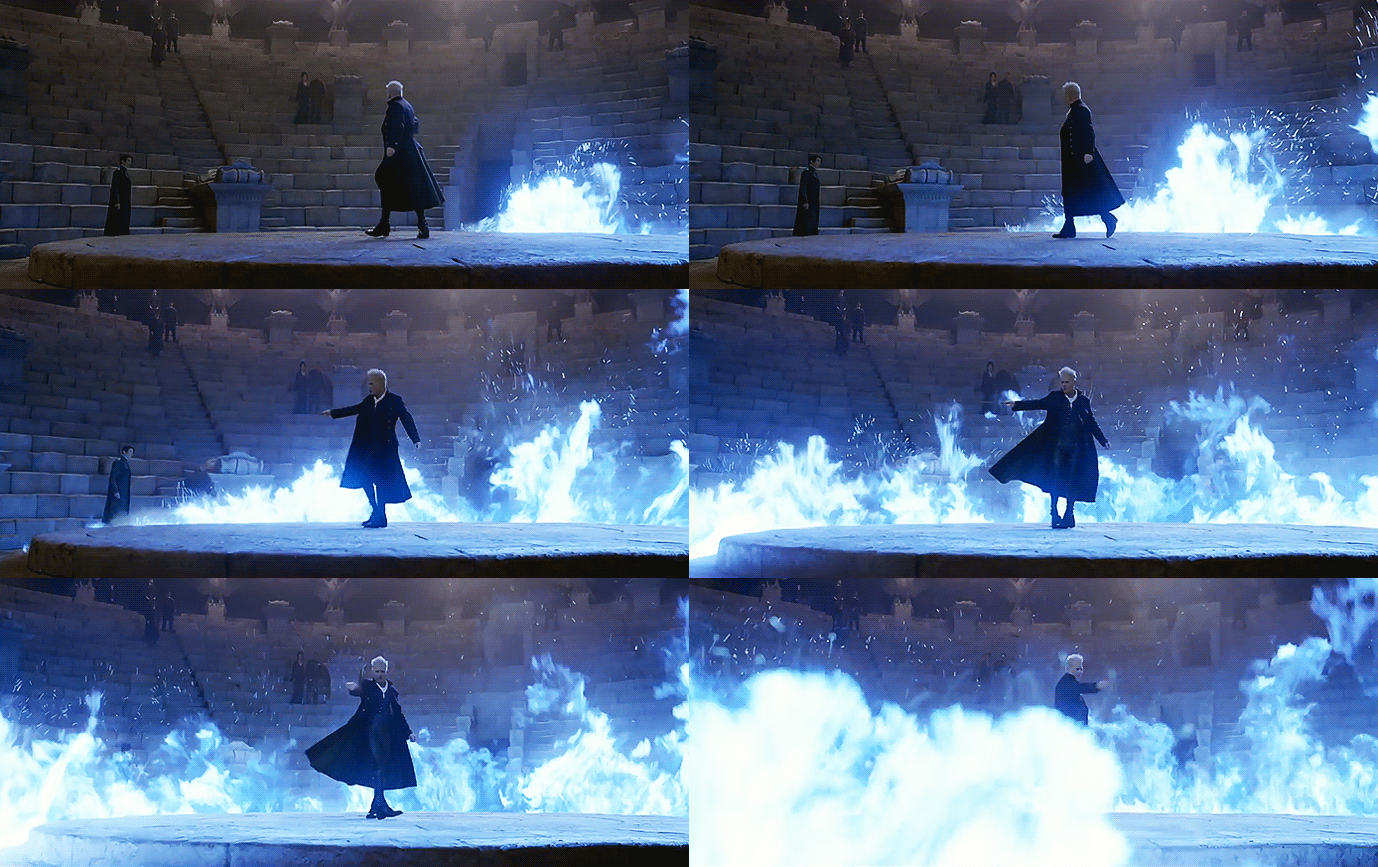
Then Grindelwald, mocking Newt Scamander by asking whether he thought Dumbledore would mourn for him, attacked him and Theseus and would have succeeded in burning them alive had he not been distracted by Leta Lestrange, who screamed at him to stop. Grindelwald did so, manipulating the black fire to act as a wall to prevent Theseus from doing anything, and in response, offered her to join his ranks. She refused, however, and cast the Stunning Spell at him that missed and blasted Vinda Rosier instead. This caused her to drop his skull-hookah, which smashed into pieces, with Grindelwald killing Leta with the flames, incinerating her.
Having struck down Leta, Grindelwald let out his fury over losing such a valuable tool by fully unleashing the dark fire, with the intent on destroying the entirety of Paris, and all of those present along with it, before he Disapparated. Just in time Nicolas Flamel arrived and instructed Newt, Theseus, Tina Goldstein and Yusuf Kama to form a ring around the mausoleum, plant their wands in the ground and use the General Counter-Spell. The effect was the creation of a counter-spell so great that it forced the black fire back into the mausoleum where it ended its effects.
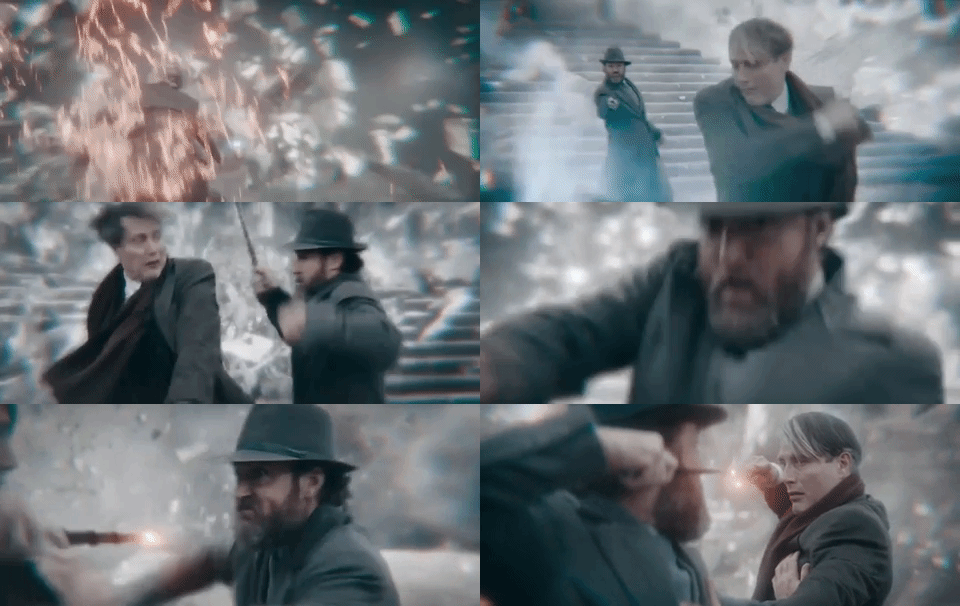
In 1932, Grindelwald used the Elder Wand to remove Yusuf Kama's memory about the murder of his sister, Leta Lestrange. Later, during the walk of the Qilin in Bhutan, Grindelwald used the Elder Wand to torture Jacob Kowalski with the Cruciatus Curse. When Newt Scamander, with the help of Credence Barebone and Bunty Broadacre, discovered Grindelwald's deception about the enchantment of a dead Qilin, a furious Grindelwald fired a Killing Curse at Credence with the intention to kill. Albus Dumbledore and Aberforth Dumbledore blocked the Killing Curse with their own spells, which caused in destroying the blood pact between Albus and Grindelwald. As a result, Dumbledore and Grindelwald fought a fierce duel that ended in stalemate. Wizards present at the ceremony wanted to capture Grindelwald, but he cast a Shield Charm around himself, then added that he had never been an enemy of the Dumbledores, then or now, and then Disapparated.
At dawn on 2 November 1945, at the height of Grindelwald's power, Albus Dumbledore finally felt compelled to confront his former friend due to the public outcry. Despite Grindelwald's mastery of the Elder Wand, as well as putting up a fight, Dumbledore defeated him in what became known as a legendary duel. Grindelwald was subsequently incarcerated in his own prison, Nurmengard, where he remained for decades. He was eventually slain there in 1998 by Lord Voldemort, who was in search of the Elder Wand. Grindelwald, however, refused to divulge any information about the wand, defying Voldemort in a last attempt to find redemption.
Albus Dumbledore's possession


I was fit only to possess the meanest of them, the least extraordinary. I was fit to own the Elder Wand, and not to boast of it, and not to kill with it. I was permitted to tame and to use it, because I took it, not for gain, but to save others from it.
When Albus Dumbledore defeated Grindelwald in 1945, mastery of the Elder Wand passed to him. Under his ownership, the wand was largely used for good, unlike many of its former masters. Dumbledore performed great magic with this wand, furthering his reputation as the world's most powerful wizard. Among that magic was the ability to produce Gubraithian Fire, a flame which has been enchanted to burn forever without dying. It is quite an advanced piece of magic, as few wizards were capable of it. Dumbledore provided Rubeus Hagrid with a branch of this fire as a diplomatic gift for the giants.
During the 1995–1996 school year, Dumbledore used the wand to stun Dolores Umbridge, Cornelius Fudge, John Dawlish, and Kingsley Shacklebolt as he made his escape when the Ministry tried to take him to Azkaban. When he arrived at the Ministry to aid the Order of the Phoenix in the battle against the Death Eaters, he engaged in a ferocious duel with Lord Voldemort, using his wand to enchant the statues from the Fountain of Magical Brethren to protect Harry. Dumbledore was able to maintain the upper hand in the duel, countering Voldemort's attacks. While the Dark Lord was able to counter or dispel Dumbledore's hail of assaults, he was ultimately forced to flee.
During Harry's sixth year, Dumbledore and Harry set out to the Cave where Dumbledore believed a Horcrux resided. When Harry dipped a goblet into the lake to provide water for Dumbledore (who was incredibly weak and thirsty after drinking the Drink of Despair to reach the Horcrux), all the Inferi that resided in the lake grabbed at Harry and attempted to drag him down and drown him in the lake. Dumbledore recovered enough to conjure a lasso of fire around them to ward off the Inferi, but remained very weak.
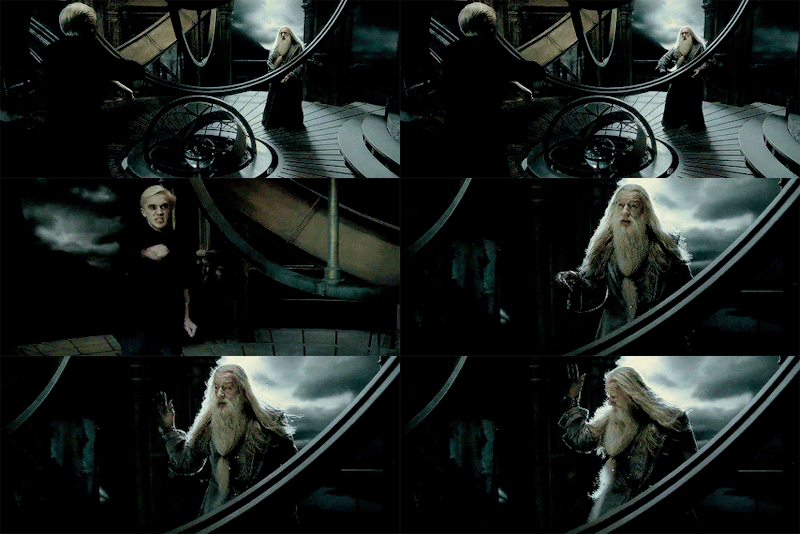
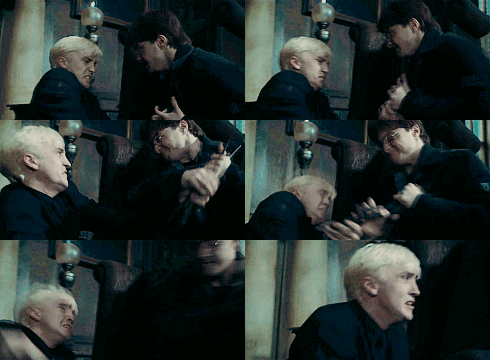
When they returned to Hogsmeade, Madam Rosmerta informed them that the Dark Mark had been conjured over the Astronomy Tower. In the tower, Dumbledore told Harry not to interfere in the events that were about to take place there, and, to ensure this, placed him in a Body-Bind Curse under his invisibility cloak. Hidden, Harry was unable to intervene as Dumbledore (now extremely weakened by the potion) was Disarmed by Draco Malfoy. The wand flew from Dumbledore's hands over the battlements, but was clearly found later, as it was placed in Dumbledore's grave alongside his corpse.
Dumbledore was conversing with Draco about the plot to assassinate him when several other Death Eaters entered the tower and tried to persuade Draco to finish his task as well as Dumbledore himself. The present Death Eaters included Bellatrix Lestrange, Thorfinn Rowle, Corban Yaxley, Gibbon, Amycus Carrow, Alecto Carrow, and Fenrir Greyback. Dumbledore briefly exchanged words with Bellatrix and Greyback. When Draco hesitated, Severus Snape appeared and performed the Killing Curse on Dumbledore himself. Harry later learned that, in order to save himself from a more agonising death, and to prevent Draco from tarnishing his soul, Dumbledore had previously instructed Snape to kill him painlessly, to which Snape had reluctantly agreed.

Unbeknownst to Snape, Dumbledore had also done this to ensure that when Snape killed him, Dumbledore would not unintentionally be "defeated" (as they had agreed to it beforehand, the Elder Wand's power will end with Dumbledore, who was ready to accept death) and thus the mastery of the Elder Wand would be vanquished for good. However, not all went according to Dumbledore's plan, since Dumbledore was disarmed and thus was defeated by Draco Malfoy. Without his knowledge, Draco thus became the next master of the Elder Wand.
Lord Voldemort's search

The Dark Lord no longer seeks the Elder Wand only for your destruction, Mr Potter. He is determined to possess it because he believes it will make him truly invulnerable.
During the summer of 1997, Voldemort held a meeting at Malfoy Manor with his Death Eaters, in which he revealed that, in order to defeat Harry, he would need to borrow another person's wand because of the connection that his own wand shared with Harry's. He finally settled on Lucius Malfoy's wand as a way of punishing the Malfoy family, but that wand was destroyed by Harry's during the Battle of the Seven Potters.
After this, a furious Voldemort tortured Garrick Ollivander into revealing more solutions to defeat Harry, eventually leading Voldemort to know of the Elder Wand's existence. Although originally desiring another wand only to defeat Potter, upon hearing the wand's legendary powers he sought its mastery in order to not only to conquer Harry Potter, but also to secure his desire as the ultimate wizard in the world, which he believed would make him invincible.
He devoted the latter half of 1997 (and into the spring of 1998) into a relentless and murderous search for the Elder Wand. He killed many people who stood in his way, including an innocent woman and her two small children. He eventually traced the wand's recent history, murdering both Gregorovitch and Grindelwald in the course of his search. It was after breaking into Grindelwald's cell in Nurmengard that Voldemort tracked the wand's ownership to Dumbledore, despite Grindelwald's efforts.
Lord Voldemort's possession
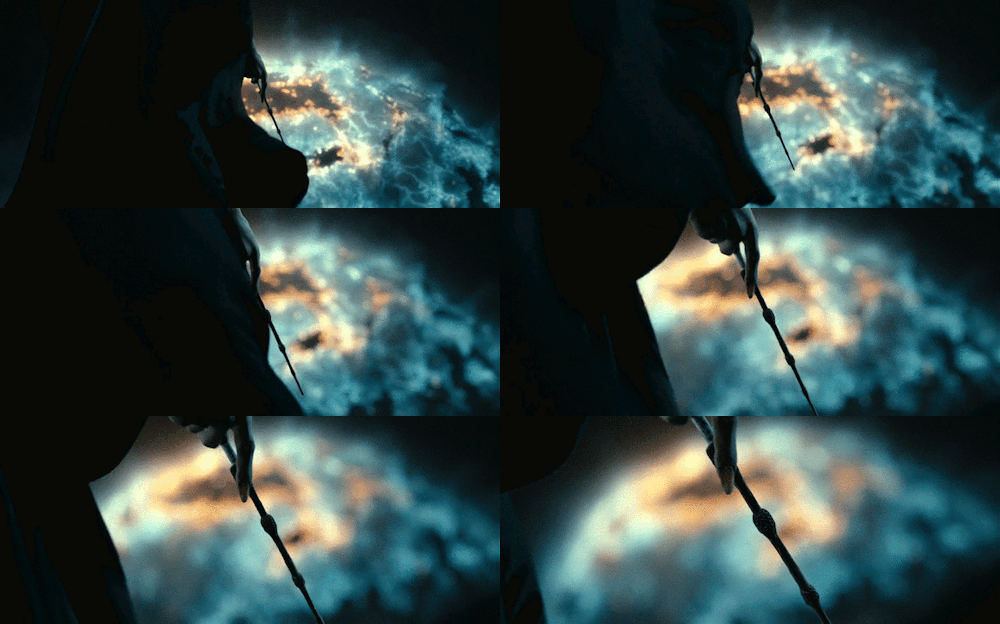
Voldemort broke into Dumbledore's grave and robbed it of the wand, which had been buried with its former master. However, unbeknownst to Voldemort, the former owner of the Elder Wand, Albus Dumbledore, had already been disarmed by young Draco Malfoy. He believed that Severus Snape was the true owner of the wand after he realised the wand was not living up to its full potential, as Voldemort thought that Snape had been the one to kill Dumbledore, not taking into account the fact that Draco had disarmed Dumbledore before Snape killed him.
As a result, Voldemort got his pet snake and Horcrux Nagini, to murder Snape. Nagini attacked in rapid succession biting Snape on the neck multiple times. He believed he was now the Elder Wand's true master, but in the Battle of Hogwarts Harry Potter, his young adversary, revealed to Voldemort that the wand had not belonged to Snape, but to Draco, and, after defeating Draco himself, Harry Potter.
Harry Potter's possession
You are the true master of death, because the true master does not seek to run away from Death. He accepts that he must die, and understands that there are far, far worse things in the living world than dying.
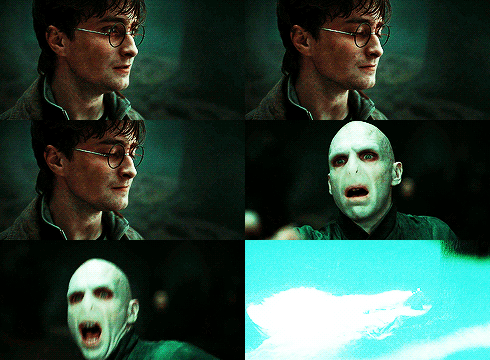
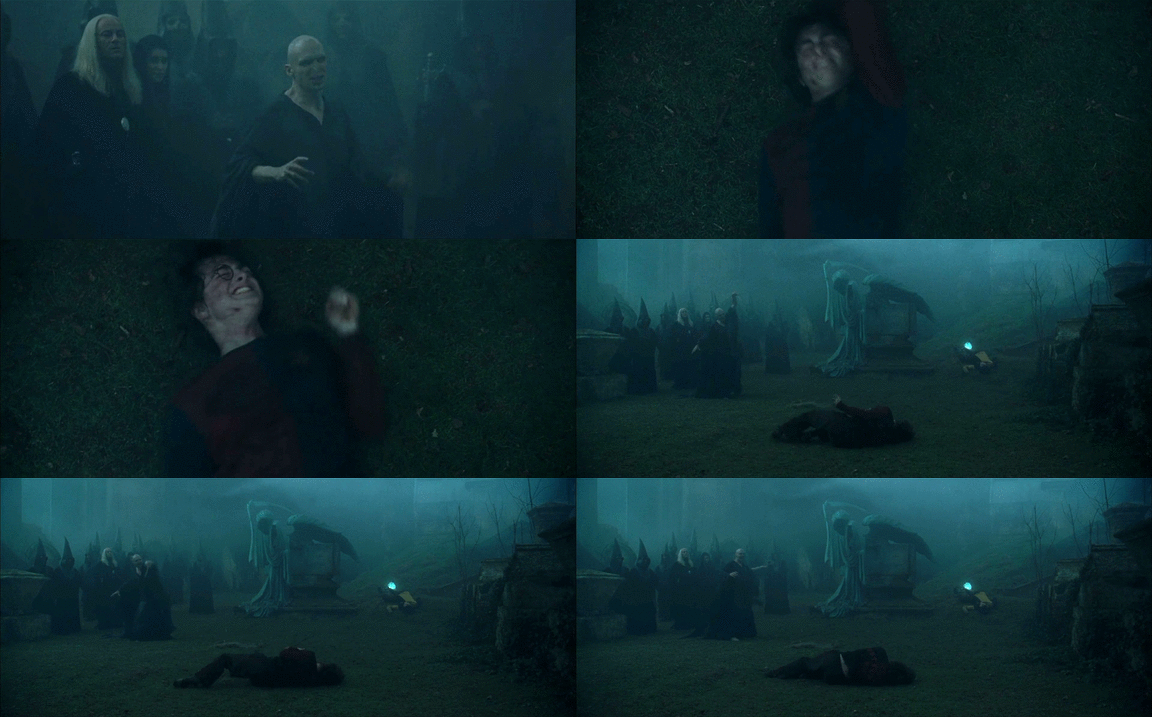
Nearly a year after Draco had unintentionally become the wand's master, Harry Potter had taken Draco's wand by force during the skirmish at Malfoy Manor, thus making him the new and final master of the Elder Wand. Late in the Battle of Hogwarts, Harry, who had learned that he had been accidentally made into Voldemort's Horcrux when he was a one-year-old baby, walked into the Forbidden Forest to sacrifice himself to Lord Voldemort. Voldemort cast the Killing Curse on Harry using the Elder Wand.
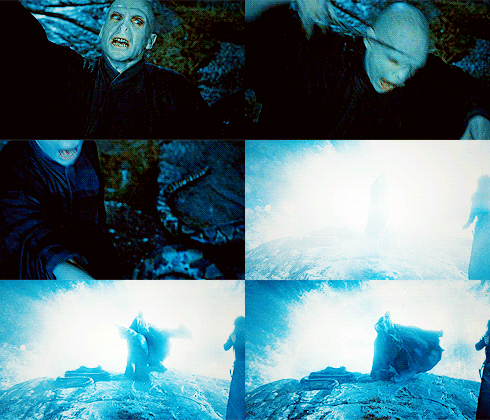
The wand seemingly worked because Harry intended to die at Voldemort's hand, much as Dumbledore had planned his death with Snape. Harry had entered a limbo state, portrayed as King's Cross Station, from which he could choose to return. When he did return, Voldemort cast the Cruciatus Curse on Harry's "dead" body; however it caused him no pain, as the wand refused to harm or kill its true master. At this point, Harry realised that he in fact was indeed the true master of the Elder Wand. Only in his final encounter with Harry at the Battle of Hogwarts was Voldemort told that he had failed to win the true allegiance of the wand, as he did not gain ownership by defeating its previous owner. Despite this, Voldemort used the Elder Wand to cast his final Killing Curse against Harry's Disarming Charm. However, because the wand's allegiance was to Harry, Voldemort's spell backfired and killed him, once and for all.

Harry's decision
I'm putting the Elder Wand back where it came from. It can stay there. If I die a natural death like Ignotus, its power will be broken, won't it? The previous master will never have been defeated. That'll be the end of it.
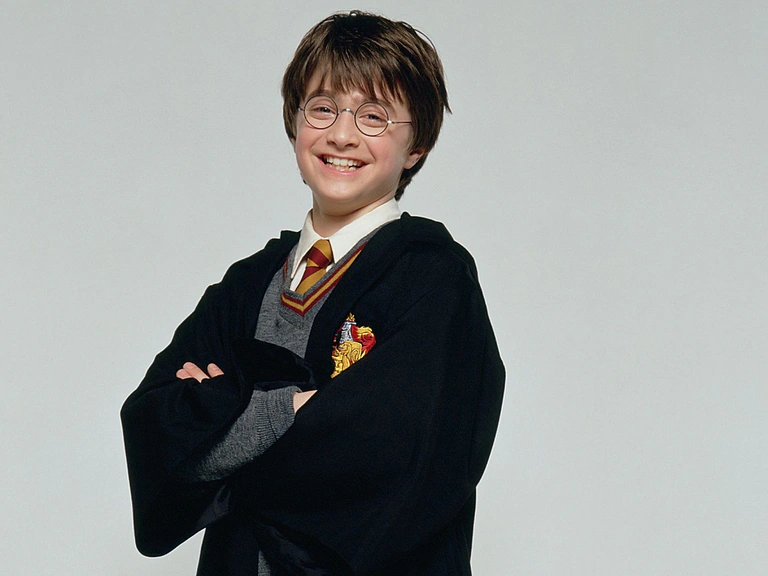
With Voldemort officially defeated, and Harry now the true and final master and possessor of the Elder Wand, he used it to repair his damaged original wand of holly and phoenix feather, which he said he was "happier with". After the repair, Harry told Dumbledore's portrait that he would place the Elder Wand back in Dumbledore's tomb, and when Harry died a natural death, the wand's power would finally be broken as Dumbledore had intended. The portrait of Professor Dumbledore approved. Ron Weasley was somewhat dissatisfied with Harry's choice to let the most powerful wand be sealed away, but Hermione Granger agreed with Harry.
Delphini and Hermione
After using a Time-Turner to go back to 31 October 1981, the night of Lily and James Potter's murder by her father Tom Riddle, Delphini engaged in a duel with Harry Potter. During the duel she disarmed Harry, and later on, Hermione bound Delphini. It is unknown if these actions had any effect on the allegiance or ownership of the Elder Wand.
Alternate timelines
In an alternate reality inadvertently created by Albus Potter and Scorpius Malfoy, in which Voldemort maintained his immortality when his final Horcrux was not destroyed, Voldemort successfully killed Harry Potter and dominated the wizarding world, meaning he had successfully attained mastery over the Elder Wand. This alternate world was eventually undone by Scorpius.
Power
An unbeatable wand, Hermione!
The Elder Wand was the most powerful wand in existence, and it made the master's magic unparalleled. Its owner could have used it to cast spells more powerful than any in existence, and by far than any believed to be magically possible. For example, Harry Potter was able to repair his regular Phoenix feather wand using the Elder Wand in 1998, even though broken wands were held, by experts such as Garrick Ollivander, to be damaged beyond magical repair, and Harry did so despite not having any training in wandlore.
Additionally, when Grindelwald used the Cruciatus Curse on Jacob Kowalski in Bhutan in 1932, the effects of the spell continued to affect Jacob even after he stopped pointing the wand at him. Conversely, when Voldemort used his own regular wand to use the Cruciatus Curse on Harry Potter in Little Hangleton, the effects of the spell ceased the instant Voldemort stopped pointing his wand at him. Both Ollivander and Voldemort believed that the wand's legendary powers is the only one capable of overpowering the bond between the latter and Harry, which created such an effect that Harry managed to overcome Voldemort's attempt to kill him.

However, there did exist limitations in the Elder Wand's power, appearing to improve pre-existing spells to perform the seemingly impossible, not actually being able to perform the impossible. Dumbledore himself was incapable of curing the petrified victims of Salazar Slytherin's Basilisk or nullifying the Jinx on the post of Defence Against the Dark Arts teacher or the curse on Marvolo Gaunt's Ring entirely, and neither was he able to overcome the enchantments upon Voldemort's Drink of Despair with the wand amplifying his own magic. In addition, while most of the times where the Elder Wand shifted allegiance was not in a fair fight but by cunning assassination, it does not entirely guarantee victory against others, as displayed by Dumbledore's ability to defeat Gellert Grindelwald without killing him and despite Grindelwald having mastered the Elder Wand, while Egbert the Egregious was known for having actually "slaughtering" Emeric the Evil in a duel to claim the wand.
This can be attributable, however, to the fact that in these circumstances, the proper counter-charms or counter-potions weren't known to the master of the Elder Wand at the time. Moreover, not all spells have a counter-spell, but instead, a counter-potion. These scenarios are comparable to when Neville in his first few years studying at Hogwarts was cursed by Draco Malfoy many times, such as being bounded by the Leg-Locker Curse, which only Hermione in their year, was able to undo the effects of. Neville himself was unable to undo the Leg-Locker Curse's effects on him, but Hermione was, highlighting the fact that knowledge of the curse, its effects, and counter-curses or counter-potions are important in removing the effects of curses and other dark magic.
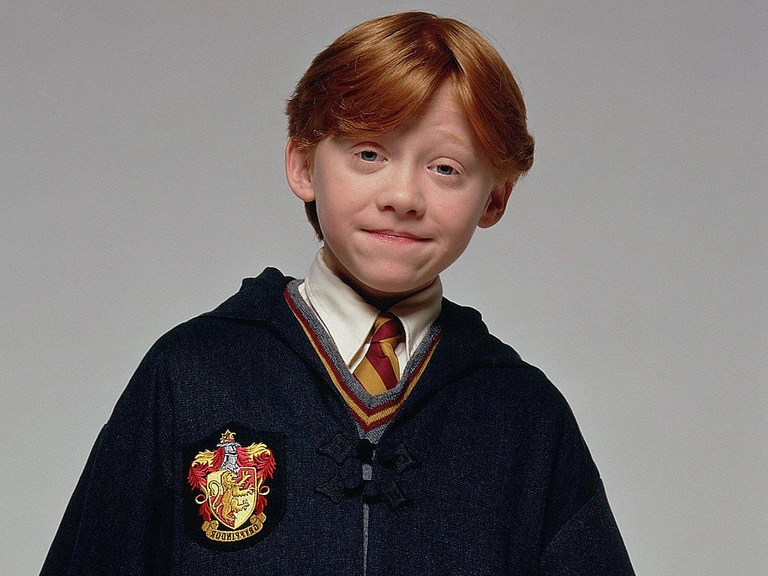
While it is stated that a wand would not give up its master so easily if it is attempted to be won, the Elder Wand seemed to do this time and time again. However, this might not be referring to its willingness to give up its master, but rather to the amount of effort it took to defeat the wielder of the wand. As the wand, like the eldest brother in the Tale, embodied the conceit that "Might is Right", greater power would, from its perspective, indicate superiority. Ron has noted that he would choose the wand of the three Hallows, but argued that he would do so while not proclaiming his ownership of it, reasoning that the wand was only dangerous to the first brother because he bragged about owning it rather than the wand being dangerous on its own.
When Lord Voldemort used the Elder Wand without mastering it, he claimed that the wand only unleashed his regular (albeit immensely powerful) level of magic and not the unbeatable effects it was rumoured to possess. It's unknown if the wand would work this way for another who hasn't mastered it though, as Voldemort has used the wands of others in the past with no handicap, it's likely that this is his own power rather than that of the Elder Wand.
It did have one redeeming quality like all other wands, however: it refused to harm or kill its true master when in the hand of someone else. It also wouldn't harm or kill those who were under sacrificial protection.
Known masters of the Elder Wand
Newt Scamander (possibly)
Antioch Peverell's killer
Emeric the Evil
Egbert the Egregious
Godelot
Hereward
Barnabas Deverill
Loxias
Arcus or Livius (possibly)
Yusuf Kama (possibly)
Delphini (possibly)
Hermione Granger (possibly)
Other elder wands
While the "Elder Wand" (capitalised) referred to one of the Deathly Hallows, other wands had been made from elder wood. In general wizards seemed to eschew elder wands, due at least in part to the sordid history of the Elder Wand itself, favouring wands made from various other woods, such as holly, willow, vine, and oak. Ron repeated an old wizarding saying, "Wand of elder, never prosper" after Hermione read The Tale of the Three Brothers, to illustrate how wizarding lore might be passed from generation to generation.
Sources
Adapted from the original article, under CC BY-SA 3.0.