Lore
Divination
Divination was a branch of magic that involved attempting to foresee the…

Many witches and wizards, talented though they are in the area of loud bangs and smells and sudden disappearings, are yet unable to penetrate the veiled mysteries of the future.
Divination was a branch of magic that involved attempting to foresee the future, or gather insights into past, present and future events, through various rituals and tools.

Divination was different from other branches of magic in that it required the practitioner to possess a natural aptitude. One could not simply study hard and expect to get better at it, if a witch or wizard lacked any aptitude for divination, then they were doomed to fail no matter how hard they worked.
Divination was also unique as a branch of magic in that humans and non-humans could practice and be taught the same techniques and methods, despite those cultures having different cultural practices. Centaurs were well known as non-humans who practised divination, but some non-human magical groups didn't practise divination at all, such as goblins and house-elves.
Human divination

Divination is one of the most imprecise branches of magic. I shall not conceal from you that I have very little patience with it.
Divination had been practised since ancient times. The earliest known method of human fortune-telling was the product known in the West as Chinese Fortune Sticks.
Seers
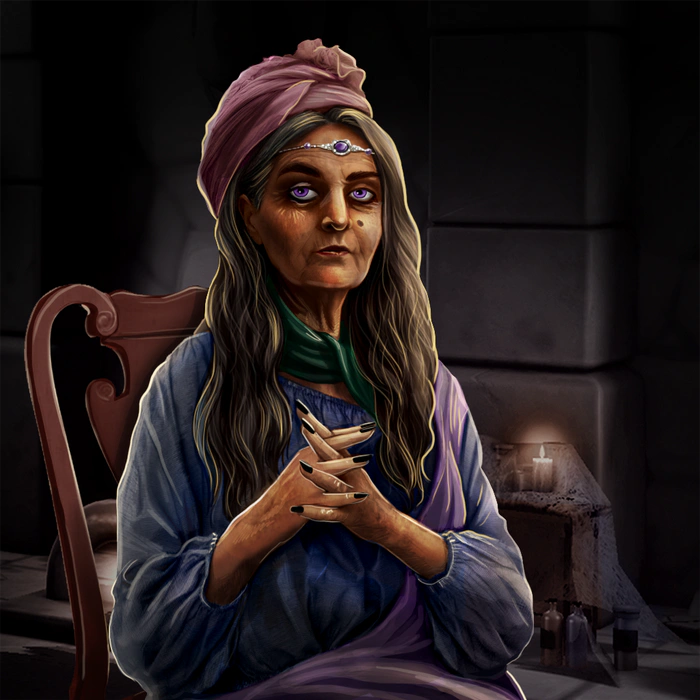
Witches and wizards who were born with the natural gift for prophecy were known as Seers, and had the ability to foresee the future with their Inner Eye. Professor Sybill Trelawney is an example of someone with this gift; her predictions almost always seemed "woolly" and even fraudulent, and she was always predicting the deaths of students. However, aside from these death predictions that never came true, Professor Trelawney actually had an impressively accurate track record, seemingly by simply making stuff up in an effort to appear all-knowing, possibly her Inner Eye at work without her even realising it.

Professor Trelawney has asserted that "The Inner Eye does not See upon command!". Furthermore, the Inner Eye apparently skips three generations in families.
According to Professor Mudiwa Onai, Divination was an important yet often misunderstood branch of magic. True Seers were very rare and as often the case with unique individuals, they could often be misread or even feared.
There was an occupation in the Wizarding world known as a Naming Seer. In exchange for gold, Seers would make predictions about the future of an unborn child and advise the parents to give them a suitable name.
Wands made from Silver lime wood had a reputation for performing best for Seers and those skilled in Legilimency.
Non-Seers
While those born with the gift of the Inner Eye were rare, non-Seers could also learn divination methods and develop and gain various insights with them. A common way of seeing the future was with the aid of a crystal ball. To this end, Divination was taught as an elective subject from the third year on at Hogwarts School of Witchcraft and Wizardry. However, the success of these non-seers varied, the main problem being that Divination was highly imprecise in the first place.

During a Divination class in 1993, Professor Trelawney told Hermione Granger that she perceived very little aura around her, indicating that she had "very little receptivity to the resonances of the future". This indicated that there was a distinct correlation between a witch or wizards' "amount" of aura and whether or not they would be competent at Divination.
Imprecision
At times, the future is murky to us all. As with rippling water, one must wait for things to settle before the reflection becomes clear.
Learned wizards and witches seemed to regard the practice of divination with scepticism. Hermione Granger once described it as "woolly" and "a lot of guesswork," Minerva McGonagall thought it was "one of the most imprecise branches of magic," and before he decided to take on Sybill Trelawney as Divination professor at Hogwarts, Albus Dumbledore was inclined to scrap the subject altogether. Be that as it may, true prophecies were not lightly dismissed, even by sceptics. The truly wise knew that the words of prophecies always held importance, even if that importance was not easily or immediately apparent.
In some cases, the signs granted by Divination can be more literal that symbolic. An example of this was when Harry Potter had the Grim (a giant spectral dog that haunted churchyards, seen as an omen of death). As it turned out, the image of a dog just meant that a dog would play a significant role in his future. The dog actually being his Godfather, Sirius Black, who was a dog Animagus.
According to Professor Onai, it was wise to have a measured perception. Nothing worthwhile was ever easy to achieve, but that is precisely why such futures were worth striving for.
The inaccuracy of Divination was not necessarily a bad thing in the right circumstances; a vision of danger did not necessarily mean certain doom. It could at least help one to prepare for what was to come. The future was not etched in stone, it could be carved out by those who had very strong wills. However, the future that one carved out for themselves could not be taken back.
Centaur divination
Centaurs had a way of practising divination distinct from that of wizardkind, which they had been doing for centuries by 1996. It was apparently mainly based around astrology, the art of observing the movement of planets, moons, and stars. It could take up to a decade for centaurs to understand what these celestial portents meant, and even then, the results were rarely precise. They may have attempted to narrow their prediction of when an event would take place by burning certain herbs, such as sage and mallowsweet, and looking for various shapes and symbols in the fumes. The Forbidden Forest centaur colony heavily practised this kind of Divination which helped them reach their predictions about what would happen.

Centaurs seemed to have had a low opinion of human methods of divination, believing that the movements of heavenly bodies were far too large scale to affect the trivial affairs that humans fussed over. Firenze, who taught Divination at Hogwarts, described what "humans call fortune-telling" as "self-flattering nonsense," and voiced the belief that humans obsessed over mundane, day-to-day predictions because they were "blinkered and fettered by the limitations of [their] kind."
Known methods
- Method(s) Notes - Astrology Harry Potter and the Goblet of Fire - Bibliomancy Harry Potter: Hogwarts Mystery - Bird entrails Harry Potter and the Prisoner of Azkaban - Capnomancy Harry Potter: Hogwarts Mystery - Cartomancy Harry Potter: Hogwarts Mystery - Catoptromancy Harry Potter and the Philosopher's Stone (see here). - Chinese Fortune Sticks Involved wooden sticks that told the user's daily fortune. - Crystal-gazing Harry Potter: Hogwarts Mystery - Dream interpretation Harry Potter: Hogwarts Mystery - Fire-omens flames. - File:Plaque de Caroline Fauconnier.webp Involving the use of handwriting. - Harry Potter and the Order of the Phoenix Unknown, possibly related to the number seven. - Ichthyomancy Involving fish. - Lithomancy Harry Potter: Hogwarts Mystery - Myomancy Harry Potter: Hogwarts Mystery - Numerology Harry Potter: Hogwarts Mystery - Ornithomancy Harry Potter: Hogwarts Mystery - Ovomancy Harry Potter: Hogwarts Mystery - Palmistry Harry Potter: Hogwarts Mystery - Phyllomancy Harry Potter: Hogwarts Mystery - Physiognomonie Involving the features of a person's face. - Rune stones Somehow using rune stones to divine the future. - Tessomancy Harry Potter: Hogwarts Mystery - Xylomancy Harry Potter: Hogwarts Mystery
Sources
Adapted from the original article, under CC BY-SA 3.0.