Creature
Basilisk
Giant serpent, also known as the King of Serpents
Of the many fearsome beasts and monsters that roam our land, there is none more curious or more deadly than the Basilisk, known also as the King of Serpents. This snake, which may reach gigantic size, and live many hundreds of years, is born from a chicken's egg, hatched beneath a toad. Its methods of killing are most wondrous, for aside from its deadly and venomous fangs, the Basilisk has a murderous stare, and all who are fixed with the beam of its eye shall suffer instant death. Spiders flee before the Basilisk, for it is their mortal enemy, and the Basilisk flees only from the crowing of the rooster, which is fatal to it.
The Basilisk was a giant serpent, also known as the King of Serpents. It was a magical beast that was usually bred by Dark wizards. Herpo the Foul was the first to breed a Basilisk. Herpo accomplished this by hatching a chicken egg beneath a toad which resulted in the creature known as a Basilisk.
Basilisk breeding was banned in Medieval times, a regulation that has not changed. The practice could be hidden when the Department for Regulation and Control of Magical Creatures came to check by simply removing the egg from the toad.
A phenomenally lethal creature, direct eye contact with a Basilisk would result in instantaneous death, but an indirect look would merely render the victim Petrified. It was also the mortal enemy of spiders. Spiders refused to speak of the Basilisk, could intuitively sense their presence, and would flee whenever they sensed them.
The Basilisk had a classification as an XXXXX creature, meaning it was a known wizard-killer that couldn't be domesticated due to its immense powers. However, since the Basilisk was still a serpent, a Parselmouth might communicate with it and potentially place the creature under their influence.
This obedience depended on the relationship between the Basilisk and the Parselmouth. Tom Riddle was the only one who could command Salazar Slytherin's Basilisk, while Harry Potter had no control over her, as he had been warned.
Physical appearance
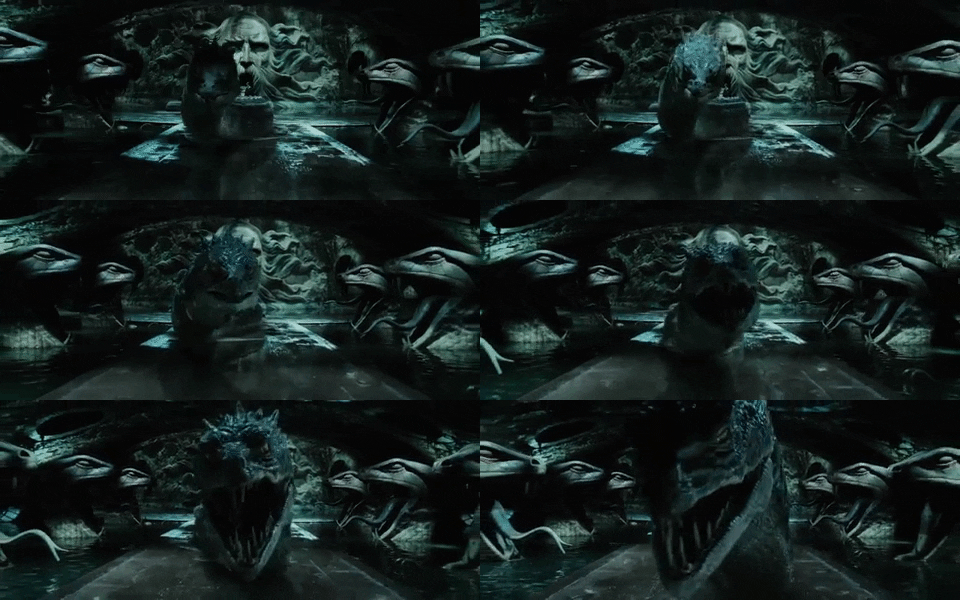
The light slid over a gigantic snake skin, of a vivid, poisonous green, lying curled and empty across the tunnel floor. The creature that had shed it must have been twenty feet long at least.
The Basilisk was a snake-like creature that could grow up to fifty feet in length. Their scales were a dark green colour with a lighter green underbelly. A male Basilisk could be distinguished from a female by a single scarlet plume on its head, which females didn't have.

The Basilisk had horns on its head. They also possessed rows of incredibly sharp venomous fangs and large yellow eyes.
Ecology
A Basilisk egg was the egg from which a Basilisk hatches. Basilisk eggs are chicken eggs hatched beneath a toad, thus creating the deadly King of Serpents. It is unknown if a Basilisk could lay live eggs of its own. Basilisks could live a natural lifespan of at least nine hundred years, though Salazar Slytherin's Basilisk lived for approximately a thousand years. This was accomplished by using Parseltongue to put the creature into a deep sleep that prevented it from ageing, similar to suspended animation. Basilisks fed off vertebrate animals, but it is unknown how much they ate at one time. The Serpent of Slytherin survived on rats.

Basilisk skin was armoured like that of a dragon's, which deflected spells cast upon it. For example, Stunning Spells would have no effect on the deadly beast. Like all other snakes, the Basilisk shed its skin at intervals when it grew.
Spiders were terrified of Basilisks, describing them as their enemy and fleeing before them. This fear was so prevalent in all spiders, such as the Acromantula, capable of speech and itself a very dangerous creature, that they would not even speak the name of their dreaded enemy. Rubeus Hagrid asked Aragog "many times" to name the monster, but Aragog refused to say her name, or even speak of her.
Their mortal weakness was the crowing of a rooster. Basilisk horns could be used as the core of a wand, and the tongue of the Basilisk could be added to confectionery products.
Abilities
Deadly gaze

When a living creature looked directly into the Basilisk's eyes, it resulted in instant death, making it one of, if not the most dangerous creature in the Wizarding world, even more so than an Acromantula.
Looking through a pair of glasses did not offer any protection, because glasses still allowed one's line of vision to connect directly and clearly with the serpent's eyes. Myrtle Warren (commonly known as Moaning Myrtle) was such an unfortunate person, as her wearing glasses did not save her from death when she looked directly at the Serpent of Slytherin's eyes.
Although, there were ways to dampen the lethal effects and save oneself, as only direct eye contact would have resulted in death. Looking at the eyes through a camera would have worked (at the cost of the lens and film being melted). Another option was to look at it through a ghost's transparent body. Ghosts could look directly into the serpent's eyes without suffering death, as those who were already dead couldn't die again. Finally, seeing the Basilisk's reflection in a mirror or some other kind of reflective surface, like water, would also have not been fatal.
If the Basilisk's eyes were damaged (thus rendering it blind), it took away the lethal ability as well, making it totally safe to look at, though its keen senses of smell and hearing meant that it was still extremely dangerous.
It should be noted that a phoenix was immune to the Basilisk's gaze, whether directly or not, as the bird is immortal. Furthermore, when Tom Riddle commanded the Serpent of Slytherin to attack Harry Potter, he was seemingly unaffected by the Basilisk's gaze, though the cause of his immunity is unknown, as it could have been any of a number of factors (him being a Parselmouth, him being the descent of Slytherin whom the Basilisk was trained to obey, or him being a memory stored in a book). It is not known if Basilisks themselves were immune to their own killing gaze, though the fact that the Basilisk in the Chamber of Secrets was in a chamber filled with water would imply this.
Petrification


Dark Magic of the most advanced kind.
As previously mentioned, looking a Basilisk directly in the eyes was fatal, but only seeing the eyes indirectly (such as its reflection) was not. However, a victim who looked indirectly at the Basilisk's eyes became Petrified, similar to the stare of a Gorgon. This was the case with Hermione Granger, Penelope Clearwater, Justin Finch-Fletchley, Colin Creevey, Nearly Headless Nick and Filch's cat, Mrs Norris.
A way of surviving a Basilisk's otherwise deadly gaze was by seeing it through another object. An example mentioned above was when Colin Creevey saw it through his camera, resulting in his Petrification and his camera lens becoming melted. Justin Finch-Fletchley saw the Basilisk through the translucent ghost Nearly Headless Nick, and was Petrified. Sir Nicholas became Petrified as well, although he looked directly into the Basilisk's eyes, he was already deceased and therefore couldn't die again.
Hermione Granger was Petrified while gathering information on the Basilisk. She figured out what the monster in the Chamber of Secrets might be and went to the Hogwarts Library to confirm her theory. Hermione was Petrified on her way back to the Gryffindor common room after seeing the Basilisk's eyes in a hand mirror she borrowed from Penelope Clearwater.
Petrification seemed quite powerful, as the legendary Albus Dumbledore, the greatest wizard of the age and wielder of the Elder Wand, concluded that the only way to reverse the effect was through the use of the Mandrake Restorative Draught.
Basilisk venom

Though its deadly gaze alone could potentially kill any victims it came across, Basilisk venom was an extremely poisonous substance that only had one known antidote: phoenix tears. Basilisk venom was so powerful that it could kill a person within minutes, making the person drowsy and causing blurry-visioned before they died. It had a very long lasting effect, as it still remained potent in the fangs, even up to five years or more after the snake had died. It could also damage inanimate objects so thoroughly that they were impossible to restore, and thus it was one of the few substances powerful enough to destroy a Horcrux.
When Harry Potter slew the Serpent of Slytherin with the Sword of Gryffindor in 1993, the goblin silver sword became imbued with the properties of Basilisk's venom, giving it the ability to destroy a Horcrux. However, the venom was not poisonous simply by touching it. When Ron Weasley extracted a Basilisk fang with his bare hands in the Chamber, he did not die.
History
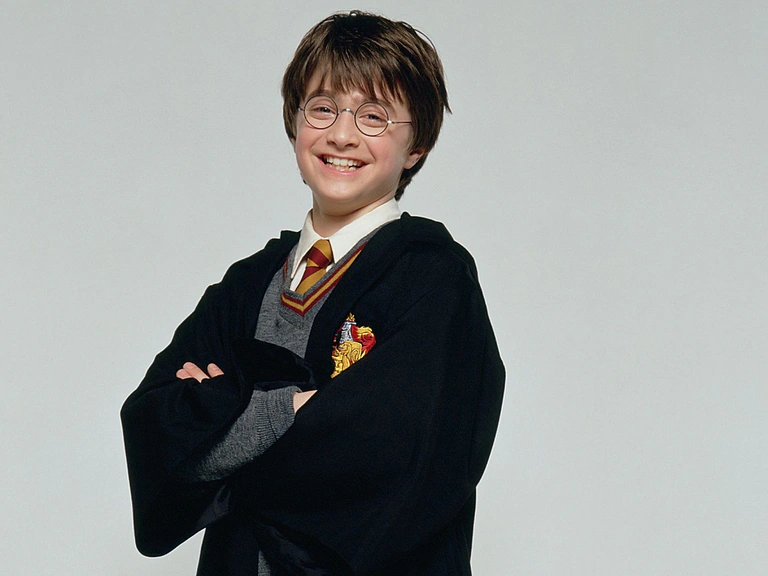
The first recorded Basilisk was bred by Herpo the Foul, a Greek Dark wizard and Parselmouth, who discovered after much experimentation that a chicken egg hatched beneath a toad would produce a gigantic serpent possessed of extraordinarily dangerous powers.
Dark wizard Herpo the Foul, while in Ancient Greece, was the first to breed a Basilisk. He accomplished this by hatching a chicken egg beneath a toad, which resulted in the creature known as a Basilisk. Herpo was able to control Basilisks due to the fact that he was a Parselmouth and thereby could speak snake language.

Basilisk breeding was banned in Medieval times. The British Ministry of Magic had said that all chicken coops in the wizarding world were subject to police inspection in order to thwart Basilisk breeding. However, the ban was quite easy to evade by simply removing the egg from underneath the toad whenever the Department for the Regulation and Control of Magical Creatures came to check. A more natural and effective limit on breeding was the simple fact that the creatures were uncontrollable except by Parselmouths, and therefore every bit as dangerous to normal Dark wizards as to other wizards and Muggles. For this reason, the serpents remained mercifully rare; in fact, until the incident in 1943 described below, there had been no confirmed reports of Basilisks in Britain since the 16th century. Affpuddle of the Cheerful Countenance, a medieval knight, died from trying to befriend a Basilisk.
Salazar Slytherin, one of the founders of Hogwarts School of Witchcraft and Wizardry, was responsible for the construction of the Chamber of Secrets beneath the school's dungeons. It was specifically created for the purpose of purging the school of all Muggle-born students. The Chamber contained a Basilisk, the Serpent of Slytherin, which could only be controlled by his own true heir and used to rid the school of all those he considered to be unworthy of studying magic.
In the late 19th century, a Cornish wizard was suspected of Basilisk breeding by the Wizengamot, after inspectors from the Department for the Regulation and Control of Magical Creatures found toad infestations in all five of his chicken coops. He was later tried by the Wizengamot for this.
In the 1942–1943 school year, when Slytherin's heir Tom Marvolo Riddle opened the Chamber of Secrets, he used the Serpent of Slytherin to attack Muggle-borns, causing the death of Myrtle Warren. In the 1992–1993 school year, Riddle opened the Chamber again, through the use of one of his seven Horcruxes. Using the bit of his soul encompassed by the diary, he took partial control of Ginny Weasley. While she was entirely unaware, he forced her to do his bidding, which included writing frightening messages on the walls and strangling the school's roosters. During this second opening of the Chamber, numerous Muggle-borns were Petrified. They were petrified due to catching a glimpse of the Basilisk's reflection.
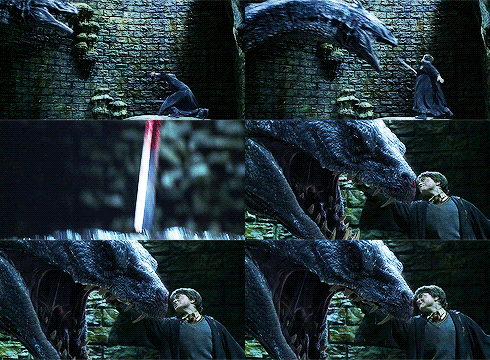
Riddle's ultimate goal was to lure Harry Potter into the Chamber and kill him. Harry Potter ultimately slayed Slytherin's Basilisk by stabbing it through the roof of the mouth with the Sword of Gryffindor. The sword came out of the Sorting Hat, which had magically appeared in front of him. The hat was originally delivered to him by Fawkes, Dumbledore's phoenix. The sword was then impregnated with Basilisk venom.
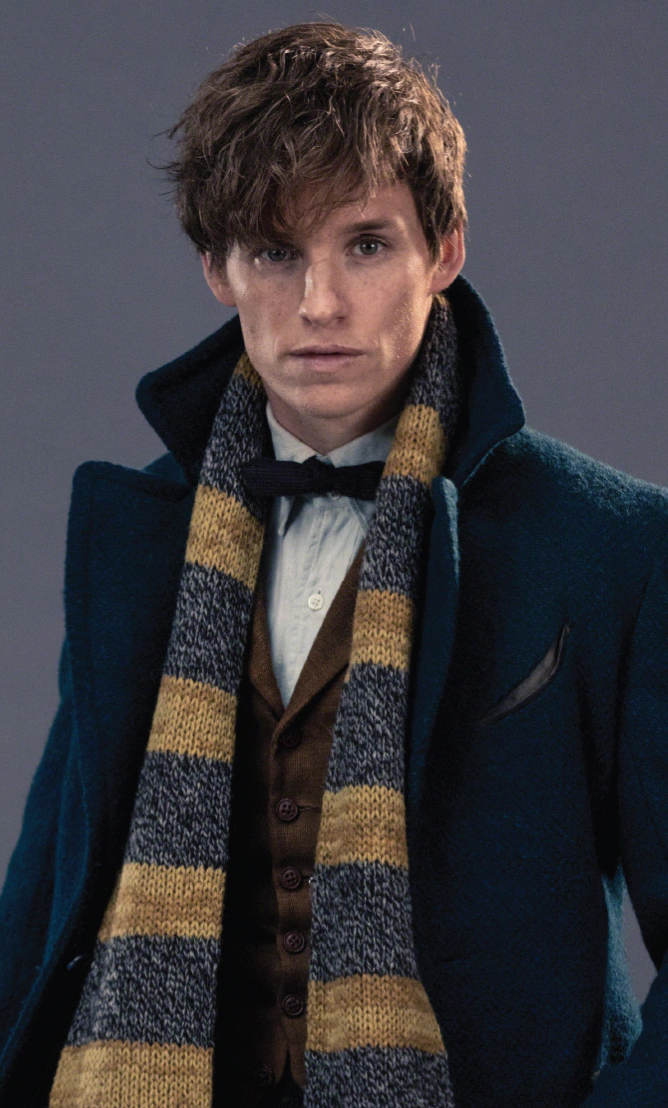
Newt Scamander stated in the fifty-second edition of Fantastic Beasts and Where to Find Them that there had been no recorded sightings of Basilisks in Britain for the last 400 years. Harry Potter wrote in his copy of the book "that's what you think".
According to Igor Karkaroff, Alastor Moody had smashed apart a birthday present that he thought in paranoia was a cleverly disguised Basilisk egg before finding out it was a mere carriage clock.
The skeleton of Slytherin's Basilisk laid within the Chamber today and was over 20 feet long. During the opening stages of the Battle of Hogwarts, Hermione Granger and Ron Weasley went down into the Chamber to fetch Basilisk fangs in order to be rid of Voldemort's remaining Horcruxes. They had to resort to the fangs after losing their earlier means of destroying Horcruxes.
Sources
Adapted from the original article, under CC BY-SA 3.0.