Lore
Astronomy (class)
Astronomy was a subject and core class and taught at Hogwarts School of…
They had to study the night skies through their telescopes every Wednesday at midnight and learn the names of different stars and the movement of planets.
Astronomy was a subject and core class and taught at Hogwarts School of Witchcraft and Wizardry and Uagadou. Astronomy was the branch of magic and science that studied stars and the movement of planets. Students would also use their wands with an Orrery to predict the next eclipse, the only known practical form of magic used in the class.
Uagadou students were known to be skilled in astronomy, implying the teaching that was provided at Uagadou was excellent.
Class information
It is increasingly rare to find a student who seeks after things celestial (of their own accord), but if you truly desire to chart the courses of the cosmos, you must rid your mind of the terrestrial babble of others. We ourselves are like blank star-charts, you know? Empty canvases waiting to be inscribed with all that the universe has to offer.
Astronomy lessons were spent observing the night skies with telescopes, as well as gaining an understanding of the various phenomena that go on in space, such as Lunar phases and Space weather. Known assignments included learning the names of stars, constellations and planets, as well as charting their locations, movements, and environments. It was a required class from year one until year five, and became an optional subject for the final two years.

Astronomy was not to be confused with the divination practice of astrology. One was concerned with mysteries stellar and lunar, the other was referred to as "mere lunacy".
It is currently unclear exactly how this subject was relevant to the education of witches and wizards, but according to Professor Shah, there was much that could be gleaned from the stars. She believed that people were like blank star charts, empty canvasses waiting to be inscribed by all that the universe had to offer. Professor Shah found it increasingly rare to find a student who sought after things celestial (of their own accord). Although, some students, like Amit Thakkar, were fascinated by the concept of infinity and limitless potential, as there was always something new being discovered in space.
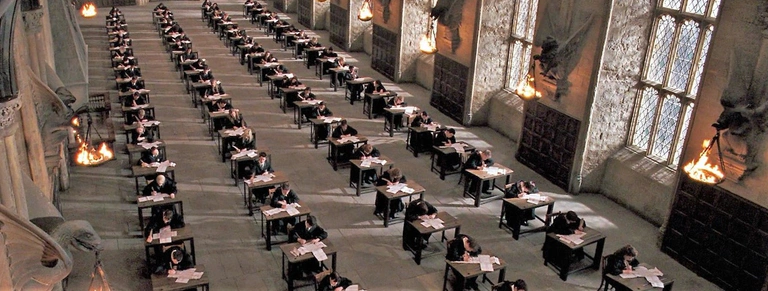
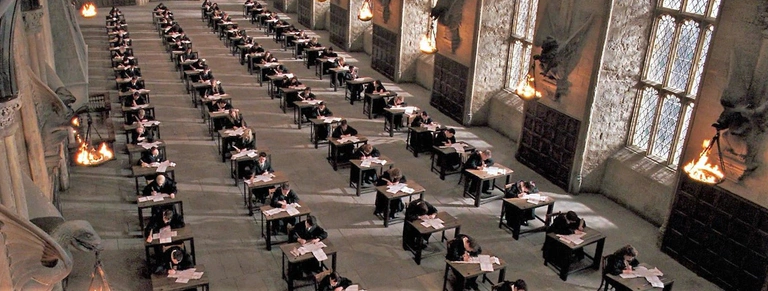
In the fifth year, the Ordinary Wizarding Level examinations were taken. During the exam, students had to fill in a blank star chart.
Wiseacre's Wizarding Equipment in Diagon Alley sold telescopes and other equipment needed for Astronomy. Aurora Sinistra was the Astronomy professor at Hogwarts during Harry Potter's time as a student. She was also teaching during Jacob's sibling's time at Hogwarts.
Classrooms
Astronomy classes took place in the highest level of the Astronomy Tower, the tallest tower in Hogwarts Castle and included sky observation sessions with telescopes (each student had to buy one of their own).

Lesson times
Year Day Period - First Wednesday midnight - Fifth evening
First year
During the first year of studies at Hogwarts, students studied the night skies through their telescopes every Wednesday at midnight and learn the different names of the stars and the movements of the planets. Towards the end of the 1991–1992 school year, Hermione Granger was quizzing Ron on Astronomy for preparation for their first year exams. Their studying included using a map of Jupiter. It was noted that the studies on Jupiter continued into later years, when Harry tried to learn the names of Jupiter's moons in his fifth year of study at Hogwarts.
Third year
In the 1993–1994 school year, one of the homework assignments included drawing a star chart which probably meant they studied stars that year, and they took a midnight exam at the end of the year.
Fifth year

Harry, yours is okay except for this bit at the end, I think you must have misheard Professor Sinistra. Europa's covered in ice, not mice.
1890–1891 school year
Constellations
1995–1996 school year
Hogwarts students studied Jupiter's moons and wrote an essay for their homework containing facts such as Europa being covered by ice and Io having many volcanoes. They filled in blank star charts and the homework during this year became intensive enough that some students had to organise a meeting to help each other get through it.
For the Astronomy O.W.L. exam in their fifth year, the written exam contained a section on Jupiter. In 1996, it was held on Wednesday morning. The practical exam took place in the evening at eleven o'clock, and each student had to "fill in a blank star chart" based on a few hours of observing the night sky.
When Harry Potter was taking the Astronomy O.W.L. in 1996, Rubeus Hagrid was confronted by Dolores Umbridge and a team of corrupt Aurors in what was an attempted sacking, which was also the night that Minerva McGonagall took "no less than four Stunners to the chest."
Sixth year
Sixth-year students studied multiple topics, including:
• Constellations, including Cetus
• Lunar phases
• Star charts
• Cosmic ages
• Space weather
• Meteor showers
Seventh year
Seventh-year students studied multiple topics, including:
• Dark cloud constellations
• Rogue planets
• Dark energy and dark matter
• Black holes and wormholes
• Jupiter's moons
Passing grades
Outstanding [O]
Acceptable [A]
Fail grades
Troll [T]
• Poor [P]
• Dreadful [D]
Sources
Adapted from the original article, under CC BY-SA 3.0.