Lore
Unforgivable Curses
The Unforgivable Curses were three of the most powerful and sinister spells…

Now... those three curses — Avada Kedavra, Imperius, and Cruciatus — are known as the Unforgivable Curses. The use of any one of them on a fellow human being is enough to earn a life sentence in Azkaban. That's what you're up against. That's what I've got to teach you to fight. You need preparing. You need arming. But most of all, you need to practise constant, never-ceasing vigilance. Get out your quills... copy this down....
The Unforgivable Curses were three of the most powerful and sinister spells known to the wizarding world, as well as the strongest known Dark spells in existence. They were tools of the Dark Arts and were first classified as "Unforgivable" in 1717, with the strictest penalties attached to their use. The three infamous curses consisted of the Killing Curse (Avada Kedavra), the Cruciatus Curse (Crucio), and the Imperius Curse (Imperio).
By the 1990s, using any of these three curses on a fellow human being—Muggle or wizard—would result in a life sentence in Azkaban without parole, unless there was sufficient evidence that the caster did so under the influence of the Imperius Curse. Many Dark wizards attempted to use this excuse to prevent themselves from incarceration when caught, particularly after the First Wizarding War. The Unforgivable Curses Appeals was a section of the Ministry designed for this purpose. Exceptions do apply, as Solomon Sallow, in his capacity as an Auror, used one on a Dark wizard, without receiving any legal repercussion aside from retiring on bad terms with the Ministry.
Aurors were permitted to use them during the First Wizarding War, and during the height of the Second Wizarding War under Lord Voldemort's regime, the curses were made legal, though this had been repealed following Voldemort's demise.
Performance
Avada Kedavra's a curse that needs a powerful bit of magic behind it — you could all get your wands out and point them at me and say the words, and I doubt I'd get so much as a nosebleed.
Since the Unforgivable Curses were very powerful, their use required both great willpower and great skill in order to bring about the effects. One must also had to possess a deep desire to use the curses for malevolent purposes and take great pleasure in their victims' sufferings. For example, Harry Potter was unable to effectively cast the Cruciatus Curse on Bellatrix Lestrange in 1996; despite being furious with her for her murder of his godfather, he lacked the desire to actually cause the intense, drawn-out pain for its own sake, and Harry's "righteous anger" only inflicted a brief moment of pain on her, though it did knock her off her feet.
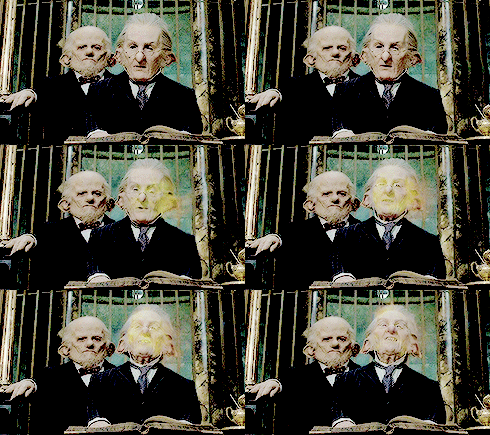
Shortly before the Battle of Hogwarts, Harry not only successfully used the Cruciatus Curse against Amycus Carrow, he also cast the Imperius Curse against two individuals during the Gringotts heist which allowed himself, Ron, and Hermione to get inside the Lestrange Vault undetected. Soon after being tortured by Harry, Amycus Carrow was also subject to an Imperius Curse cast by Minerva McGonagall. Perhaps because the curses were cast during a period when the ban on their use had been lifted, there was no indication of either Harry or McGonagall being punished for using them in these legalised circumstances.
Killing Curse (Avada Kedavra)

So that was how his parents had died... exactly like that spider. Had they been unblemished and unmarked too? Had they simply seen the flash of green light and heard the rush of speeding death, before life was wiped from their bodies?
Description: Killed the victim instantaneously and painlessly.
The incantation of Avada Kedavra caused a blindingly intense green bolt of light to shoot from the end of the caster's wand, followed by a distinctive rushing sound, which, on contact with the victim, resulted in instant death. There were no secondary effects; the victim simply "drops dead" for no biological reason. It is possible that the victim's internal organs immediately and completely ceased function. However, it seemed to be more likely that the method of killing was due to the soul of the victim being magically ripped from their body.
Evidence for this came from the testimony of perhaps its most prolific caster, Lord Voldemort. Having experienced the lethal effects of a rebounded Killing Curse but surviving due to his creation of multiple Horcruxes, Voldemort described the sensation of being struck by it as having his consciousness torn from his body, accompanied by a sensation which he described as being "pain beyond pain". Muggle coroners were quite unable to figure out a possible cause of one's death in such an attack, but the British Ministry of Magic coroners at once recognised the "signs" of the curse.
The Killing Curse had no counter-curse and could not be blocked by most magical means. However, the green energy bolt could be dodged, blocked with solid objects or intercepted with a few other powerful fast spells, particularly the Stunning Spell. For instance, Albus Dumbledore enchanted a statue from the Fountain of Magical Brethren to shield Harry Potter from Voldemort's Killing Curse during the Battle of the Department of Mysteries. If the curse missed the victim and struck an inanimate object instead, it could cause a large greenish explosion at the point of impact results, which could start a fire. However, the curse might also ricochet off the object in question.

The Killing Curse was used regularly by Lord Voldemort, possibly by far more than any other spell, and his Death Eaters used it as well. The spell was performed verbally as a rule; Bellatrix Lestrange killed a fox with the curse nonverbally after Apparating with Narcissa Malfoy at Spinner's End, thinking that it was a lurking Auror.
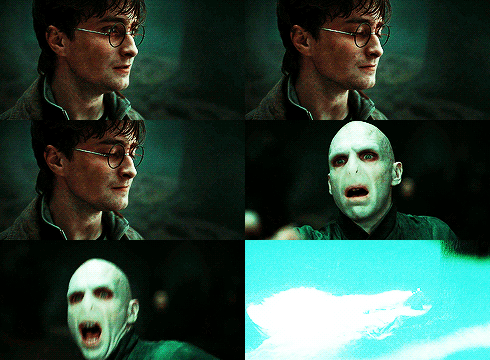
Only two people had ever been able to survive the effects of this curse: Harry Potter, who was given magical protection against Lord Voldemort's use of the curse through his mother's loving sacrifice, and Voldemort himself due to his Horcruxes, which each had part of himself in them. Harry used the Disarming Charm and was additionally aided and saved by the effects of Priori Incantatem when his and Voldemort's wands locked during a duel in 1995 because of their wands' twin cores. When Voldemort struck him with a Killing Curse again in 1998, Harry was able to survive once again because Voldemort had taken some of Lily Potter's protection of Harry into his own body by using Harry's blood in his rebirth ritual in 1995. This process somehow tethered Harry to life so long as Voldemort himself was alive.
In 1996, Fawkes sacrificed himself by swallowing a Killing Curse that Voldemort aimed at Dumbledore. It killed him as it would anything living, but in a typical display of a phoenix's response to death, he burst into flames and was immediately reborn from his own ashes, as phoenixes are immortal.
Lord Voldemort murdered many people with this curse: victims include his father, his grandfather, his grandmother, James Potter, Lily Potter, Charity Burbage, Frank Bryce, Gellert Grindelwald, Bertha Jorkins, a German-speaking Muggle family of three, and countless more. It is known that he killed enough people to create an army of Inferi.
Cruciatus Curse (Crucio)
Harry shouted, "Crucio!". The Death Eater was lifted off his feet. He writhed through the air like a drowning man, thrashing and howling in pain, and then, with a crunch and a shattering of glass, he smashed into the front of a bookcase and crumpled, insensible, to the floor.
Description: Tortured the victim by subjecting them to excruciating pain.
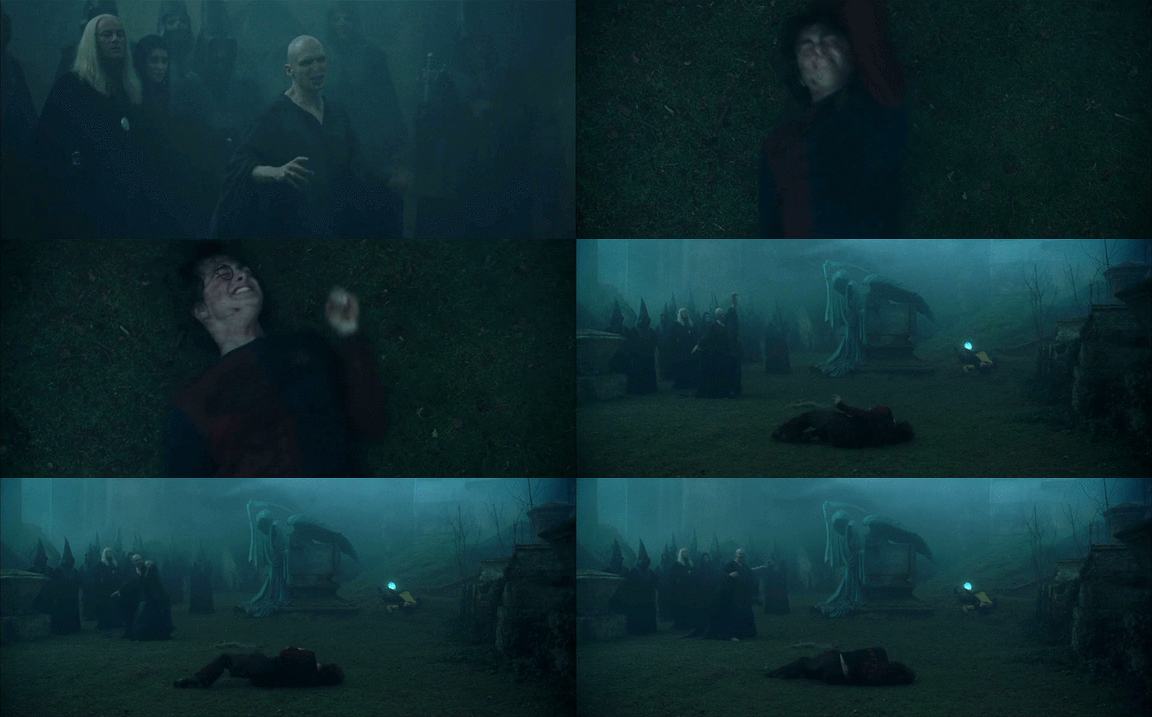
The Cruciatus Curse, which inflicted intense, excruciating physical pain upon the victim, required the verbal incantation and the use of a wand. The effects of the curse depended upon the desires and emotions of the character—to produce the excruciating pain implied by the name, the caster must, according to accomplished caster Bellatrix Lestrange, feel a true desire and enjoy causing pain and take great pleasure in their victims' suffering. The extreme pain inflicted by the curse made it uniquely suited as a form of torture, and was used regularly by the Death Eaters.
When Harry Potter was made the victim of the curse in June 1995, he described it as feeling like his head was being split open while having his bones set on fire as well as white-hot knives boring into every inch of his skin. However, since this was the only time Harry was known to have been inflicted with the Curse, and as no one else had ever given a description of its effects, it is unknown if this was how the curse always felt.
The prolonged exposure to the Cruciatus Curse caused Alice and Frank Longbottom such suffering that they were admitted to the permanent ward at St Mungo's Hospital for Magical Maladies and Injuries as extreme cases of insanity. This was carried out by: Barty Crouch Jnr, Bellatrix Lestrange, Rodolphus Lestrange, and Rabastan Lestrange. This act was considered one of the most depraved crimes of all time, in terms of damage to the victim and the sadism of their attackers.
Imperius Curse (Imperio)
Look at that, you lot... Potter fought! He fought it, and he damn near beat it! We'll try that again, Potter, and the rest of you, pay attention — watch his eyes, that's where you see it — very good, Potter, very good indeed! They'll have trouble controlling you!
Description: Caused the victim to become unquestioningly obedient to the caster.

The Imperius Curse placed the victim in a calm, trance-like (or dreamlike) state, an experience described as a "wonderful release" from any sense of responsibility or anxiety, making the victim under its power profoundly and unquestionably obedient to all the commands of the caster, whose hold on their free will was deeply rooted in part by the victim's unwillingness to impart with the comfortable sensation and in part by their newfound lack of (and thus indifference to) the moral perspective of the caster's desires, making the victim inclined to carry out whatever task thrust upon them for no other reason than that they failed to see why they should not do so, leaving him or her largely under the complete control of the caster.
The victim was calm and they obeyed any order the caster gave them without a second thought; whether they were order to do things they would be physically or mentally incapable of otherwise, or even if they were ordered to commit horrible crimes. It was also seen that the curse worked on animals, as Barty Crouch Jnr cast the Imperius Curse on a spider during class when disguised as Alastor Moody.
Death Eaters often made use of this curse; for instance, Lucius Malfoy forcing Broderick Bode and Sturgis Podmore to try to steal a prophecy from the Department of Mysteries and to place several officials under their control to facilitate their take-over of the British Ministry of Magic and overthrow Minister Rufus Scrimgeour in 1997. Many Death Eaters also lied about being under the Imperius Curse during the First Wizarding War just to avoid imprisonment in Azkaban.
Resisting the Imperius Curse was possible, but extremely difficult. Only those of a particularly strong will could achieve it. Harry Potter, Barty Crouch Snr, and Barty Crouch Jnr each learned to resist the curse after being subjected to its effects. Harry Potter in particular appeared to be extraordinarily great at this, as he was able to partially resist the curse from the very first time it was ever cast upon him, and he was later able to completely resist it when it was cast upon him by Voldemort himself.
Early history

The Cruciatus, Imperius, and Killing Curses were first classified as Unforgivable in 1717, with the strictest penalties attached to their use.
These three curses were invented at an unknown point in the Middle Ages. Salazar Slytherin wrote about them in his spellbook, as he believed that students should be taught to use them, as they weren't considered "Unforgivable" in his time. They had been classified as "Unforgivable" in wizarding society since 1717, according to Albus Dumbledore.
First Wizarding War
During the First Wizarding War the Death Eaters made frequent use of these curses and in an effort to even things out, the Ministry of Magic gave Aurors special permission to use them as well.

After the First Wizarding War ended with the disappearance of Lord Voldemort, Alice and Frank Longbottom were tortured into insanity with the Cruciatus Curse by four Death Eaters. This crime was considered by many to be one of the most horrific crimes in living memory. The victims never recovered and spent the rest of their lives in the Janus Thickey Ward for irrevocable spell damage at St Mungo's Hospital for Magical Maladies and Injuries.
Between the wars
Moody began to beckon students forward in turn and put the Imperius Curse upon them. Harry watched as, one by one, his classmates did the most extraordinary things under its influence. Dean Thomas hopped three times around the room, singing the national anthem. Lavender Brown imitated a squirrel. Neville performed a series of quite astonishing gymnastics he would certainly not have been capable of in his normal state.
During the 1988–1989 school year at Hogwarts School of Witchcraft and Wizardry, the Defence Against the Dark Arts Professor Patricia Rakepick wished to demonstrate the Unforgivable Curses to Jacob's sibling, after their friend Rowan Khanna had been subjected to the Imperius Curse. In a trip in Knockturn Alley, she demonstrated the Cruciatus Curse on a Dark wizard, much to the student's shock and horror.
Later that school year, Rakepick tortured Merula Snyde sadistically with the Cruciatus Curse in the Buried Vault, and in the next school year, she murdered Rowan Khanna with the Killing Curse in the Forbidden Forest whilst aiming for Ben Copper during a duel. As revenge, Merula Snyde attempted to use the Cruciatus Curse on Rakepick in the Sunken Vault, but was unsuccessful as Rakepick moved her away with Mobilicorpus before she could finish the incantation.
In the 1990–1991 school year, the Japanese Dark wizard Kazuhiro Shiratori was found guilty of having used the Unforgivable Curses in the conclusion of his Wizengamot trial, along with other crimes, and was sentenced to life imprisonment in Azkaban.

When disguised as Alastor Moody using Polyjuice Potion during the 1994–1995 school year, Barty Crouch Jnr performed each Unforgivable Curse on a spider in front of his fourth-year Defence Against the Dark Arts class in 1994. He told his class that the penalty for using an Unforgivable Curse on another human being was life imprisonment in Azkaban. He also told the class that they were not supposed to be shown what the curses did until their sixth year. He later bewitched several of his students with the Imperius Curse, to teach them how to resist the effects of the curse, with only Harry Potter being successful.
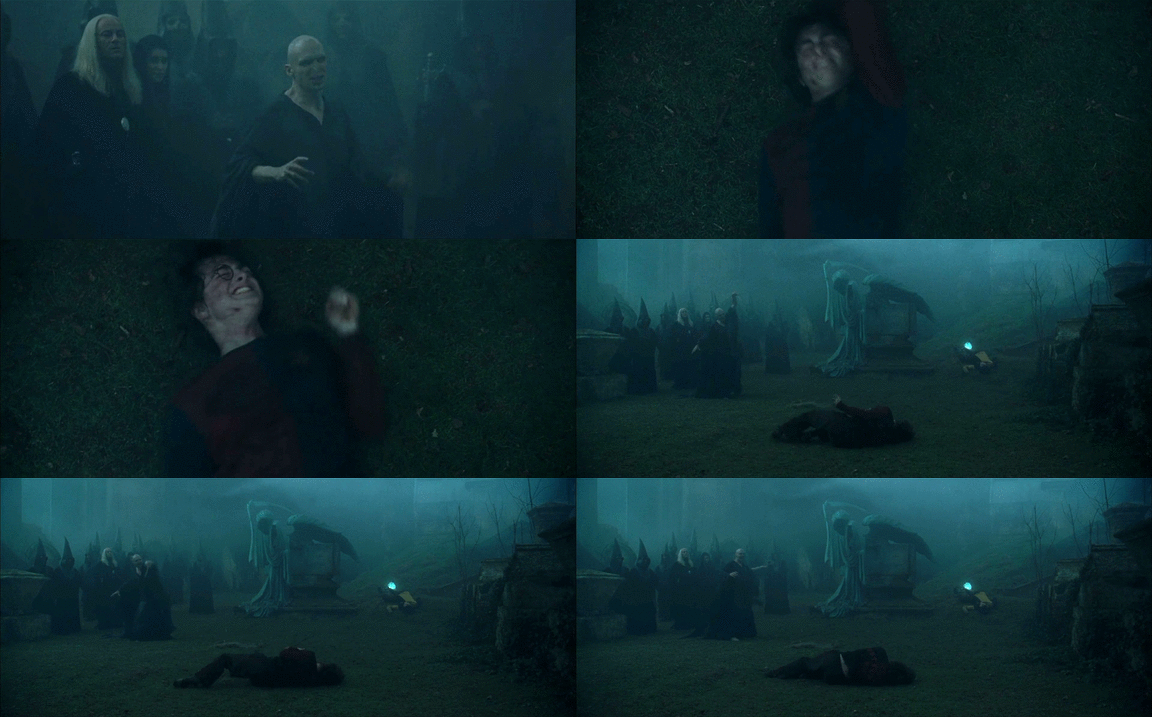
On 24 June 1995, Harry Potter was subjected to the Cruciatus Curse twice and the Imperius Curse once by Lord Voldemort in the Little Hangleton graveyard; he was able to resist the latter, ironically thanks to Barty Crouch Jnr's teaching.
Second Wizarding War

Never used an Unforgivable Curse before, have you, boy? You need to mean them, Potter! You need to really want to cause pain — to enjoy it — righteous anger won't hurt me for long — I'll show you how it is done, shall I?
During the Battle of the Department of Mysteries, Harry tried to use the Cruciatus Curse on Bellatrix Lestrange as a means of vengeance for killing Sirius Black, but it was ineffective, because he was doing so out of "righteous anger". She taunted Harry that he needed to really love and "enjoy" causing pain in order for it to actually work, as he learned later when he successfully used the Cruciatus Curse on Amycus Carrow before the Battle of Hogwarts on 1 May 1998, completely incapacitating him (i.e. "Amycus was thrown into the air, thrashing and screaming in pain, and then knocked unconscious").

Snape killed Dumbledore using the Killing Curse on the top of the Astronomy Tower. Also during the Battle of the Astronomy Tower, Thorfinn Rowle was recklessly firing off Killing Curses left and right, one of which accidentally killed fellow Death Eater Gibbon. Throughout the 1996–1997 school year, Draco Malfoy used the Imperius Curse on both Katie Bell and Rosmerta, and unsuccessfully attempted to torture Harry with the Cruciatus Curse, as he was severely injured by the Sectumsempra curse casted by Harry.
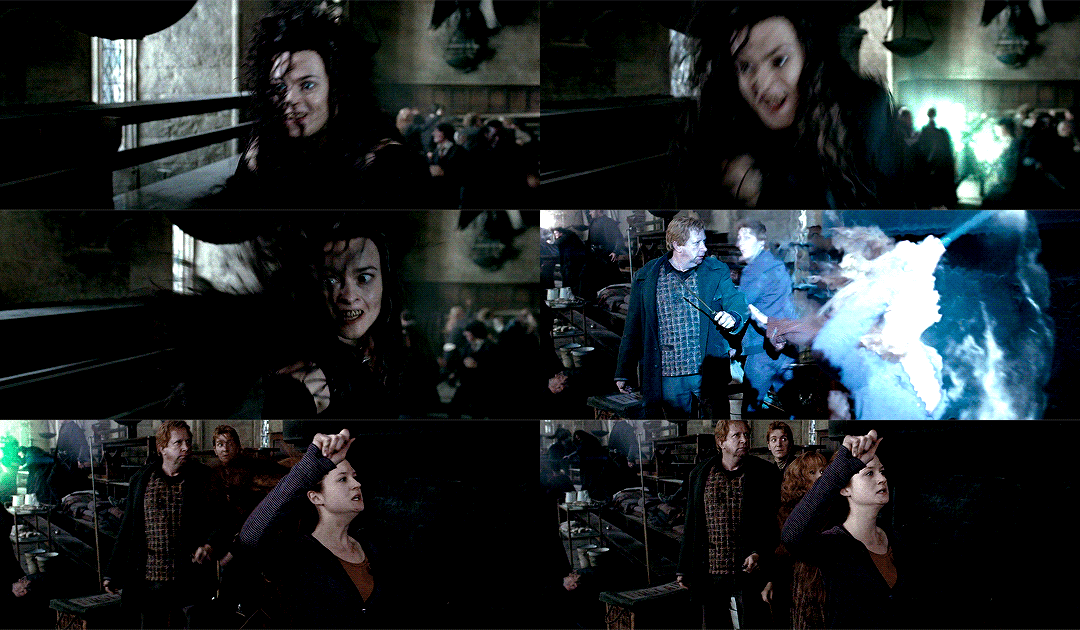
Bellatrix Lestrange brutally tortured Hermione Granger with the Cruciatus Curse at Malfoy Manor and Harry used the Imperius Curse numerous times during the Trio's 1998 Gringotts break-in. In the same year during the Battle of Hogwarts, Voldemort attempted to murder Harry with the Killing Curse twice, once in the Forbidden Forest and the other during their final duel in the Great Hall. Also during this battle Bellatrix almost hit Ginny Weasley with the Killing Curse, missing by a several inches, but because of Harry's sacrifice and Ginny's ability to relatively easy dodge opponents' spells, it would not have most likely harmed her.
During the Second Wizarding War the Unforgivable Curses were made legal by Lord Voldemort, after he and his Death Eaters successfully infiltrated and usurped the British Ministry of Magic. After the war ended, this was abolished by Kingsley Shacklebolt, when he became the new Minister for Magic.
Sources
Adapted from the original article, under CC BY-SA 3.0.