Lore
Laceration Curse
The Laceration Curse (Sectumsempra) was a curse invented by Severus Snape that…
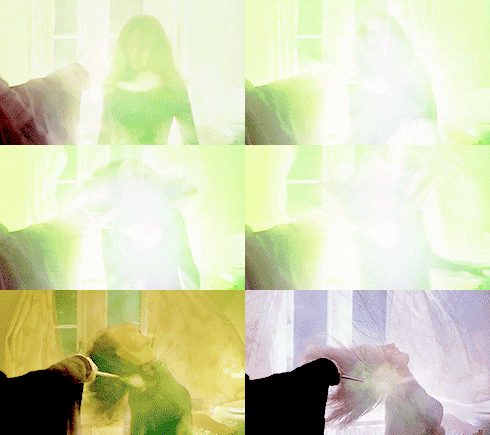
Blood spurted from Malfoy's face and chest as though he had been slashed with an invisible sword. He staggered backward and collapsed onto the waterlogged floor with a great splash, his wand falling from his limp right hand. Slipping and staggering, Harry got to his feet and plunged toward Malfoy, whose face was now shining scarlet, his white hands scrabbling at his blood-soaked chest.
The Laceration Curse (Sectumsempra) was a curse invented by Severus Snape that lacerated the target and caused severe bleeding. Snape created it as a student of Hogwarts, and contrary to other spells he created for usage against opponents in duels, like Langlock and the Dangling Jinx, he explicitly marked for usage against enemies. It was one of his signature spells.
Creation

You dare use my own spells against me, Potter? It was I who invented them — I, the Half-Blood Prince!
The Laceration Curse was invented by Severus Snape during his time as a student at Hogwarts, when he was known as "The Half-Blood Prince". At the time he created various spells, some of which were general purpose, such as Muffliato, and some of which to use against opponents in magical fights, such as Langlock and the Dangling Jinx, but Sectumsempra was one that was specifically demarcated as being for use against enemies. According to Remus Lupin it was one of his signature spells.

It is unknown the exact date Severus Snape invented the curse, though it was written in his N.E.W.T.-level Potions textbook. Snape had extensive knowledge of curses since before attending Hogwarts, according to Sirius Black, Snape "knew more curses when he arrived at school than half the kids in seventh year."
1996–1997 school year
Many years later, in the 1996–1997 school year, Harry Potter came into the possession of Snape's textbook and learned the incantation. Knowing nothing more than that it was "for enemies" and believing that the "Half-Blood Prince" (Snape's nickname signed into the book) merely copied it as a note of reference, Harry became interested in trying it. He expected humorous effects, as he had found with Levicorpus and other spells in the book.

Harry initially considered using it against Cormac McLaggen for annoying him, though it was not until he confronted Draco Malfoy in the sixth-floor boys' bathroom that he tested it, seriously wounding Malfoy. Snape intervened to heal Draco, and having realised that Harry got a hold of his old textbook, he punished Harry with a multitude of detentions. Hermione Granger later believed that the reason why Snape did not expose Harry's source of the curse despite knowing where it came from was due to fear of being exposed as the one who invented it, hence his relatively lenient punishment for Harry.
Despite disliking Malfoy, Harry did not want to harm him to such an extent, and was both horrified and guilt-ridden for using the curse against him, while reprimanding the Prince within his mind for adding such a deadly spell into his notes. Professor McGonagall considered Harry to be very lucky not to have been expelled for such an act and wholeheartedly supported the detentions, while Pansy Parkinson wasted no time in vilifying Harry far and wide; Ginny Weasley, however, stood up for Harry's usage of the curse, as it saved him from being struck by Malfoy's Cruciatus Curse.
During Harry and Dumbledore's hunt for a Horcrux, Harry accidentally attracted the attention of an army of Inferi inside The Cave. In an attempt to stop them, one spell Harry used was the Laceration Curse, but it merely slashed their unfeeling flesh and did not seriously impede their approach. Later that night, after Snape killed Dumbledore, Harry attempted to use the Laceration Curse against him multiple times, only for Snape to block it repeatedly and angrily reveal to Harry that he was its inventor.
1997–1998 school year
The next year, during the Battle of the Seven Potters, Snape attempted to use the Laceration Curse to sever the hand of a fellow Death Eater, but due to a slip, he accidentally cut off George Weasley's left ear instead, leaving him guilt-ridden.

The Order of the Phoenix was not able to regrow the ear, as curse wounds (especially those in the nature of the Dark Arts), were unable to be healed, and the counter curse was unknown. Due to the nature of the events at the time, the Order believed Snape acted on ill-intent, and their grudge against him intensified, until Snape revealed his misfiring, posthumously, via his memory to Harry.
Nature
Apparently I underestimated you, Potter. Who would have thought you knew such Dark Magic? Who taught you that spell?
A rather dangerous curse, when the incantation was uttered, its effect was the equivalent of an invisible sword; it was used to slash the victim from a distance, and resulted in deep wounds. The slash followed the user's wand movements. Its creator himself, Severus Snape, noted its extreme ominous nature, feigning both surprise and ignorance that Harry, whom he regularly belittles, would even know of this particular curse to actually cast it for the first time ever while in the heat of the moment. Due to the depths of the cut, victims of this curse ran the risk of dying from blood loss if treatment was not applied in time, and if the wounds were not instantly fatal.
Limitations
The curse's effects followed the path of the caster's wand movements, hence if the user slips in their movement, it could either miss or cause an unintended target to be struck, as in the case of the aforementioned incident when Snape accidentally cut off George Weasley's left ear due to a slip in his firing.
While the curse could inflict damage on undead puppets, like Inferi, such targets had long since lost all sensation and blood when they died, and would have therefore had no reaction to pain and injuries, ultimately rendering the curse pointless against them.
Counter and treatment
Minor wounds inflicted by this curse can be cured by the song-like incantation Vulnera Sanentur; the first usage eased the blood flow, the second caused the wounds to knit and the third removed the worst effects of the curse. The victim would still require medical treatment, and if dittany was applied quickly enough, scarring could still be prevented.

Though the aforementioned healing spell may have healed the wounds and essence of dittany may have prevented scars, any body parts that had been severed by this curse could not be grown back (a trait of dark magic's permanent effects), as demonstrated by George Weasley when he lost his left ear to the spell.
Known uses
Caster(s) Victim(s) Note - Severus Snape George Weasley 27 July 1997 Harry Potter and the Deathly Hallows - Harry Potter Draco Malfoy Early May 1997 Harry Potter and the Half-Blood Prince - Inferi 29 June 1997 Used it against an army of Inferi that guarded the Cave, though they were unimpeded as they no longer feel pain or blood loss.
Unsuccessful
Caster(s) Victim(s) Note - Harry Potter Severus Snape 29 June 1997 Harry Potter and the Half-Blood Prince
Sources
Adapted from the original article, under CC BY-SA 3.0.