Lore
Patronus Charm
Most famous and one of the most powerful defensive charms known to wizardkind
This ancient and mysterious charm conjures a magical guardian, a projection of all your most positive feelings. The Patronus Charm is difficult, and many witches and wizards are unable to produce a full, corporeal Patronus, a guardian which generally takes the shape of the animal with whom they share the deepest affinity. You may suspect, but you will never truly know what form your Patronus will take until you succeed in conjuring it.
The Patronus Charm (Expecto Patronum) was the most famous and one of the most powerful defensive charms known to wizardkind. It was an immensely complicated and extremely difficult spell that channelled the caster's positive emotions into a powerful protection. When cast properly, it evoked a partially-tangible positive energy force known as a Patronus (pl. Patronuses) or spirit guardian. It was the primary protection against Dementors and Lethifolds, against which there were no other defences.
There were two types of Patronuses: the incorporeal variant, which took the form of a shapeless wave of mist, and the corporeal variant, which had a definite shape, taking on the form of the animal that the caster had the greatest affinity for. The incorporeal Patronus was weaker than its corporeal counterpart, but the corporeal Patronus was more advanced and difficult.
Some wizards like Remus Lupin chose to cast incorporeal Patronuses, even if they were capable of a more powerful corporeal Patronus, as a way to prevent the Patronus animal from revealing their identity.
Early history
It is evident from old woodcuts and scrolls that the Patronus Charm had been used since ancient times. Therefore, it is unknown who created it, or when it was first invented. However, use of the charm is attested in Greek antiquity, as ancient Greek wizard Andros the Invincible became famous for being able to summon a Patronus the size of a giant. The charm also has a long association with those fighting for lofty or noble causes (those able to produce corporeal Patronuses were often elected to high office within the Wizengamot and Ministry of Magic).
According to legend, one of the most famous Patronuses of all time was a lowly mouse, which belonged to a young wizard called Illyius. Illyius cast the Patronus Charm when his village was being attacked by the Dark wizard Raczidian and his army of Dementors. Despite the mouse's diminutive size, it shone with a brilliant light, bringing the Dementors to a halt as it nimbly moved through the ranks of fleeing villagers. Enraged, Raczidian decided to enter the fray himself. He tried to summon a Patronus to ward off Illyius's mouse.
However, Raczidian failed to remember that only the pure of heart could produce a Patronus. Thus, for the first time in history, it was revealed what happened when a competent, but unworthy wizard or witch attempted the spell. Maggots shot out of Raczidian's wand and quickly devoured him as they engulfed his entire body. The villagers then hailed Illyius as a hero.
Second Wizarding War
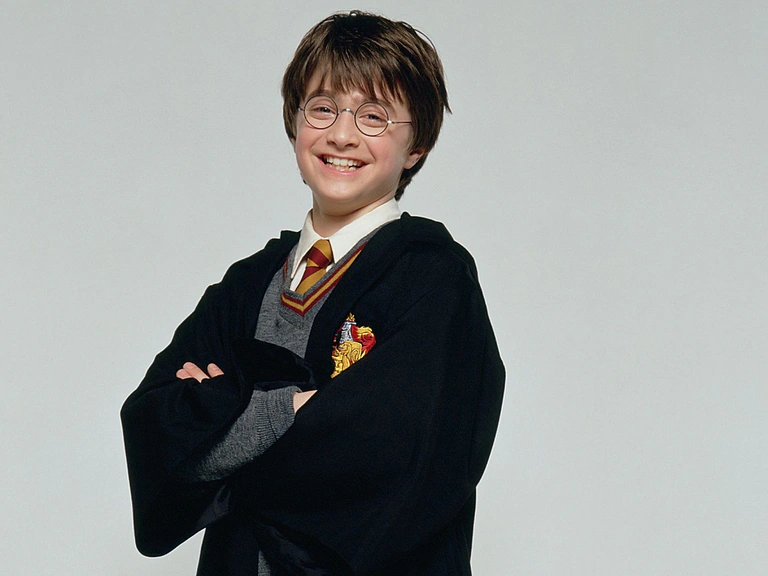
And out of the end of his wand burst, not a shapeless cloud of mist, but a blinding, dazzling, silver animal. He screwed up his eyes, trying to see what it was. It looked like a horse. It was galloping silently away from him, across the black surface of the lake. He saw it lower its head and charge at the swarming dementors...
Harry Potter took Anti-Dementor lessons with Remus Lupin in order to learn the advanced charm and was one of the youngest to attempt this charm with actual results. During a Quidditch match against Ravenclaw in 1994, he cast his very first corporeal Patronus, when several Slytherin students were impersonating Dementors. He performed the charm again in June when he, along with Hermione Granger and Sirius Black, were being attacked by over a hundred Dementors, and cast a corporeal Patronus powerful enough to drive them all away.

On 24 June 1995, Harry cast the charm against a Boggart that he thought was a Dementor during the third task of the Triwizard Tournament, in the Triwizard Maze. The following summer, he and Dudley Dursley came under attack by two Dementors in Little Whinging, and Harry managed to drive them away with the charm, leading to him being put on trial for underage magic in an attempt to discredit him.
Harry also taught the members of Dumbledore's Army the charm, some of whom were successful in casting it.
The charm was used frequently to ward off Dementors, such as when The Trio escaped from the British Ministry of Magic after obtaining Slytherin's Locket, and during the Battle of Hogwarts. Severus Snape also conjured his Doe Patronus to guide Harry to the hiding place of the Sword of Gryffindor in the Forest of Dean.
The Order of the Phoenix would send out messages with their Patronuses, such as Kingsley Shacklebolt and Arthur Weasley, who in 1997 delivered warnings.
After the war
So shall it be written in Hogwarts: A History: A Patronus of Light was summoned at Hogwarts that day.
This charm was used by Hogwarts staff, students and alumni during the 2010–2011 school year when Dementors and other Dark creatures attacked the castle. Minerva McGonagall personally met some students in the Great Hall and urged them to practise the charm even though it was an advanced spell. Later in the greenhouses, a Dementor attacked Daniel Page, and an unidentified student tried to cast the spell to no avail, but Filius Flitwick arrived and successfully used the spell to banish the Dementor. At the end of the final battle, Harry Potter came to the rescue and cast the final Patronus Charm.

In the same school year, having heavily practised the charm, Daniel Page, Ivy Warrington and the unidentified student cast it to fend off the Dementors in the dungeon of Victor Gridley's caravan.
In 2020 of an alternate reality, Hermione Granger stopped Ron Weasley from casting the spell to drive off Dementors in order to buy time for Scorpius Malfoy to travel back in time and set things right. Severus Snape subsequently cast the spell, surprising Scorpius with its doe shape. Snape sent his Patronus to clear the way for Scorpius to reach the Great Lake, sacrificing himself in the process, since the doe protected Scorpius instead of its caster. The doe disappeared when Snape was given the Dementor's Kiss, but succeeded in safely guiding Scorpius to the lake.
Nature
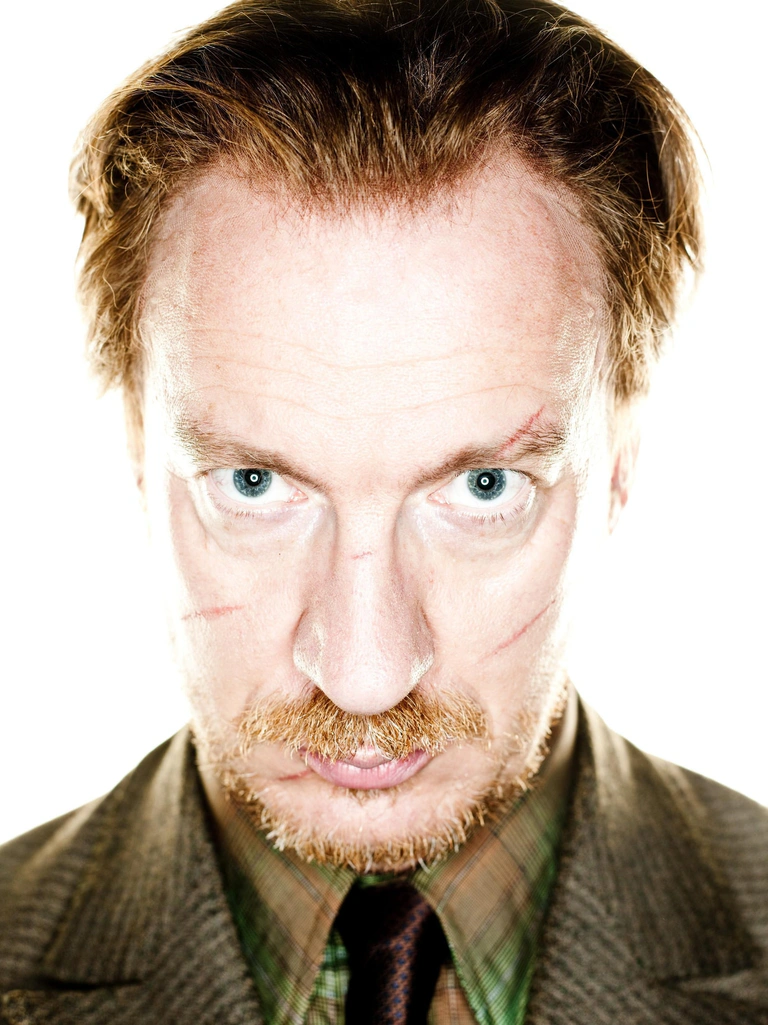
Well, when it works correctly, it conjures up a Patronus, which is a kind of anti-Dementor — a guardian which acts as a shield between you and the Dementor. The Patronus is a kind of positive force, a projection of the very things that the Dementor feeds upon — hope, happiness, the desire to survive — but it cannot feel despair, as real humans can, so the Dementors can't hurt it. But I must warn you, Harry, that the Charm might be too advanced for you. Many qualified wizards have difficulty with it.
According to Charms of Defence and Deterrence, the masterwork of the great eighteenth-century researcher of Charms, Professor Catullus Spangle, the Patronus represented that which was hidden, unknown but necessary within the personality. When a human was confronted with inhuman evil, such as the Dementor, they must draw upon resources they might never have needed otherwise, and the Patronus was the awakened secret self that lay dormant until needed, which must now be brought to light.
Corporeal Patronuses took the form of whatever animal the caster had the greatest affinity for. It could take a form that its caster might not expect, animals for which they had never felt a particular affinity, or (in rare cases) even recognised. Every Patronus was as unique as its creator, and even identical twins had been known to produce very different Patronuses.
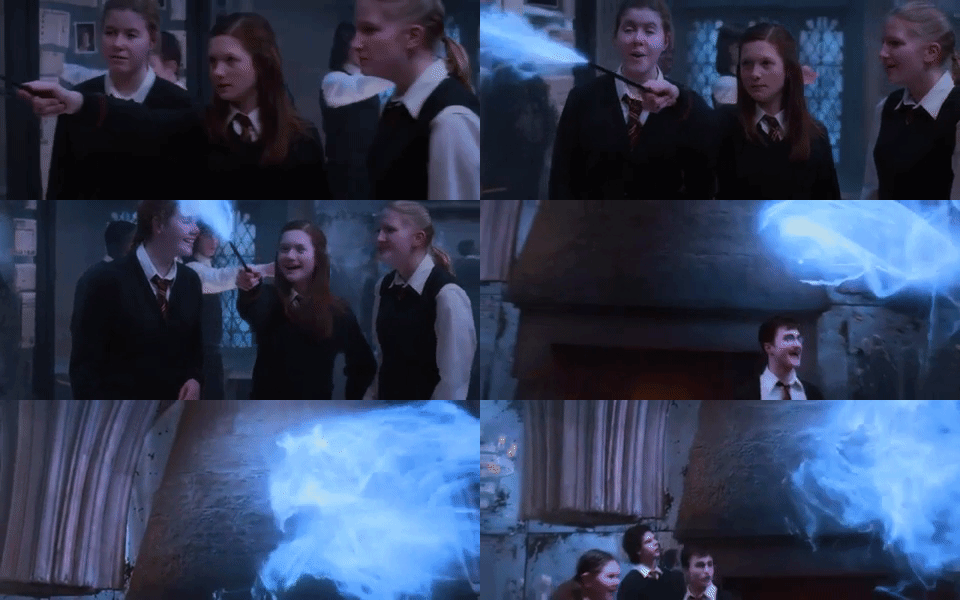
Dogs, cats, and horses were among the most common Patronuses when cast. Given these animals' long affinity with humans, it is perhaps unsurprising that humans would commonly have an affinity for them. Although it must be noted that any corporeal Patronus was highly unusual.
The unusual witches and wizards who produced a Patronus that took the form of their favourite animal was an indicator of obsession or eccentricity. Here was a wizard who may not have been able to hide their essential self in common life, and may have paraded tendencies that others might have preferred to conceal. Whatever the form of their Patronus, one would be well-advised to show respect, and occasionally caution, towards a witch or wizard who produced the Patronus of their choice.
If they were not protecting anyone, Patronuses seemed to take on the traits of the creature they resembled and generally followed their caster around. This made it unsure whether or not they were truly sentient. Harry's Patronus was able to follow both oral and physical commands.
Remus Lupin also owned a spellbook which detailed the casting of the Patronus Charm.
Casting
To successfully cast the spell, one began by mustering the happiest memory they could think of; the happier the memory, the better the charm would work. Alternatively, one could fantasise a scenario that would act as a very happy memory, as Harry did for his Defence Against the Dark Arts O.W.L. exam, which impressed his examiners. The next step was to begin drawing circles with their wand so as to increase the power of their spell. They then had to say the incantation, Expecto Patronum; the Patronus would come from the tip of the wand and could be directed towards a target by pointing one's wand at said target.
The vast majority of witches and wizards were unable to produce any form of Patronus, and to create even the weaker and less difficult incorporeal variant was generally considered a mark of superior magical ability. Rubeus Hagrid was an example of a wizard who could not conjure any form of Patronus, as the charm was too difficult for him. Alternatively, Minerva McGonagall was the only person seen to be able to produce three Patronuses at once.
Some witches and wizards may have been unable to produce a Patronus at all until they had undergone some kind of psychic shock.
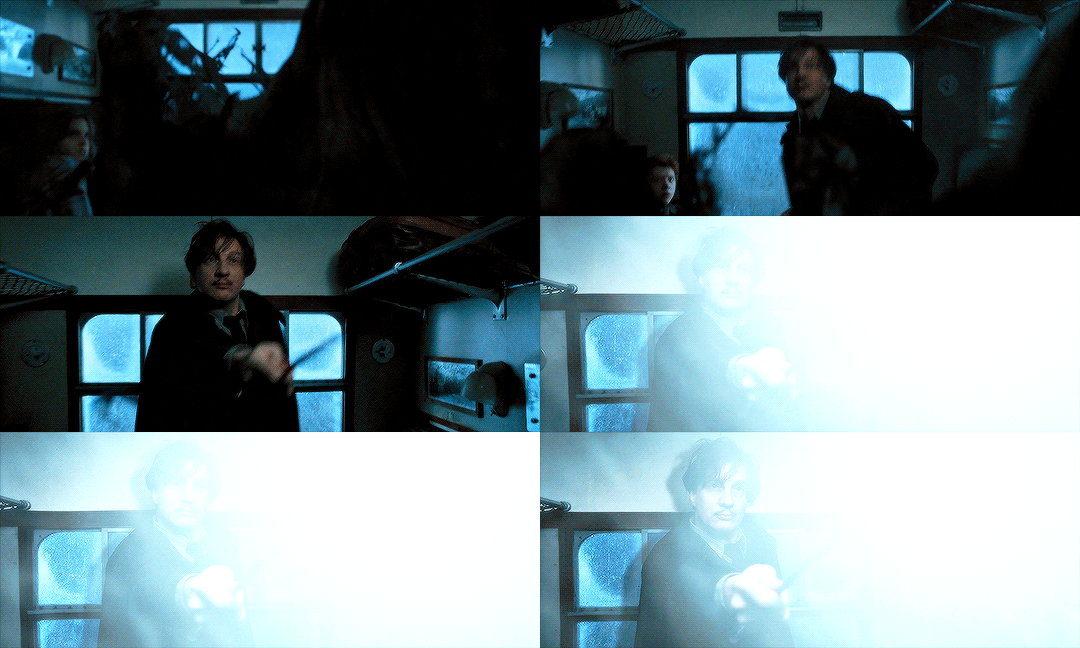
It was possible to disguise the form one's Patronus took, which was done both by Severus Snape to hide his love for Lily Evans, and by Remus Lupin, who felt it would give away his condition.
Patronuses only remained active whilst the caster was focusing on them.
Although it was extremely hard to fully conjure a Patronus, in an alternate reality, fourth-years in Defence Against the Dark Arts class were tasked with casting this charm.
Difficulty
That's very, very advanced magic.
The Patronus Charm was widely regarded as advanced magic, far beyond N.E.W.T.-level. It was very complex, and many qualified wizards and witches had trouble with it. Being able to cast a Patronus, whilst fighting Dementors or not, was not required to graduate from Hogwarts, so it was something that was only taught under special circumstances. Amelia Bones and potential members of the D.A. were all very impressed when Harry Potter revealed that he could cast not only a Patronus Charm but a corporeal one to boot, which was notably more difficult than casting an incorporeal one, from as early as his third Hogwarts school year. In fact, Harry Potter was one of the youngest known wizards able to cast a Patronus; he was taught how to do so in early 1994 at the age of thirteen by Remus Lupin, who described the charm as "ridiculously advanced".
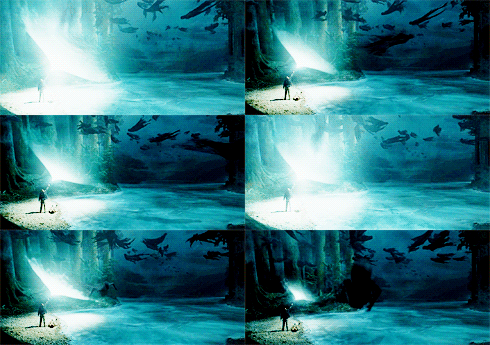
In a Dumbledore's Army lesson, Harry taught the members how to use the charm. Some were even successful in casting a corporeal form, though Harry said this might be because there was no Dementor to make them frightened and thus impede their efforts. However, three members were later able to cast corporeal Patronuses in the presence of Dementors.
Given that the success of the charm was directly reliant on the caster retaining a particular mental state, it was more difficult to cast in emotionally trying circumstances. For instance, Harry Potter, Ron Weasley, and Hermione Granger all had difficulty casting their Patronuses when under the negative influence of Slytherin's Locket, one of Lord Voldemort's Horcruxes, and after witnessing the death of Fred Weasley in the final battle. This feature of the Charm was particularly unfortunate, since the Charm's primary use was to defend against Dementors, which were specifically equipped to mentally unhinge people.
Self-confidence may also play an important role in casting the spell. In 1994, after going back in time, Harry was able to cast the spell successfully, driving off a large number of Dementors in the process (which, according to Severus Snape, was only achievable by a very powerful wizard), thus saving Sirius Black and a younger version of himself, seemingly without recalling a happy memory. Harry cast the charm when he realised that his future self had already done it, although he could potentially have had the required 'happy memory' upon realising that he had already saved all three of their souls.
Worthiness
While there is a widespread and justified belief that a wizard who is not pure of heart cannot produce a successful Patronus (the most famous example of the spell backfiring is that of the Dark wizard Raczidian, who was devoured by maggots), a rare few witches and wizards of questionable morals have succeeded in producing the Charm...
It was a general (and justified) belief held by the wizarding world that only those who were pure of heart were able to cast the Patronus Charm. This, however, was untrue, as several characters with negative personality traits were able to cast a fully-fledged Patronus.

If an unworthy witch or wizard attempted to cast it, they would be devoured by a swarm of maggots coming from their wand. This could be a metaphor to describe how, for some people with certain psychological issues, positive feelings like happiness or hope may trigger intense discomfort and even lead to a breakdown. However, such aversion to positive feelings is not necessarily linked to being evil, which explains why several characters with negative personality traits were still worthy of casting the Patronus Charm.
Dark witches and wizards would generally not try to produce a Patronus at all, not having any need for one. Most such men and women, who became desensitised to the effects of the Dark creatures whom they may ally themselves with, regarded the Patronus not being necessary to know. For this reason, Lord Voldemort and his Death Eaters were not able to cast a Patronus Charm (not that it was necessary, as they already had the Dark creatures under their control via their affinity to darkness, and would have no use for Patronuses). Draco Malfoy numbered among those unable to cast the Patronus Charm. Severus Snape was the only Death Eater capable of casting the charm.
However, some witches and wizards of questionable morals, such as Dolores Umbridge, were able to produce corporeal Patronuses. This may have been because she had a true and confident (though erroneous) belief in the righteousness of her actions. Merula Snyde could only conjure an incorporeal Patronus, though it should be noted that she was only a fourth-year at the time and it was an advanced spell; the only other wizards known to produce a corporeal Patronus by that age were Harry Potter, Nymphadora Tonks, and Jacob's sibling. Patricia Rakepick was a Dark witch who sadistically tortured Merula Snyde with the Cruciatus Curse and murdered Rowan Khanna with the Killing Curse, yet was able to cast a corporeal Patronus in the form of a lioness.
The Patronus
A successfully conjured Patronus could take one of two forms: incorporeal and corporeal. Both types varied greatly in their appearances and strength.
Incorporeal
A thin wisp of silver escaped his wand and hovered like mist before him.
An incorporeal Patronus was one that did not resemble any living creature and had few distinguishing features, if any. Incorporeal Patronuses resembled a burst of vapour or smoke without any clearly defined form shooting from the tip of the caster's wand.
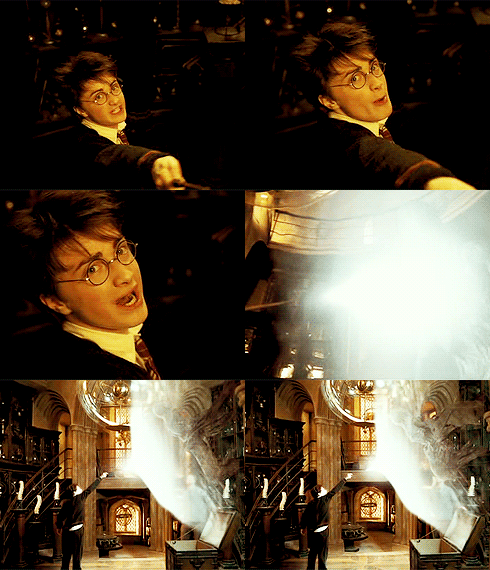
While they might be partially effective at halting Dementors (but not repelling them) and shielding the caster from them, incorporeal Patronuses were not "fully-fledged" Patronuses, and were regarded as a simpler and weaker version of the Charm. However, being able to cast even an incorporeal Patronus was still seen as an impressive feat.
Corporeal
A corporeal Patronus was one that was fully-formed, taking the shape of a bright, silvery, translucent animal. It was the strongest form a Patronus could take, being able to fully drive Dementors away.

The animal species it took the form of was the one which the caster had the greatest affinity for. Furthermore, the specific animal forms that a corporeal Patronus took would vary from person to person and reflect each individual's innermost personality. No two Patronuses were the same. Most Patronuses took the form of a mundane animal. Hedley Fleetwood's woolly mammoth Patronus was a notable exception. It was very rare for Patronuses to take the form of extinct animals. Patronuses resembling a magical creature, such as Albus Dumbledore's phoenix Patronus, were the most uncommon kind of all. Andros the Invincible was the only known wizard capable of casting a Patronus the size of a giant, although whether it was a true giant or not is unknown.
No reliable system for predicting the form of an individual's Patronus has ever been found.
It should be noted that the animal was a reflection of the caster, not a reflection of the strength of the spell. While a rare and magical Patronus undoubtedly reflected an unusual personality, it did not follow that it was more powerful, or will enjoy greater success at defending its caster. In fact, one of the most famous Patronuses of all time was a lowly mouse, which belonged to a legendary young wizard called Illyius, who used it to single-handedly hold off an attack from an army of Dementors, led by Raczidian.
Additionally, Patronus forms were subject to change if the caster went through an emotional upheaval of some sort, including falling in eternal, unchanging love. For example, Nymphadora Tonks's Patronus changed from its previous jack rabbit form to an ambiguous four-legged creature, which others guessed was a wolf because it would reflect her love for Remus Lupin, himself a werewolf. Another example was Severus Snape, whose Patronus was that of a doe, the same as Lily Evans, though this may have been the case all along rather than a change from its original form, as Snape was in love with Lily for most of his life.
Based on the fact that Patronuses were conjured by recalling happy memories, it stands to reason that a Patronus might change its form after one fell in love and the memories used to conjure the Patronus largely revolved around the person the caster was in love with. In addition, it seemed that some couples had "complementary" Patronuses (male and female forms of the same animal), such as Lily and James Potter. It is, however, unknown if this was a coincidence or not.
If a wizard was an Animagus and could summon a corporeal Patronus, their animal transformation and the Patronus animal might take the same form. This was the case for Minerva McGonagall (a cat) and James Potter (a stag). Apparently, the form one's Patronus took may have been predetermined by the same inner-traits as the Animagus form.
Remus Lupin's Patronus took the form of a true wolf.
Uses
As a pure, protective magical concentration of happiness and hope (the recollection of a single talisman memory is essential in its creation) it is the only spell effective against Dementors.
There were two known uses for the Patronus Charm. The first and main use of the Patronus was to drive off certain dark creatures, such as Dementors and Lethifolds, and was the only known charm that would work against them. As Dementors fed on happy memories, causing humans to drown in their own sadness and hopelessness, the Patronus acted as a shield of sorts, of which the Dementor would try to feed off of instead — and since the Patronus was comprised exclusively of positive feelings and couldn't comprehend negative emotion, the Dementor's influence couldn't affect it.

The other use was devised by Albus Dumbledore, who invented a way of using the Patronus (corporeal and incorporeal) as a means of communication. They could deliver messages, speaking with the voice of the caster. This source of communication was believed to be exclusive to the members of the Order of the Phoenix. Using the Patronus for communication offered great advantages in security, as Patronuses identified the caster and were Dark Arts-proof. A prime example of this was when Minerva McGonagall used her cat Patronus to call for help to the other Heads of Houses in 1998, when she found out that Harry Potter had returned to Hogwarts in search of Rowena Ravenclaw's Diadem.
Multiple Patronuses could be cast for communication, as McGonagall was able to create three. Another was when Severus Snape used his Patronus to lead Harry Potter to a pool in the Forest of Dean in 1997, where he had laid the Sword of Gryffindor for Harry to retrieve. It is unknown if Snape had conjured the Patronus with instructions to follow, or if he was hiding nearby and controlling it for this task.
Patronuses and practitioners
The majority of witches and wizards are unable to produce Patronuses and to do so is generally considered a mark of superior magical ability.
+ - bgcolor="#cccccc" Witch/wizard Patronal form Note - Hedley Fleetwood Woolly mammoth An unusual form, due to the extreme rarity of Patronuses based on extinct animals. - Symposia Rawle Ladybird An unusual form that was very powerful, despite its tiny size. - Andros the Invincible Something allegedly the size of a giant Harry Potter and the Chamber of Secrets (video game) - Illyius Mouse Initially, Illyius's fellow villagers mocked him as they had never seen such a small and weak-looking Patronus, which corresponded to Illyius's timidity and for being tongue-tied. However, when the Dark wizard Raczidian invaded and terrorised the village with his army of Dementors, Illyius's mouse Patronus proved to be stronger than the others, making him a hero. - Flavius Belby Something with horns Fantastic Beasts and Where to Find Them - Helen Thistlewood Rabbit Hogwarts Legacy (see this video) - Albus Dumbledore Phoenix Harry Potter and the Goblet of Fire The phoenix was a rare form of the Patronus Charm. - Aberforth Dumbledore Goat Hog's Head in an attempt to convince the Death Eaters who had seen Harry's stag Patronus that they really saw a goat. - Minerva McGonagall Cat followers. - Dolores Umbridge Harry Potter and the Deathly Hallows - Arthur Weasley Weasel First seen when Arthur sent a message about Rufus Scrimgeour's arrival on Harry's seventeenth birthday. Later seen when Arthur sent a Patronus to 12 Grimmauld Place to inform Harry, Ron, and Hermione that the Weasley family was safe. - Kingsley Shacklebolt Lynx Ministry of Magic and Rufus Scrimgeour's death. - Peregrine Unknown Harry Potter: Hogwarts Mystery - Patricia Rakepick Lioness Harry Potter: Hogwarts Mystery - Miriam Strout White Swan Harry Potter: Hogwarts Mystery - Lily Potter Doe Mentioned in conjunction with Snape's Patronus. It was also the female form of her husband's Patronus. - Severus Snape Godric Gryffindor's Sword was hidden. Snape's Patronus mirrored Lily's due to his unspoken love for her that began when they were small children. - Cast by Severus Snape to aid Scorpius Malfoy and himself in the alternate reality created by Albus Potter and Scorpius in 2020. - Nymphadora Tonks Jack Rabbit Harry Potter: Hogwarts Mystery Her Patronus originally took the form of a jackrabbit. - Wolf Harry Potter and the Half-Blood Prince . - Remus Lupin Remus often deliberately disguised the form of his Patronus by casting it as an incorporeal one, because he felt that it would give away too much about his lycanthropy. - Jacob's sibling white stallion, unicorn, Abraxan, tiger, cheetah, leopard, Spotted Hare, Mountain Hare or Lop-Eared Rabbit In their fourth year, they learnt the charm under Tonks' tutelage. - James Potter Stag James' Patronus form was also that of a stag. - Harry Potter Harry's Patronus was in the shape of his father's Animagus form and Patronus. He learned how to conjure a Patronus at an exceptionally young age. - Cho Chang Swan Seen in the last Dumbledore's Army meeting in 1996. - Seamus Finnigan Fox Seamus could not produce a fully formed corporeal Patronus in Dumbledore's Army, though, in the Battle of Hogwarts in 1998, he managed to conjure a Patronus in the shape of a fox. - Hermione Granger Otter Ministry of Magic. - Luna Lovegood Hare Seen in the last Dumbledore's Army meeting in 1996 and in the Battle of Hogwarts in 1998. - Ernie Macmillan Boar Seen in the Battle of Hogwarts in 1998. - Fred Weasley Magpie - George Weasley - Ginny Weasley Horse Seen in the last Dumbledore's Army lesson in 1996. - Ron Weasley Jack Russell terrier Seen in the last Dumbledore's Army lesson in 1996 and in the Battle of Hogwarts in 1998. - Constance Pickering Harry Potter: Wizards Unite - Baby Beasts A rare form, given how the unicorn was a magical creature. - Daniel Page Black cat Harry Potter: Magic Awakened - Lottie Turner Hummingbird - Cassandra Vole Mink - Colby Frey Rhinoceros - Fischer Frey Crocodile - Ivy Warrington Pug - Robyn Thistlethwaite Polar Bear - Kevin Farrell Hedgehog - Victor Gridley Bird - Elliot Evers Harry Potter: Magic Awakened weibo: "化身乌鸦的守护神,携着召唤者的意志向着霍格沃茨飞去,背后的一切是更大的阴谋还是未知的改变?" (in Chinese) Normally ravens and crows are not distinguished in the definition of Chinese word '鳥鴉'.
Patronus forms
• Crocodile
• Panda
• Pug
Sources
Adapted from the original article, under CC BY-SA 3.0.