Group
British Auror Office
The British Auror Office, alternatively known as Auror Headquarters, served as…
Level two, Department of Magical Law Enforcement, including the Improper Use of Magic Office, Auror Headquarters, and Wizengamot Administration Services.
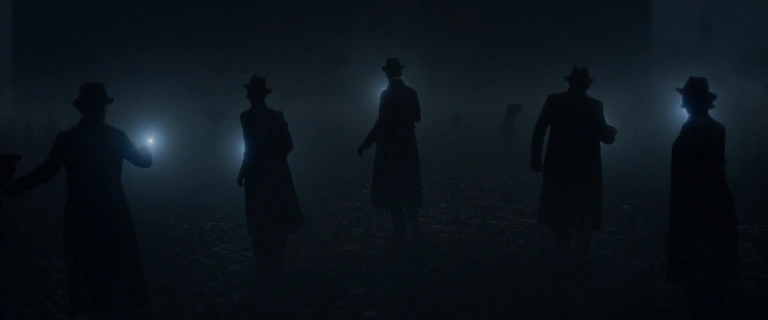
The British Auror Office, alternatively known as Auror Headquarters, served as the headquarters of the Aurors of Great Britain. The department was a main division of the Department of Magical Law Enforcement of the British Ministry of Magic. It specifically dealt with the capture of Dark witches and wizards.
In other words, Aurors were essentially the wizarding equivalent of the Muggle police force/detectives, and their headquarters operated as their base of operations. The leader of this department was referred to as the Head of the Auror Office.
Location
A lopsided sign on the nearest cubicle read: Auror Headquarters.
Located on Level Two of the British Ministry of Magic, the Auror Headquarters consisted of a circular chamber with a high ceiling and a green-tiled floor. Just to the left of the entrance was a small waiting area with two green armchairs and a potted plant, with a notice board covered with pinned papers hung on the wall. At the opposite end of the room, a large enchanted window admitted in light. Five private cubicles lined the curved walls on the left-hand side of the room, each with a dark wooden door bearing bronze plaques, and housing a private office space with a chair and desk, along with a smaller bewitched window of its own and towering, cluttered bookcases on the right-hand side. At least one of the cubicles was enchanted to reveal different interiors as required. The cubicle at the far end ordinarily contained a small enclosed office with its own window, much like the others. However, the same doorway could also open onto at least two alternative spaces: the office storage and the records room.
During the 1995–1996 school year, the main space consisted of a series of open cubicles decorated with pictures of known Dark wizards, maps, clippings from the Daily Prophet, and other odds and ends. By the 2011–2012 school year, however, these had been replaced with a cluster of wooden desks arranged in a circle to form a shared workstation in the middle of the room, at the centre of which rose a towering column of stacked books and documents. There were also training rooms and a practice range, among them the Light and Shadow Room.
Functions

Aurors are the Wizarding World's best defence against the practitioners of the Dark Arts.
The Auror Office was tasked with investigating crimes related to the practice of the Dark Arts and with the capture of Dark wizards. For this reason, it was standard procedure that every Auror 'started the archives' and spent more time cataloguing old case files in the records room than they did working active cases for the first few years as a fully-fledged Auror, as means of learning the patterns of the perpetrators before they began chasing them.
It was not uncommon for said lawbreakers to resist arrest, however, with some choosing to fight to the death rather than let themselves be captured. As a result, veterans in the department, such as Alastor Moody, were known to sustain permanent injuries over the course of their duties, and Aurors were known to have called upon the support of trained Hit Wizards from the Magical Law Enforcement Squad when in need of backup. Once a criminal was apprehended, they were usually placed in custody while awaiting trial to answer for any crimes they committed, and, if found guilty, would be sentenced to Azkaban.
The Auror Office in Britain would also collaborate with their counterparts in other countries during international manhunts for particularly dangerous individuals wanted in multiple countries, and, on occasion, even sent some of their own agents to assist Aurors in foreign countries in dire situations. There were also times when the Head of the Department of Magical Law Enforcement utilised the officers of the department as soldiers to wage Wizarding Wars, including those fought against Gellert Grindelwald and Lord Voldemort.
The job
We're well-versed in offensive magic, because our very lives depend on it. It takes courage, wit, and guile. Not many have the stomach for it. Do you?
While most members of the Department of Magical Law Enforcement worked exclusively domestically, including highly trained members, such as Hit Wizards, and would obtain their position through a regular employment, the term "Auror" was more accurately described as a rank that a witch or wizard received before they officially assumed the role. They assumed the role through a formal document of appointment as a commissioned officer of the Ministry's internal, uniformed service.

Aurors were tasked with defending the worldwide wizarding community from practitioners of the Dark Arts. As such, even though British Aurors worked mostly within their own Ministry's jurisdiction, their work would occasionally require them to assist their counterparts abroad, such as during the Global Wizarding War.
Commission as an Auror was gained through the acceptance of an eligible candidate into the necessary recruitment programme, either by passing a stringent series of character and aptitude tests given at the Auror Office, or by possessing the right qualifications and such a solid background of public service that it was bestowed upon them by a sufficiently high-ranking official, such as the Head of the Auror Office or the Minister for Magic.

Internally, Aurors were assigned to a wide variety of different tasks and were implied to have operated through an informal hierarchy based on years of service and track record. Some, for instance, solved crimes and were something akin to detectives, looking into reports of illegal magical activity to track down suspects by questioning witnesses, examining evidence, and following up on leads. Nymphadora Tonks, a relatively new Auror, was one of several stationed at Hogwarts during the Second Wizarding War to protect the school against Dark forces.
The Aurors that had distinguished themselves would be put in charge of an investigation, referred to as a 'Lead Auror', to whom a number of Investigative Assistants, lower-ranking Aurors tasked with helping them, reported. Others seemed to act more like intelligence agents, tasked with secretly tailing a specific target to monitor their activities, or assigned to provide extra security for high-profile places, or to guard high-risk targets.
They also carried out prisoner transfers between the holding cells at the Ministry and Azkaban, and, as of 1998, they also doubled as prison guards after the island was purged of Dementors, working in shifts and rotating from the mainland. In addition, the Aurors also had at least some civilian research assistants whose job it was to compile and fact-check evidence for them.
Status
Described as "the Wizarding World's best defence against the practitioners of the Dark Arts", the work of the Auror department was seen as glamorous because of the sheer amount of danger involved, as well as because of the difficulty in joining the ranks of the Ministry's "Dark wizard catchers". Harry Potter, Carl Hopkins, Fay Dunbar, and Medb O'Sullivan were all noted to have aspired to become Aurors during their time at school.
As commissioned officers, the Aurors also enjoyed a certain degree of seniority over their fellow law-keepers at the Ministry. This seniority was because acceptance into the recruitment programme and acquiring the rank of "Auror" was seen as a promotion. Additionally, members of other divisions (including those that headed them) were required to assist Aurors with their investigations when called upon to do so. They also outranked elite members of the Magical Law Enforcement Squad, as Hit Wizards would be called upon by the Auror Office for backup in the event that they needed to increase the number of skilled wands on their side for violent encounters with Dark wizards. Famous Aurors were honoured with banners placed around the office. Hesphaestus Gore, one of the first Aurors, was honoured with this, as were Frank and Alice Longbottom, two Aurors who were permanently and irreversibly injured due to their work.
Early history
The Auror recruitment programme was established by former Minister for Magic Eldritch Diggory at some point between his election in 1733 and untimely demise in 1747, and their concomitant headquarters were already up and running by 1752, when Hesphaestus Gore, one of the earliest Aurors, put down several revolts during the Goblin Rebellions.

In 1750, a new clause was added to the International Statute of Wizarding Secrecy stating that each nation's wizarding governing body would be responsible for the concealment of magical creatures, beings, and spirits within their respective territories. Consequently, Aurors were so frequently tasked with patrolling hidden and protected habitats to ward off or capture poachers that few Aurors ever went their whole careers without meeting one.
In 1783, a fearsome Dark wizard by the name of Flannery went on a murderous rampage throughout Great Britain. Hamish Steed, one of his intended targets, was subsequently placed under Ministry protection. This did not prevent the killer from locating him, however, as he used an ancient spell to track down his greatest desire — which happened to be the location of the late Steed.
Later history
In the early 20th century, at least one member of the Auror Office, Theseus Scamander, was involved in the wizarding efforts during the First World War. Theseus would subsequently become Head of the Auror Office and participate in the Global Wizarding War. In 1927, several British Aurors, including Theseus, went to Paris to find Theseus' brother, Newt, who had illegally travelled to France despite his ban on international travel. Once there, the French Ministry of Magic received intelligence that indicated Gellert Grindelwald would be rallying his supporters at a nearby cemetery, which they shared with Theseus and his men. Together, the Aurors from the British and French Ministries of Magic went to put a stop to it, an incident that resulted in the deaths of Leta Lestrange, a red-haired young witch, and several Dark wizard catchers, and the escape of Grindelwald.

From 1970 to 1981, the Auror Office was involved in waging the First Wizarding War against Lord Voldemort and his followers. By the 1990–1991 school year, veteran Auror Alastor Moody noted that, while the amount of paperwork had increased noticeably from back when he first joined their ranks, he ultimately viewed it as a good thing, as it helped keep the department "organised and honest".
Following the escape of suspected Death Eater and mass-murderer Sirius Black from Azkaban in 1993, the Auror Office was tasked with tracking him down, a process that — owed in no small part to Kingsley Shacklebolt — was still ongoing in 1995, when Arthur Weasley took Harry Potter through the office before his disciplinary hearing. The Auror Headquarters, a "cluttered open area divided into cubicles, which was buzzing with talk and laughter", impressed Harry, who was thinking about becoming an Auror once he left Hogwarts. Despite the efforts which Minister Cornelius Fudge made to discredit and suppress claims which Albus Dumbledore and Harry gave about the return of Lord Voldemort, their words reached some members of the Auror Office, who came to believe that the Dark Lord had been restored, including Shacklebolt and Nymphadora Tonks, a protégé of Moody. With the support that these individuals and like-minded colleagues leant its cause, the restored Order of the Phoenix was able to secure contacts inside the British Ministry of Magic who assisted the secret organisation and its moves to sabotage the concurrent efforts which Voldemort was making to resume connections with the factions of his former army.
Following the outbreak of the Second Wizarding War, the Auror Office assigned several of its members to guard high-risk targets, such as Harry Potter and the Muggle Prime Minister and stationed several Aurors in Hogsmeade to provide extra security to Hogwarts Castle in 1996.
Recent history
Following the fall of the British Ministry of Magic on 1 August 1997, it was reported by the Daily Prophet that the Aurors had been decommissioned and stripped of their wands and jobs. Individuals with the appropriate blood status, such as Kingsley Shacklebolt and John Dawlish, were allowed to continue to serve the government in some manner, albeit beneath a department that had been brought under the control of the Death Eaters and their allies.
Though some members of the Auror Office remained compliant with their administration and followed orders given to them regardless of the draconian policies behind them, Shacklebolt was ousted as a member of the resistance after breaking the Taboo which alerted followers of the Dark Lord whenever another individual used the name of their master. Shacklebolt was exposed, but escaped from the Ministry and became a voice on Potterwatch until the night that Hogwarts fell under attack from Voldemort after it was found to be harbouring the trio.

Harry and Ron utterly revolutionised the Auror Department in — at the Ministry of Magic. So they — I mean, they are now the consummate — they are experts... And by the time — 19 years later — I would imagine that Harry is heading up that department, which is not corrupt in any way.
After the war ended, Shacklebolt became the new Minister for Magic, and Harry Potter and Ron Weasley joined the recommissioned Auror Office and helped revolutionise the department and round up the late Dark Lord's followers that had gone into hiding. In 2007, Harry Potter became the Head of the Auror Office.
Between 2015 and 2021, the Auror Office ran an investigation into the disappearance of the so-called 'London Five', as well as assisted the Calamity World Centre with containing and handling said catastrophic event, training those of its agents wanting to pursue a career as an Auror. The Aurors also participated in the cold war between the Ministry of Magic and the secret society known as The Unforgivable.
Known Aurors
- Person Notes -
Heads of office
Theseus Scamander Head of the Auror Office during Gellert Grindelwald's revolution in the 1920s. - Rufus Scrimgeour Lord Voldemort on 1 August, 1997. - Harry Potter and the Half-Blood Prince Took over in 1996, after Scrimgeour became Minister for Magic. - Harry Potter Harry Potter and the Cursed Child -
Aurors
- Helen Thistlewood Hogwarts Legacy - Patricia McManners Hogwarts Legacy - Aesop Sharp Potions class is in session. #HogwartsLegacy - Aesop Sharp's partner File:Aesop Sharp details - AMHL.jpg - Solomon Sallow File:Sebastian Sallow details - AMHL.jpg - Venusia Crickerly Became Minister for Magic in 1902. - Cassius Bell An Auror in the 1920s who defected and joined Gellert Grindelwald's Alliance. - Cho Chang's grandfather Fantastic Beasts: The Crimes of Grindelwald - The Original Screenplay - Stebbins - Alastor Moody's father File:AlastorMoodyMinistryFile.png - Alastor Moody's mother - Alastor Moody Harry Potter and the Deathly Hallows - Alice Longbottom Mentally incapacitated by a group of Death Eaters via the Cruciatus Curse in the final days of the First Wizarding War in 1981. - Frank Longbottom - Crescent Flump An Auror at some point before the 1991–1992 school year, he retired after a mistake nearly cost the lives of multiple other Aurors, including August Quill. - August Quill Harry Potter: Hogwarts Mystery - Proudfoot Aurors that were stationed in Hogsmeade along with others during the 1996–1997 school year at Hogwarts. - John Dawlish - Savage - Kingsley Shacklebolt - Nymphadora Tonks - Williamson Harry Potter and the Order of the Phoenix - Ronald Weasley Retired, later worked at Weasleys' Wizard Wheezes. - Neville Longbottom Resigned position to become Professor of Herbology at Hogwarts. - Mordecai Berrycloth Hosted useful combat training visits to field members of the Department for the Regulation and Control of Magical Creatures in the 2010s. - Dorian Fungbury url=https://web.archive.org/web/20210414102606/https://wizardsunitehub.info/profession-skill/somatic-casting/ - Penelope Fawley file:WU trailer documents ref.png - Riya Patel - Cerberus Langarm Harry Potter: Wizards Unite , SOS Task Force Training - Arurorial Appraisal: Resilience Training - Nienna Robins An Auror in the 21st century.
Sources
Adapted from the original article, under CC BY-SA 3.0.