Place
London
London is the capital of England and the United Kingdom, and one of the largest…

They passed book shops and music stores, hamburger bars and cinemas, but nowhere that looked as if it could sell you a magic wand.
London is the capital of England and the United Kingdom, and one of the largest and most famous cities in the world. Standing on the River Thames in the south east of the island of Great Britain, it had long stood as an important centre of British commerce and government for wizards and Muggles alike.
17th century
In the early 17th century, wizard thief Eldon Elsrickle returned to London after having fled to Africa for a time to evade imprisonment. In Africa, he learnt about the Unlocking Charm (which was, at the time, an unheard of spell in the western world) from an ancient African sorcerer.

Elsrickle terrorised London with his new spell, burgling Muggle and wizarding homes alike. It was only when fellow Londoner Blagdon Blay invented the Anti-Alohomora Charm (in response to having his house broken-into nineteen times in the course of two weeks) that Londoners found safety again, and a frustrated Elsrickle stopped.
The Great Fire of London was a major conflagration that swept through the central parts of the City of London, beginning on Sunday, 2 September, 1666. The Muggles say the Great Fire of London started in a bakery on Pudding Lane, but there is debate among the wizarding community whether it began in the bakery or in the basement of the house next door, where legend has it a young Welsh Green was being kept.
19th century
In the 1880s, Sir Herbert Varney, a vampire, started to prey on London women. He was eventually hunted down and killed by a specially-assigned task-force from the Department for the Regulation and Control of Magical Creatures. Around the same time, a Boggart, popularly known as the Bludgeoning Boggart of Old London Town, prowled the back streets of London and, feeding on people's fears, took on the form of a "murderous thug", before having been reduced to a hamster with one simple incantation.

On 1 September 1890, Eleazar Fig and a new fifth-year student at Hogwarts School of Witchcraft and Wizardry met in an alley. British Ministry of Magic official George Osric Apparated there shortly afterward, reporting that he had gotten lost and mistakenly Apparated to the West End and scared a few theatre-goers. Together they all departed in a carriage for Hogwarts.
20th century
In 1926, The New York Ghost reported that European Aurors were searching for Gellert Grindelwald all across Europe, including London.
On 1 April 1979, Caractacus Phelps exploded no less than eight-hundred Stink Pellets, by dropping them en-masse from the roof of the Daily Prophet building in Diagon Alley. The resultant gas cloud caused untold discomfort throughout London, and approximately five-hundred cases of Stinkitus were reported. The Muggle authorities explained the stinking cloud away as an unpleasant emission from a nearby factory.
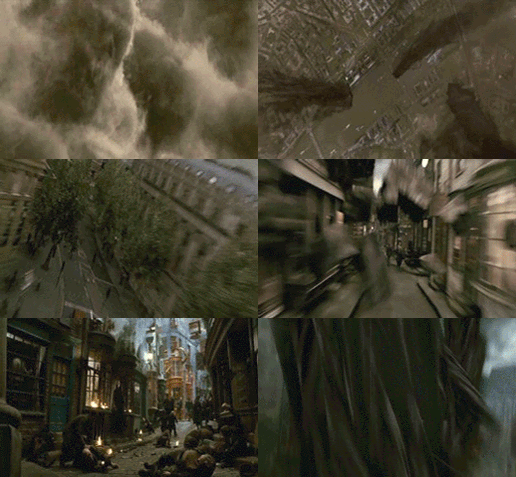
London felt the effects of the Second Wizarding War severely. Many buildings and homes were destroyed or ransacked, and many people were attacked within the City during Lord Voldemort's rise of power: Emmeline Vance was found dead near 10 Downing Street, Diagon Alley was attacked, leading to Garrick Ollivander's kidnapping and Florean Fortescue's murder.
Governmental locations
London was an important city because it is where the Government of the whole United Kingdom was located. Some of its governmental locations included:

10 Downing Street (the official residence and office of the Muggle Prime Minister of the United Kingdom)
British Ministry of Magic (main offices of the British Ministry of Magic)
Buckingham Palace
London City Hall
Palace of Westminster
Commercial locations
London was a centre of commerce for both the Muggle and the wizarding community. Some of its commercial sites included:

9 Sherringford Square (used as the main residence of Newt Scamander in the 1920s)
A hamburger restaurant at Paddington Station
Chester Stevens Estate Agents (a Muggle property management establishment)
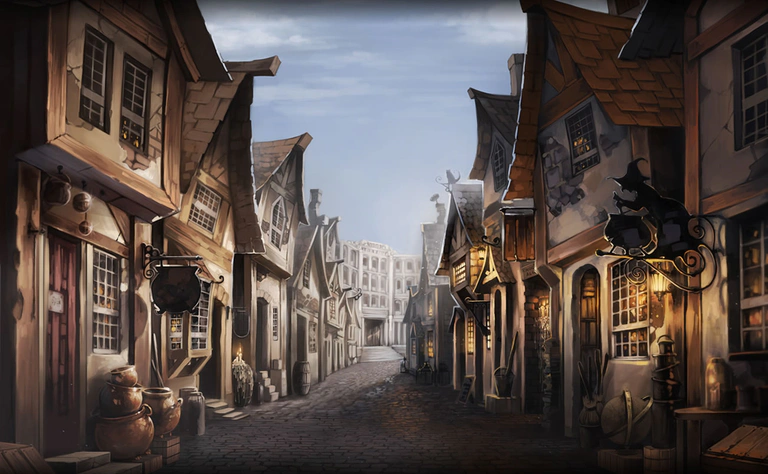
Diagon Alley (a wizarding commercial street, including many shops)
Gladrags Wizardwear (a wizarding clothing shop)
John Kent Fruiterers (a Muggle greengrocer's)
Knockturn Alley (a wizarding commercial street, including many shops dedicated to the Dark Arts)
Pudding Lane's Bakery (formerly)
Screed & Sons
The Leaky Cauldron (a "portal between the two worlds", this wizarding inn was used to gain entrance to Diagon Alley)
Third Hand Book Emporium (a large bookshop)
Institutions
London was the location of many important institutions, including:

The main offices of Gringotts Bank (the wizards' bank; located at Diagon Alley)
St Mungo's Hospital for Magical Maladies and Injuries (a wizarding hospital, concealed in a disused department shop)
12 Grimmauld Place (first used as the main residence of the House of Black; it was once used as headquarters of the Order of the Phoenix)
Museum of Quidditch (a museum concerning the History of Quidditch)
Society for the Tolerance of Vampires Head Office (a candlelit office where STV matters are dealt with)
Wool's Orphanage (formerly)
Euro-Glyph School of Extraordinary Languages had a branch here
Other locations
King's Cross Station (a Muggle train station, where Platform Nine and Three-Quarters was hidden)
Paddington Station (a Muggle train station)
Surbiton Station (a Muggle train station)
London Underground
Millennium Bridge (a pedestrian bridge over the Thames; destroyed in 1996)
Library
St Paul's Cathedral (Cathedral across from the Millennium Bridge)
Trafalgar Square (Square that the Death Eaters travelled past to get to Diagon Alley)
London Eye (Ferris wheel on the River Thames)
Big Ben (Great Bell of Elizabeth Tower)
Hampstead Garden Suburb
Southwark Bridge
Cannon Street Station
Tower Bridge
Tower of London
BT Tower
30 St Mary Axe
Canary Wharf
One Canada Square
One Churchill Place
London Eye
HSBC Building
Citigroup Building
Tottenham Court Road
Carnaby Street

Sources
Adapted from the original article, under CC BY-SA 3.0.