Thing
Headteacher's portrait
A headteacher's portrait referred to a magical living portrait which depicted…

A headteacher's portrait is a memoir. It is supposed to be a support mechanism for the decisions I have to make. But I was advised as I took this job to not mistake the painting for the person. And you would be well-advised to do the same.
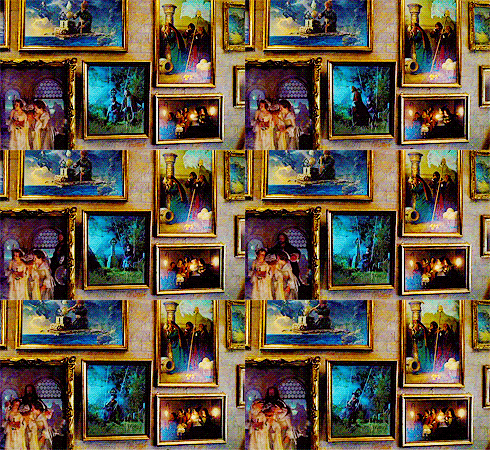
A headteacher's portrait referred to a magical living portrait which depicted the painted likeness of a previous Headmaster or Headmistress of Hogwarts School of Witchcraft and Wizardry. The portraits were mounted and housed in a private gallery in the Headteacher's office in Hogwarts Castle.
The portraits were put up after the former Headmaster or Headmistress they depicted had died, and until then, throughout their tenure at Hogwarts and afterwards, the former school Heads diligently trained their portraits with all the wisdom they could instill. These portraits were honour-bound to serve the current Headmaster or Headmistress at all times and act as a support system.
A trait shared by many of the portraits was that they spent most of the time asleep or pretending to be asleep, though most of them, with the occasional exception of Phineas Nigellus Black, would immediately awake when addressed.
Several of these portraits had counterparts in other prestigious magical institutions, such as the British Ministry of Magic and St Mungo's Hospital for Magical Maladies and Injuries, as well as the homes of their living descendants, such as the portrait of Headmaster Phineas Nigellus Black in the Black family home at 12 Grimmauld Place. This was extremely useful, as the individuals depicted in such portraits might travel freely between them and keep the incumbent headteacher informed on the goings-on elsewhere.
1995–1996 school year
When Arthur Weasley was attacked by Nagini on 18 December, Albus Dumbledore called upon several of the portraits to relay or provide information on the event. Everard was sent to his portrait at the Ministry of Magic to make sure Arthur was found, Dilys Derwent was sent to St Mungo's to monitor his arrival there, and Phineas Nigellus Black was sent to 12 Grimmauld Place to inform Sirius Black that Harry Potter and the Weasley children would be arriving there by Portkey.
The portraits witnessed Cornelius Fudge's attempt to arrest Dumbledore later that year, and did not sham sleep that night, but instead outright supported him against the Ministry, with one or two even giving Fudge a rude hand gesture. Even Phineas could not deny that Dumbledore's defence against Fudge's brigade as impressive.
1997–1998 school year
After the death of Albus Dumbledore, then-Head Severus Snape continued to be advised by, and take orders from, his portrait. It was under these orders that Snape delivered the Sword of Gryffindor to Harry Potter, and arranged for Harry to view several of his memories.
Following the defeat of Lord Voldemort at the Battle of Hogwarts, the portraits cheered on Harry when he visited the Headmaster's office. Dumbledore in particular complimented Harry, and supported his decision to discard the Resurrection Stone and return the Elder Wand to the White Tomb.
Knowledge of portraits
Dumbledore is dead, Harry. And I've told you before, portraits don't represent even half of their subjects.
While the paintings in the wizarding world, such as those mounted on the walls of Hogwarts Castle, had all been bewitched by their painters so that the subjects depicted in them to move, talk and, by extension, interact with each other and those that looked at them, they were typically very limited in what they could say and do. Possessing little knowledge into the lives of the witches and wizards they depicted, the portraits at Hogwarts were typically more or less reducible to two-dimensional representations of their once living counterparts as seen by the painter; capable of using some of their favourite phrases and mimicking their general demeanour, but little else. The gallery in the Headteacher's study, however, was an exception to the rule; as the headmasters and headmistresses of Hogwarts poured so much of themselves into their painted likenesses that what they left behind in the office following their passing were more accurately described as faint imprints of themselves than mere pieces of art, and the depth of their insight was unknown to all but the head of the day.
Indeed: Whilst not as fully realised as ghosts, the fact that these paintings were not only capable of considerably more interaction with the world outside their frames than the other portraits in the castle, but appeared so lifelike that even the current Head of the school were sometimes cautioned against mistaking them for the people they depicted, both further illustrated the accuracy of Minerva McGonagall's high praise the abilities of the school's Professors, as a portrait's level of sentience depended not on the skill of the witch or wizard that painted them, but rather the power of the witch or wizard depicted.
Identified portraits
Unidentified portraits
• Gimlet-eyed Hogwarts Headmistress
Unknown if they had a portrait
First Headmaster of Hogwarts
Headteacher in 1792
Eupraxia Mole
Sources
Adapted from the original article, under CC BY-SA 3.0.