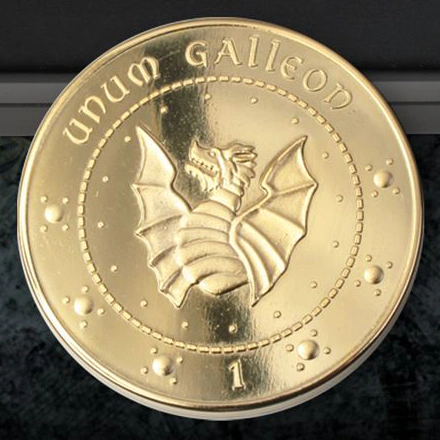
Thing
Leprechaun gold
Material that was produced by leprechauns, that possessed magical properties
Leprechauns produce a realistic gold-like substance that vanishes after a few hours, to their great amusement.
Leprechaun gold was a material that was produced by leprechauns, that possessed magical properties.
Description
It was a gold-like substance produced by leprechauns that looks and felt authentic as regular coins, that had the unique quality of disappearing after a few hours. Not many wizards and witches seem to have been aware of this fact, as shown with the pure-blood wizard Ronald Weasley. Although the coins seemed identical to ordinary ones, goblin experts could differentiate them from ordinary coins, as Harry Potter, Hermione Granger, and Ron Weasley overheard when they visited Gringotts Wizarding Bank in search of one of Lord Voldemort's Horcruxes in the Lestrange Vault.
History

I didn't know leprechaun gold vanishes.
Ludo Bagman paid off bets to Fred and George Weasley, as well as many other winners, including goblins, at the 1994 Quidditch World Cup using leprechaun gold. Although Bagman refused to reimburse many of the gamblers for this deceit, the goblins chased after him and took all of his winnings as compensation.

In 1995, Rubeus Hagrid used leprechaun gold coins in a Care of Magical Creatures class where he was introducing the students to Nifflers, and Gregory Goyle's attempt to pocket them secretly was thwarted when he heard they would disappear eventually. Ron Weasley paid back Harry Potter in leprechaun gold for the Omnioculars in the Quidditch World Cup, not knowing that leprechaun gold would disappear until Hagrid told him later in Care of Magical Creatures class. Ron felt bad about this, but Harry told him it was no problem.
Sources
Adapted from the original article, under CC BY-SA 3.0.