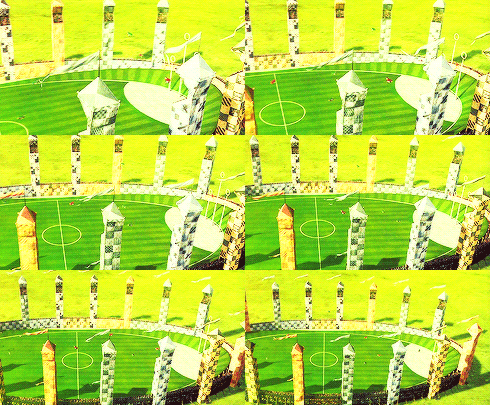
Event
Quidditch World Cup
Held every four years since 1473
A source of vehement disagreements, a security risk for all who attend it and a frequent focus for unrest and protest, the Quidditch World Cup is simultaneously the most exhilarating sporting event on earth and a logistical nightmare for the host nation.
The Quidditch World Cup (also called the World Cup or World Championship) was held every four years since 1473. The competition saw Quidditch teams representing countries around the world to compete for the World Cup, while the International Quidditch Tournament was between regional teams.
History
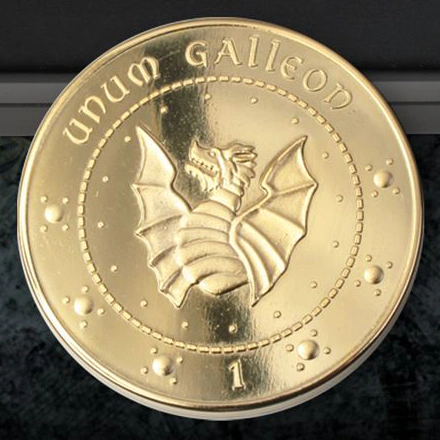
The Official Guide to the Quidditch World Cup was the official guidebook to the Quidditch World Cup, written and published by the International Confederation of Wizards' Quidditch Committee, providing information on the rules and history of the Quidditch World Cup. Sold in most reputable bookstores, this tome cost thirty-nine Galleons, leading most wizards and witches to call it overpriced.

The tournament was held every four years since 1473. As with so much else about the wizarding world’s most important sporting competition, many queried the accuracy of this statement. As only European teams competed during the fifteenth and sixteenth centuries, purists preferred to date the Quidditch World Cup’s inception from the seventeenth century when it became open to all continents.
There was also heated debate about the accuracy of some historical accounts of tournaments. A substantial amount of all post-game analysis centred on whether magical interference took place and whether it made, or ought to have made, the final result moot.
Regulations
The ICWQC has the unlucky job of regulating this contentious and anarchic competition.
The ICWQC was an international regulatory body, subject to the International Confederation of Wizards, that oversaw international Quidditch competitions, such as the World Cup. Namely, it located suitable venues, arranged transportation for spectators, and provided policing for the games themselves. It was also the ICWQC that chose the referees for World Cup matches.<

The rulebook concerning both on-and-off pitch magic was alleged to stretch to nineteen volumes and to include such rules as no dragon is to be introduced into the stadium for any purpose including, but not limited to, team mascot, coach or cup warmer’ and modification of any part of the referee’s body, whether or not he or she has requested such modification, will lead to a lifetime ban from the tournament and possibly imprisonment.'
Mentor Metaxas, a Greek wizard, was the chairman of the International Confederation of Wizards Quidditch Committee in 2014.
Statute of Secrecy
A watershed moment for the Quidditch World Cup was the implementation of the International Statute of Secrecy in 1692, which was intended to conceal the existence of magic and wizards. The International Confederation of Wizards (ICW) saw the Quidditch World Cup as a security risk of the highest magnitude because of the mass movement and congregation of so many members of the international wizarding community.
However, following mass protests and threats to the ICW, it was agreed that the tournament could continue and a regulatory body — the ICWQC — was set up to locate suitable venues — usually remote moors, deserts and deserted islands — arrange transportation for spectators (as many as a hundred thousand routinely attend finals) and police the games themselves, a task generally agreed to be among the most thankless and difficult in the wizarding world.
Format and Qualifying
The number of participating countries varied from tournament to tournament. Any country could enter a team within twelve months of the previous final.
Quidditch World Cup Qualifying
Sixteen separate groups of teams were formed. Each team played all of the other teams in their group over a two year period. During the group phase, there was a cap of four hours on every game to avoid player exhaustion. On the occasion that the game ended after four hours of play and the Golden Snitch wasn't caught, the result was decided by the amount of goals scored. A win earned two points.
In addition to these two points, a win by 150 points earned five points, by 100 points an extra three points and by 50 points an extra one point. If two teams were level on points, they were separated by whichever team captured the Snitch most often, or most quickly during their matches. The sixteen teams who finished top of the sixteen groups qualified for the World Cup.
The Quidditch World Cup
The tournament proper was straight knockout. The sixteen qualified countries were ranked according to how many points they obtained in the qualifying groups. The team who won the most points played the team who earned the least, the team who earned the second most played the team who earned the second least, and so on. This theoretically allowed the two best teams from the qualifying phase to meet in the final. For the 2014 Quidditch World Cup though, Nigeria and Norway were the top seeded teams and could face each other as early as the semi-finals.
15th-18th century
- Date Notes - 1473 Quidditch Through the Ages - 17th century Non-European teams compete in the tournament for the first time.
19th century
- Date Notes - 1801 or 1805 HarryPotter.com - 1809 Attack of the Killer Forest The 1809 Quidditch World Cup was a major catastrophe and one of the most notorious controversies in the history of the World Cup, as well as the worst exhibition of temper ever given by a player. It resulted in several injuries and even death. - 1877 Tournament that Nobody Remembers The 1878 Cup was a restaging of the 1877 Cup (dubbed 'The Tournament That No One Remembers'). The tournament has been held every four years since the recall. A tournament was arranged for 1877, with a venue chosen, tickets sold and merchandise produced, but nobody, player or supporter, could remember having attended any matches. - 1878 Brazil reached the quarter finals.
20th century
- Date Notes - c. 1964 her letter in 1994; 1994-30=1964, though 1964 was not a year the World Cup was held in. - 1966 Australia won this tournament, with Chaser Royston Idlewind. - 1974 Royston Idlewind and the Dissimulators Syrian Quidditch team. - 1982 The Brazilian National Quidditch team participated in the Quidditch World Cup. The team made it to the finals. - 1986 The American National Quidditch team participated in the Quidditch World Cup. Maximus Brankovitch III was their captain and Seeker. - 1990 Harry Potter and the Goblet of Fire - 1994 Reappearance of the Dark Mark the wand that made the Mark, and Rita Skeeter wrote a scathing report about the raid criticising the Ministry's security at the Cup. The results of the Cup were: - 1998 regime over Britain in 1997-1998, the Quidditch World Cup was reportedly cancelled. This resulted in a number of death threats directed to the British Ministry of Magic. After the Battle of Hogwarts, the de-corrupted Ministry (now led by Kingsley Shacklebolt) still managed to organise the World Cup, in which Malawi won over Senegal in the finals.
Transylvania defeated England, 390-10
Luxembourg defeated Scotland
Uganda defeated Wales
Semi-final: Ireland defeated Peru
Final: Ireland defeated Bulgaria, 170-160
21st century
- Date Notes - 2002 Bulgaria when Rawya Zaghloul caught the Snitch right before Viktor Krum. It was such a loss that Viktor Krum then tearfully resigned. - 2006 France. The Burkinabé Seeker Joshua Sankara, became the Minister of Magic in his country for 2 days before he resigned to continue playing Quidditch. - 2010 China. The match lasted 3 days, and contained some of the finest Quidditch ever seen. - 2014
illegal capture of the Snitch).
NB: There was a play-off between the semifinals losers to determine third place; Japan beat the USA 330 to 120.

Sources
Adapted from the original article, under CC BY-SA 3.0.