Thing
Chocolate Frog
Chocolate Frogs were a very popular wizarding sweet made from dark, milk, or…
Oh, of course, you wouldn't know — Chocolate Frogs have cards inside of them, you know, to collect — famous witches and wizards. I've got about five hundred, but I haven't got Agrippa or Ptolemy.
Chocolate Frogs were a very popular wizarding sweet made from dark, milk, or white chocolate in the form of a frog. They came with a collectible card of a famous witch or wizard in each pack. The frogs were made of seventy percent croakoa. Presumably, this substance was what allowed them to magically act like an actual frog.
Chocolate Frogs also came in a white chocolate variety. A popular game for Hogwarts students was to let a bunch of Chocolate Frogs hop around, and to grab the normal ones while avoiding the white ones.
History

What are these? They're not really frogs, are they?
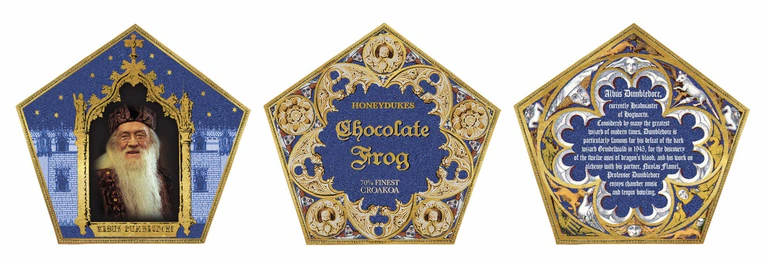
Harry Potter bought some Chocolate Frogs to share with Ron Weasley on the Hogwarts Express on 1 September 1991. In his first-ever Chocolate Frog, Harry received an Albus Dumbledore Chocolate Frog Card. Gregory Goyle later tried to steal their remaining Chocolate Frogs, but he was bitten by Scabbers and fled.

Hermione Granger gave Harry a large box of Chocolate Frogs for Christmas that year. Harry gave the last Chocolate Frog from this box to Neville Longbottom to reassure him after a run-in with Draco Malfoy in early 1992, and Neville let Harry keep the Albus Dumbledore card inside, unwittingly giving Harry, Ron, and Hermione the clue they needed to discover the identity of Nicolas Flamel.
In June 1992, Harry received "loads" of Chocolate Frogs (among other gifts) from his admirers after he defeated Professor Quirrell, and he offered one to Rubeus Hagrid when he came to visit Harry in the hospital wing.
In January 1994, after Harry's first attempt at summoning a Patronus, Professor Lupin gave him a Chocolate Frog to eat. Rubeus Hagrid gave Harry a box of all his favourite sweets, including Chocolate Frogs, for Christmas in 1994, and later that year, Harry guessed "Chocolate Frog" was the password to Dumbledore's office, though it was in fact Cockroach cluster.
Harry gave Ron a Chocolate Frog to eat on the Hogwarts Express after his first prefects' meeting. George Weasley helped himself to a Chocolate Frog from either Ron or Harry's presents on Christmas 1995. Fred and George later sent Ron a "small mountain" of Chocolate Frogs after he was injured in the Battle of the Department of Mysteries. He shared them with Harry, Ginny, and Neville. Later on, Harry Potter, Ron Weasley, and Hermione Granger were placed on Chocolate Frog cards for their efforts in defeating Lord Voldemort. Both Ron Weasley and Albus Dumbledore considered being put on Chocolate Frog cards as their proudest moment.
Nearly a century after Miranda Goshawk's spell journal was written and stolen, at some point between the 2008–2009 and 2010–2011 school year, an unidentified Muggle-born Hogwarts student and their fellow students from Gryffindor (Kevin Farrell and Robyn Thistlethwaite) followed a gone-astray Chocolate Frog, which brought them to find the book hidden on a quiet bookshelf in the Hogwarts Library.
André Leroux sold Chocolate Frogs in his shop in Hogsmeade as part of the Gastronomic Explorer career programme, where they were used as garnishes for dishes.
Chocolate Frog cards
Chocolate Frog Cards came in Chocolate Frog packages (along with a chocolate frog). Hogwarts students collected and traded them. The faces on some of the cards were famous even to Muggles, although their magical abilities were not always recognised by the non-magical community.

The Chocolate Frog collectible cards played an important role in Harry, Ron, and Hermione's first year at Hogwarts, as Dumbledore's card enabled them to ascertain the identity of Nicolas Flamel.
Some notable cards were: Albus Dumbledore, Ptolemy, Circe, Paracelsus, Merlin, Morgan le Fay, Cliodna, Hengist of Woodcroft, Alberic Grunnion, Harry Potter, Hermione Granger, Ronald Weasley, and Agrippa.
Sources
Adapted from the original article, under CC BY-SA 3.0.