Lore
Counter-spell
A counter-spell was a type of spell where the primary effect was to inhibit…
Classification
Although the exact definition of a counter-spell is unclear, it can be assumed from the name, that counter-spells countered the spell type that replaces the "-spell" suffix in their name (if it did so). For example, a counter-charm should theoretically reverse a charm, a counter-curse should reverse a curse, a counter-jinx a jinx, a counter-transfiguration a transfiguration and so on.
For example, in their confrontation in the Chamber of Secrets, Tom Riddle asked Harry Potter how he survived the former's Killing Curse and then concluded that it was the result of Lily's Sacrificial Protection, which he mentioned was a powerful counter-charm. Similarly, in 1991, while Quirrell jinxed Harry Potter's broom, Snape was later revealed to have been muttering a counter-curse. Whilst this would suggest that counter-curse referred to a counter-spell that countered a spell of any type, this cannot be true due to the known existence of counter-jinxes.
Likewise, there was the term Untransfiguration (which reverses transfiguration) as opposed to counter-transfiguration, which would be expected. Therefore, the true counter-spell nomenclature is unknown, though (according to all canonical sources), it seems to go as such: counter-spells that acted like charms (regardless of the spell type they countered and regardless of whether they prevented or removed the spell in effect) were termed counter-charms; counter-spells that acted like Transfigurations were Untransfigurations; a counter-spell designed to foil another offensive spell was termed either a counter-jinx, -hex or -curse depending on how strong it was (similar to the offensive spell hierarchy); and counter-spells that prevented jinxes (but do not remove them) were termed anti-jinxes.
For the purposes of this wiki, broad-spectrum counter-spells (such as the widely-used Finite Incantatem, which simply terminated spell effects in general) or ones that appeared to be counter-spells but are of unknown type are termed undifferentiated counter-spells. Although they could also be considered as more general counter-charms, to lessen or terminate any charms and minor dark spell effects.
Wilbert Slinkhard once said that the term "Counter-Jinx" was improperly named, and that "Counter-Jinx is a name wizards give their spells to make them sound more friendly". Hermione Granger disagreed with this assessment.
It should be noted that the categories are not mutually exclusive either.
Counter-spells
Finite Incantatem - Non-specific counter-spell that acted over an area to terminate spell effects in general. Finite - Same as Finite Incantatem , but acted on a specified target. Harry Potter: Wizards Unite Fantastic Beasts: The Crimes of Grindelwald - The Original Screenplay Harry Potter and the Chamber of Secrets (film)
• Offero - counter-spell to return elements to their previous state.
• Reverte - counter-spell to reverse physical and magical actions and movements of objects.
Counter-curses
Harry Potter and the Philosopher's Stone Counter-curse for Jelly-Legs Curse Harry Potter and the Philosopher's Stone (video game) Harry Potter and the Philosopher's Stone Harry Potter and the Half-Blood Prince
Counter-charms
Colloportus Alohomora Harry Potter and the Prisoner of Azkaban (film) Sonorus Harry Potter and the Order of the Phoenix Harry Potter and the Goblet of Fire Sacrificial Protection for the Killing Curse
Anti-theft charm for the Summoning Charm
An unknown charm counters Annihilare, Dunamis, Emancipare, and Liberare
Untransfigurations
Harry Potter and the Prisoner of Azkaban Harry Potter and the Philosopher's Stone
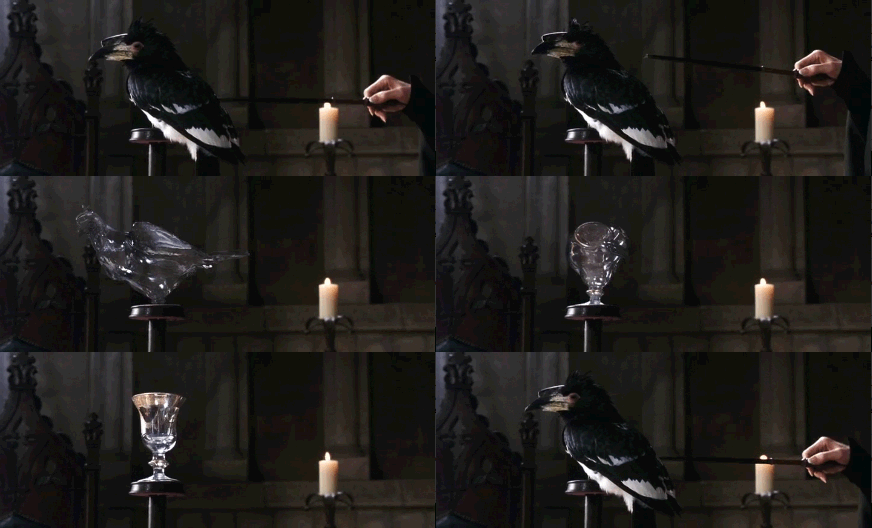
Reparifarge for poorly performed or partial Transfigurations.
Ferret to human for Human to ferret spell.
Sources
Adapted from the original article, under CC BY-SA 3.0.